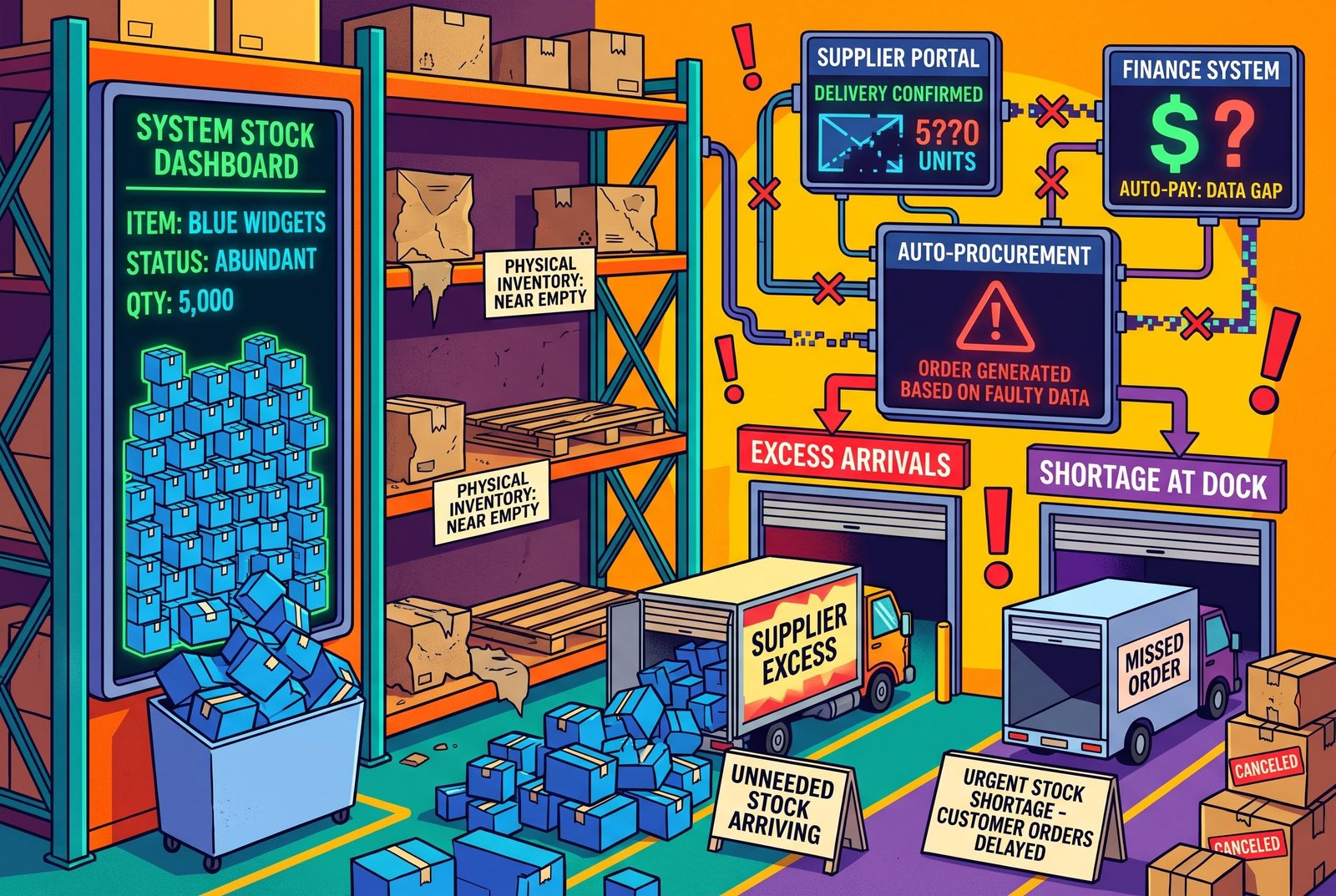
Procurement increasingly depends on information moving accurately between purchasing, warehouse, finance and supplier systems. A purchase order is only one part of the process: decisions about what to buy and when rely on records of stock, deliveries, receipts and invoices matching what has happened in the physical supply chain.
In a Medium article, Stephanie Koehl argues that procurement teams need to understand both operational logistics and the digital systems that document ...
Continue Reading This Article
Enjoy this article as well as all of our content, including reports, news, tips and more.
By registering or signing into your SRM Today account, you agree to SRM Today's Terms of Use and consent to the processing of your personal information as described in our Privacy Policy.
them. A mismatch between warehouse stock and supplier records, or a late update to a delivery status, can distort automated replenishment decisions. The result may be an apparent shortage that prompts an unnecessary order, or a real shortage that goes unnoticed.
Research shows why the gap between records and reality matters. A study published in Management Science examined nearly 370,000 inventory records across 37 stores belonging to one retailer. It found that 65 per cent did not accurately reflect stock on hand. The researchers also found that inaccuracy varied by product category and store, suggesting that organisations should look for patterns rather than treat discrepancies as random. Auditing can help, while more complex operating and distribution environments can make accuracy harder to maintain.
Errors in shipment information pose a related challenge. A Massachusetts Institute of Technology thesis analysing freight-forwarding records distinguishes between errors that violate rules built into software and operational mistakes that fall outside those rules. It explores how data analysis and predictive methods might help companies identify records more likely to contain errors, allowing them to focus corrective work where it is most useful. Inaccurate or late shipment data can increase staff rework and weaken visibility of goods in transit.
Automated systems are particularly vulnerable when their inputs do not reflect events on the ground. A study of hospital inventory management found that if staff fail to record items taken from point-of-use stock, the system can overstate available supplies. Replenishment may then be too low, increasing the risk of shortages and backorders. Although the research concerns healthcare, it illustrates a broader principle: automated ordering cannot compensate for activity that has not been recorded accurately.
Verification controls can connect different stages of the process. Microsoft’s Dynamics 365 guidance describes invoice matching that checks supplier charges against purchase orders and goods-receipt records. Under three-way matching, for example, an invoice can be checked against both the order and the quantity recorded as received. Differences in price or missing receipt information can be flagged for review before payment is approved. Such controls do not eliminate errors, but they can make discrepancies visible before they pass further through the system.
Integration is another part of the response. IBM describes tools intended to connect information held in enterprise resource planning, warehouse, sales and supplier systems, with updates that can reflect stock changes more quickly. Oracle’s sample integration documentation similarly shows how inventory adjustments, purchase-order receipts and shipment confirmations can be exchanged between ERP and warehouse platforms. These are vendor materials describing capabilities, not independent evidence that a particular implementation will prevent inaccuracies. They do, however, illustrate the technical links organisations may use to align digital records with physical movements.
The wider challenge is not simply connecting software. A systematic review of 55 studies on data management in smart manufacturing supply chains identifies persistent problems including fragmented information, inconsistent data quality and weak interoperability. The review also notes that research tends to focus on individual functions, leaving less attention to information flows across procurement, transport and downstream logistics.
Koehl’s central argument is that procurement should be treated as part of a connected operational system, rather than as a discrete act of placing orders. Reliable decisions depend on clear handovers, routine checks and records that stay aligned as goods move between suppliers, warehouses and finance teams. Where discrepancies occur, tracing them across both the digital workflow and the physical chain can help distinguish a genuine supply problem from a failure of information.
Source: Noah Wire Services