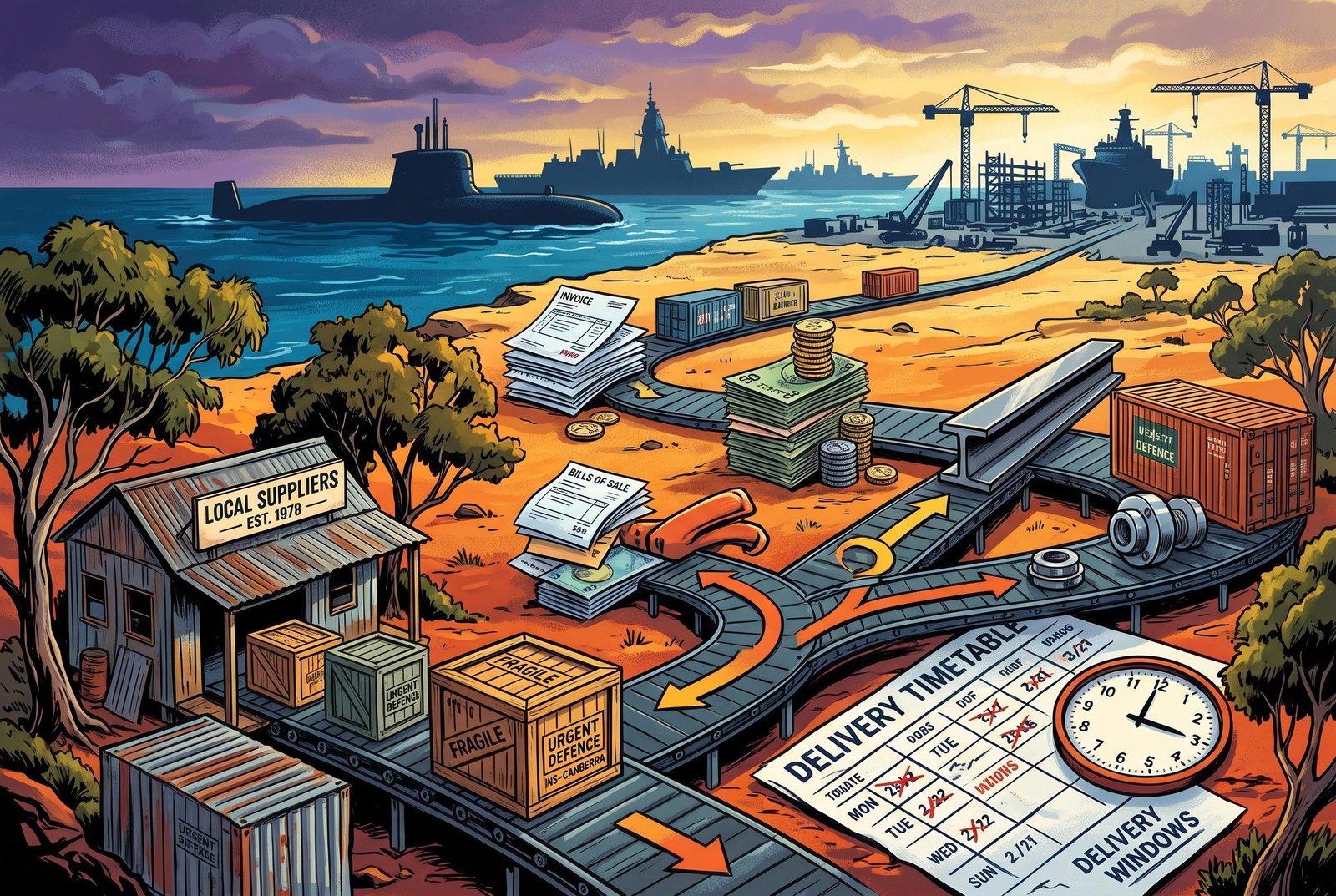
Australia’s expanding defence programme is opening a long-term market for domestic suppliers, but technical expertise alone may not be enough to secure and retain contracts. Companies will also need to show that they can withstand disruption and continue delivering to demanding schedules.
The scale of the opportunity is substantial. The Australian Government’s 2024 Naval Shipbuilding and Sustainment Plan puts projected maritime capability investment at between A$123 billion...
Continue Reading This Article
Enjoy this article as well as all of our content, including reports, news, tips and more.
By registering or signing into your SRM Today account, you agree to SRM Today's Terms of Use and consent to the processing of your personal information as described in our Privacy Policy.
and A$159 billion over 30 years. Its programme includes nuclear-powered submarines, surface combatants and other vessels, alongside a drive to sustain shipbuilding and maintenance capacity over time. The plan anticipates around 8,500 jobs in naval shipbuilding and sustainment by 2030, as well as 20,000 further jobs over three decades in support of the Nuclear-Powered Submarine Program.
Australian firms have already established a place in international defence supply chains. Lockheed Martin Australia’s 2024 Economic Impact Report says more than 70 local companies had secured contracts worth over A$5 billion through the F-35 programme. Their work supported more than 2,400 high-technology manufacturing jobs, and Australian-made components feature in every F-35. The report also records delivery of the final nine Australian F-35A aircraft in December 2024, completing the Royal Australian Air Force’s fleet of 72.
Yet a large pipeline of work does not remove the risks of delivering it. William Buck Chief Economist Besa Deda warned that “The fragmentation of globalisation and breakdown of traditional global trade arrangements poses risks for all economies around the world and Australia is not immune.”
For smaller suppliers, the effects can be immediate: a late overseas component or a sharp increase in input costs may squeeze cash flow, erode margins and threaten contract milestones. The Australian Government’s Defence Industry Development Strategy notes that many small and medium-sized firms sit at Tier 3 of the supply chain, where businesses can face financing constraints, skills shortages, supply gaps, higher freight costs and inflation. Defence-specific obstacles include security requirements, limited visibility of future demand and lengthy waits for contracts to be finalised. The strategy identifies growing the number of Australian Tier 2 businesses as one way to strengthen the industrial base.
Lower-tier suppliers can be particularly vulnerable because a problem with one specialised material or manufacturing process may have no quick substitute. The US Government Accountability Office has warned that dependence on a single supplier or facility can disrupt production, maintenance and system availability, especially when decision-makers lack clear information about dependencies and mitigation plans. Its findings underscore why companies need to look beyond their immediate suppliers and understand the vulnerabilities further down the chain.
Finding a replacement is not necessarily straightforward. The International Aerospace Quality Group describes the 9100 standard as a sector-specific extension of the ISO 9001 quality-management framework, intended for organisations across aviation, space and defence supply chains. A substitute supplier may need to meet relevant quality and certification requirements before it can be used, limiting how quickly a business can respond to a disruption.
Long lead times add further pressure. A US Government Accountability Office review of weapons replenishment after transfers to Ukraine found that the wait for electronic components on one missile programme had grown from 19 to 34 months over two years. The report linked delays to existing capacity constraints, the effects of the pandemic and increased demand. While the findings relate to the US defence sector, they illustrate how quickly component bottlenecks can complicate programmes with fixed schedules.
Financial exposure can extend beyond the affected contract. Suppliers may have to hold more stock to guard against delays, while missed milestones can defer payments and drain working capital. If performance falters, lenders and insurers may reassess their exposure. A delivery failure can also undermine a company’s standing with prime contractors, which increasingly need confidence in the resilience of their own suppliers.
Preparedness is therefore not simply a matter of maintaining larger inventories. Businesses need to identify critical dependencies, assess what a disruption would mean for cash flow and delivery, and decide where alternative suppliers or additional capacity are worth the cost. A backup source may carry a modest premium, but that expense can be less than the consequences of being unable to fulfil an order.
Suppliers also benefit from raising concerns early. Prompt communication with a prime contractor may create scope to address delivery schedules, costs or other practical issues before a problem becomes a contract failure. At the same time, businesses need working-capital plans capable of absorbing delays and unexpected expenses.
The government’s long-term shipbuilding ambitions depend on an industrial base able to support complex programmes over decades. For smaller firms seeking to win a place in that work, resilience is both an operational discipline and a commercial requirement: they must be able to explain who their critical suppliers are, how alternatives are assessed, how quality is controlled and how much financial headroom they need to manage a prolonged interruption.
Source: Noah Wire Services