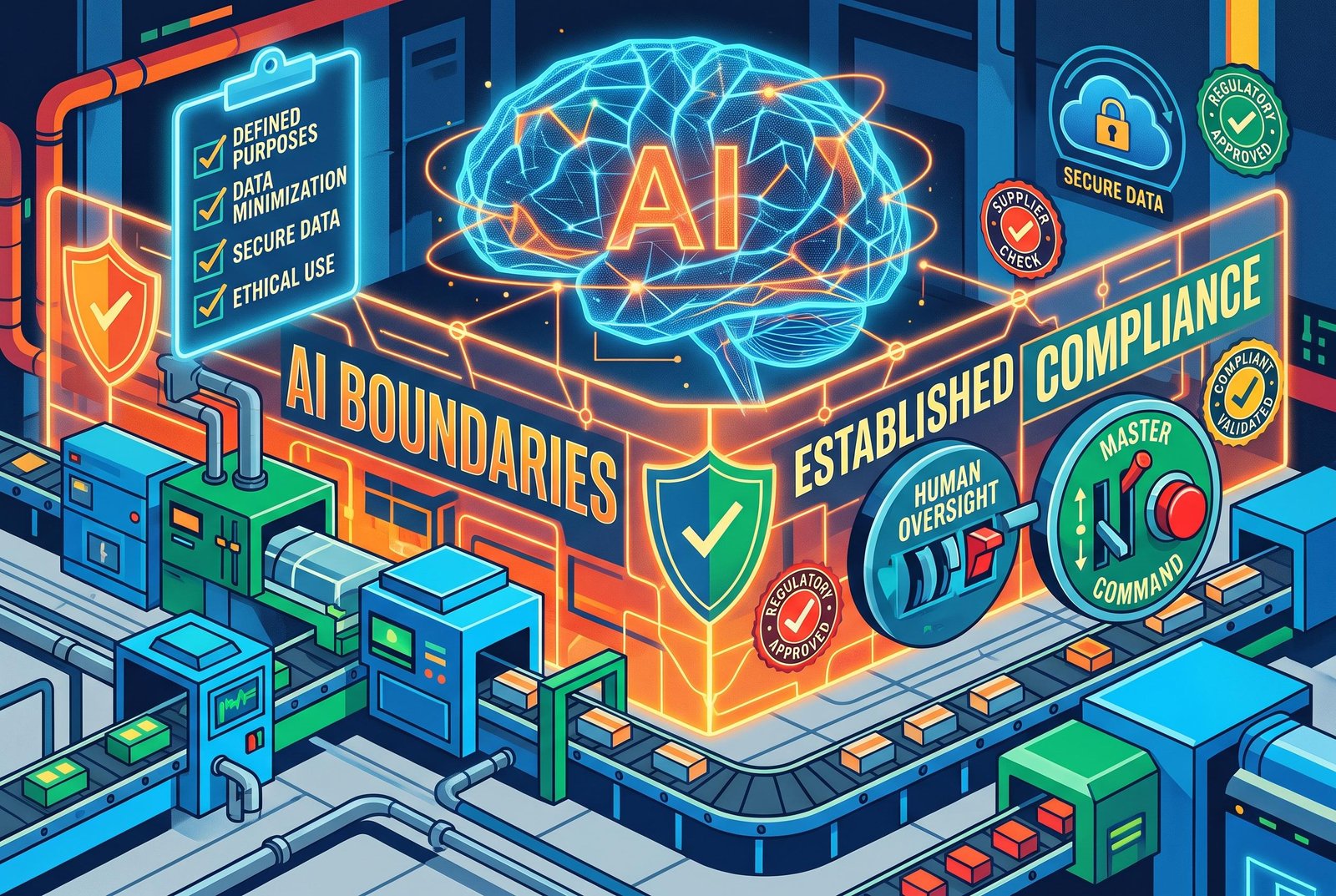
Manufacturers have long incorporated automation into production, but the spread of artificial intelligence brings risks that cannot be managed through procurement decisions alone. The efficiency gains may be compelling, particularly when businesses are under pressure to improve performance, yet each deployment needs a clear purpose, defined limits and accountable oversight.
Mason Clutter, an AI governance partner at law firm FBT Gibbons, argues that companies should record why ...
Continue Reading This Article
Enjoy this article as well as all of our content, including reports, news, tips and more.
By registering or signing into your SRM Today account, you agree to SRM Today's Terms of Use and consent to the processing of your personal information as described in our Privacy Policy.
they are introducing a system and establish its intended role before it is put to work. A lack of direction from senior leaders can leave staff uncertain about where AI is being used and what safeguards apply. That uncertainty matters when systems may handle confidential information, intellectual property or data relevant to safety and regulatory compliance.
The potential consequences differ sharply between applications. Analysing anonymised sensor data to anticipate equipment maintenance may present relatively limited risks. An AI tool that assesses suppliers or makes decisions about product quality could have more serious effects on operations, safety and compliance. Manufacturers need to understand what information a model uses, where it is stored and how its outputs are generated before relying on them.
Vendor scrutiny is equally important. Clutter recommends establishing, before any data is shared, whether a supplier can use customer information to train its models and what restrictions apply to secondary use. Those commitments should be written into contracts, alongside protections for sensitive information relating to customers, staff and products. Buying a system from an outside provider does not remove the manufacturer’s responsibility to consider its security and the way it is used.
A cross-functional governance group can help ensure that decisions are not left to a single department. Clutter advocates involving legal, information technology, security, operations, marketing and sales, with one person clearly responsible for overseeing the work. Staff also need training and continuing guidance, rather than being expected to understand a system’s limits after it has already been deployed.
That approach aligns with the voluntary Artificial Intelligence Risk Management Framework developed by the US National Institute of Standards and Technology. NIST’s guidance encourages organisations to address trustworthiness and risk throughout the design, development, use and evaluation of AI. Its resources include material on generative AI, whose risks may require particular attention. The framework is not a replacement for legal obligations, and NIST says it is being revised, but it offers a structure for turning broad governance principles into practical steps.
Cybersecurity is another part of the equation. Guidance issued by the US National Security Agency’s AI Security Center with CISA, the FBI and partner agencies in Australia, Canada, New Zealand and the UK focuses on protecting AI systems, their data and related services against malicious activity. For manufacturers integrating externally developed tools, this underlines the need to assess vulnerabilities and put controls in place around both the model and the systems connected to it.
Regulatory requirements also depend on what an AI system is designed to do and where it is used. The European Commission’s explanations of the EU AI Act describe a risk-based framework, with some uses prohibited, certain applications classed as high-risk, and many others facing no additional requirements under the Act. High-risk systems can be subject to obligations covering risk management, data quality, documentation, traceability, cybersecurity and human oversight. The Commission and the Council of the European Union stress that providers and users have distinct responsibilities, and that the system’s purpose and context help determine its classification. Manufacturers operating in or supplying the EU will need to check the rules that apply to each system and the relevant implementation timetable.
Some organisations may decide that AI should not be used for particular critical tasks, or that proprietary data must never be fed into a model. Such limits can be especially important where safety requirements or contractual obligations leave little room for automated judgement.
For Clutter, human involvement remains essential. The more an organisation relies on a tool by default, she warns, the greater the risk. AI may support expertise, but it cannot take responsibility for the decisions a manufacturer makes.
Source: Noah Wire Services