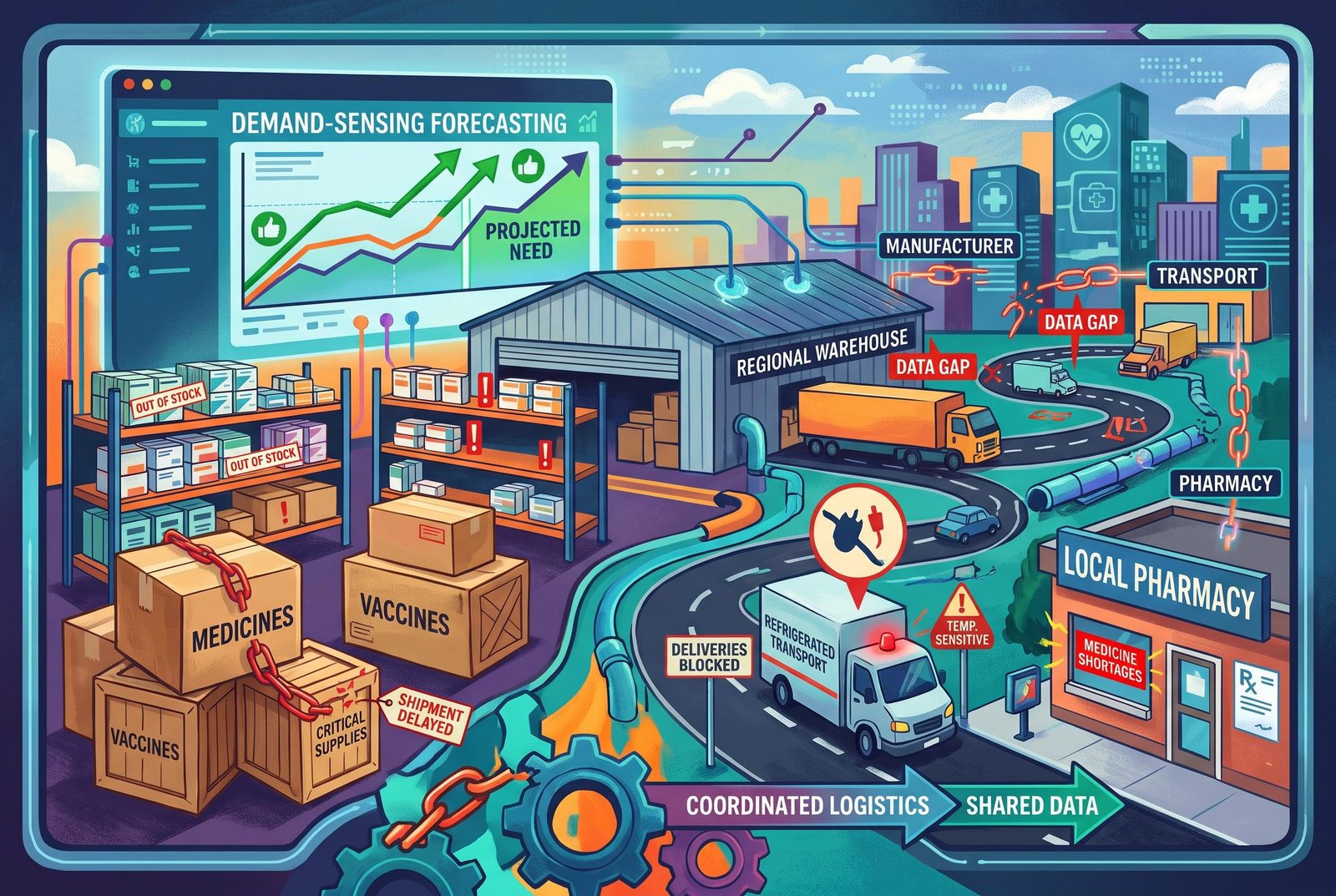
Pharmaceutical supply chains have traditionally planned production and distribution around past sales and forecasts made months in advance. That approach can leave medicines in the wrong places: surplus stock may accumulate while pharmacies and hospitals face shortages. Demand-sensing analytics offer a way to make decisions using more current signals, including sales, distributor inventories and other indicators of changing need. But better forecasts are only one part of the answer. T...
Continue Reading This Article
Enjoy this article as well as all of our content, including reports, news, tips and more.
By registering or signing into your SRM Today account, you agree to SRM Today's Terms of Use and consent to the processing of your personal information as described in our Privacy Policy.
heir value depends on reliable data, effective coordination and the ability to act on what the analysis reveals.
The case for greater visibility is especially clear in the United States. A Senate committee report on drug shortages described a supply network extending from raw materials and active ingredients to manufacturers, distributors, pharmacies and patients, while finding that no single, complete picture of those stages is readily available. Gaps in information about suppliers, manufacturing capacity and demand can make it harder to spot risks early. The report recommended better supply-chain mapping, data integration and predictive analysis, alongside stronger reporting of changes in demand and downstream conditions.
For pharmaceutical companies, demand sensing means bringing together information from across that network, rather than relying on one historical sales series. Point-of-sale activity and distributor stock can indicate where products are being used; epidemiological trends, demographics and market indicators can help explain why needs may be shifting. Machine-learning systems can then detect patterns and anomalies that might be missed by conventional forecasting.
A research paper examining US healthcare markets tested a hybrid forecasting model using 864 monthly observations for six products across four regions between 2023 and 2025. Its authors reported a mean forecasting error of 4.33 per cent for the Hybrid LSTM-GRU model, compared with 6.95 per cent for an XGBoost benchmark. The results suggest that combining methods can improve forecasts in the study’s defined sample. They do not show that the same performance would hold across all products or markets, or that forecasting accuracy alone can prevent shortages. The researchers also point to supplier diversification, region-specific inventory policies and flexible safety stocks as measures needed to address vulnerabilities beyond demand prediction.
That distinction matters. A more accurate estimate of need cannot compensate for a single-source supplier, limited manufacturing capacity or a disruption to transport. Nor does one inventory target suit every medicine. A peer-reviewed case study of pharmaceutical inventory management found that internal factors, including demand and production throughput, strongly influenced stock decisions at the company examined. It also recognised the importance of external and downstream conditions. Because the research covered one company, its findings are not a universal template; they reinforce the need to adapt inventory policies to products and circumstances.
Real-time shipment information can complement demand data, particularly for medicines that require controlled temperatures. A study of an Internet of Things-based system for diabetes medication shipments in Saudi Arabia describes sensors, RFID tags, GPS tracking and cloud-based data management to monitor temperature, humidity and location. Such tools can help operators identify problems during transit and assess product conditions. The work illustrates a possible application, rather than proving sector-wide gains or guaranteeing uninterrupted supply.
Digital twins, virtual representations of supply-chain processes that can be updated with operational data, could also support monitoring, simulation and risk planning. A National Institute of Standards and Technology review identifies potential uses in biopharmaceutical supply chains, including improved visibility and disruption response. It also finds limited evidence of deployment in the sector and highlights unresolved issues: data quality and access, privacy and security, and the need to demonstrate a return on investment. Connected technology, in other words, is not a substitute for sound information and a credible implementation plan.
These systems can be particularly valuable for cold-chain logistics, where a delay or excursion in storage conditions may threaten a product’s integrity. Shipment tracking can help teams identify a problem sooner, while route-planning tools and shared stock information may support more informed distribution decisions. The scale of any savings in time, cost or emissions will depend on how well these tools work in real operating conditions; the available examples do not establish universal results.
Technology alone cannot create a joined-up supply chain. Manufacturers, logistics providers, distributors and healthcare organisations need to exchange information in forms that are consistent and usable. The US Pharmacopeia has argued that limited transparency about suppliers, inputs and supply conditions makes it harder to identify vulnerabilities and anticipate shortages. Better visibility therefore depends not only on digital platforms, but also on agreed data standards, appropriate sharing arrangements and trust among partners.
Within pharmaceutical companies, the same principle applies across manufacturing, sales and logistics. If teams retain information in separate systems or fail to share it, useful signals may not translate into changes in production or distribution. A demand-sensing programme consequently requires investment in data governance, integrated infrastructure and staff capability, alongside a willingness to collaborate across functions and with external partners.
The ultimate measure of these efforts is whether medicines reach patients when needed and remain safe to use. More precise demand and inventory information can help companies make better decisions about replenishment and stock placement, while monitoring can provide warning of problems in transit. Yet no analytical model can remove every source of risk. Resilience still depends on the breadth and quality of the data, the flexibility of operations, the reliability of suppliers and the ability of organisations to respond when conditions change.
Source: Noah Wire Services