Construction procurement has long depended on networks of familiar manufacturers, distributors and contractors. Those relationships can help buyers manage risk in an industry where a faulty component may have serious consequences. But they can also leave capable suppliers outside the market simply because they are not already known to the people making purchasing decisions.
Artificial intelligence is beginning to offer procurement teams another way to find potential suppliers. ...
Continue Reading This Article
Enjoy this article as well as all of our content, including reports, news, tips and more.
By registering or signing into your SRM Today account, you agree to SRM Today's Terms of Use and consent to the processing of your personal information as described in our Privacy Policy.
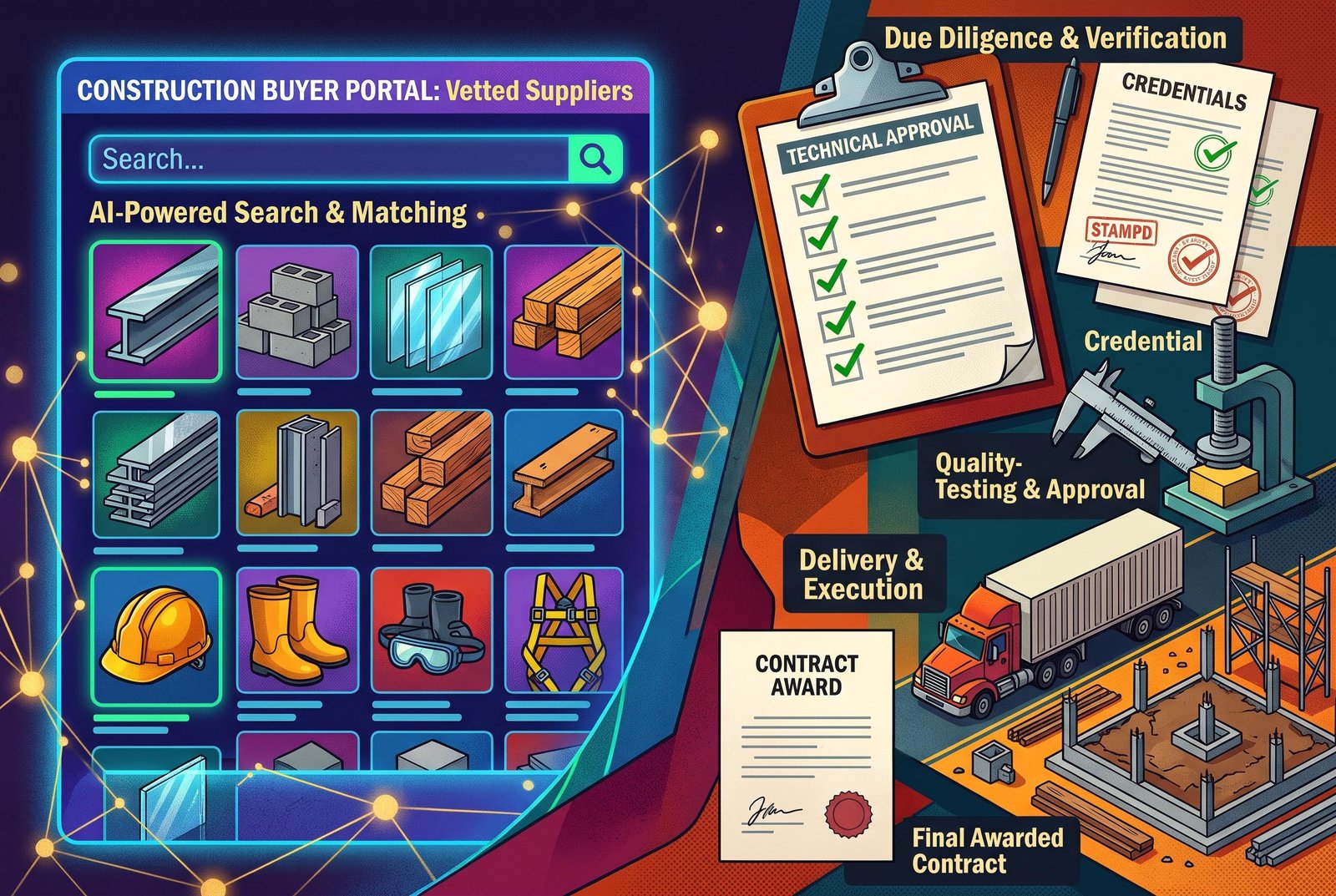
A buyer can use digital tools to investigate manufacturers overseas, compare available product information and build an initial shortlist without relying solely on established contacts. That may widen the field of candidates, but it does not establish that a company or product is suitable for a particular project.
The distinction matters. A highway safety barrier manufacturer in Vietnam, for example, might have the capacity and expertise to supply an Australian project, yet still need to prove that its product meets local technical requirements and that it can support delivery and installation. Easier discovery is only the first step.
Formal supplier qualification remains central to construction purchasing. Contractors need evidence of organisational capability, product performance, certification, financial standing and reliable delivery. For safety-critical equipment, claims must be checked against original test reports and the precise product configuration proposed for use.
In the UK, Build UK’s Common Assessment Standard provides an industry-agreed framework for assessing construction suppliers’ organisational capabilities. It is intended to reduce repeated pre-qualification work across participating clients and contractors. But an organisational assessment does not establish that every product in a supplier’s catalogue is appropriate for every project: technical approval may still be required separately.
For highway barriers, that distinction can be especially important. The US Manual for Assessing Safety Hardware, or MASH, sets out crash-testing guidelines and criteria for evaluating results. Europe’s EN 1317 series is a different framework. A claim that a product complies with one regime does not, by itself, establish acceptance under another. Buyers must consider the relevant authority’s requirements and whether the evidence relates to the exact system and installation proposed.
International sourcing also involves commercial questions that a search engine cannot settle. Freight, import duties, insurance, lead times, local representation and technical support can affect whether a low factory price is genuinely competitive. Sourcing agents may therefore retain a role in checking manufacturers, arranging factory inspections and coordinating logistics, even if AI makes the initial search easier.
The tools are emerging alongside reforms intended to make procurement and product information more accessible. The UK Government’s enhanced Find a Tender service, launched on 24 February 2025 under the Procurement Act 2023, allows suppliers to maintain core business information and makes public procurement opportunities searchable. It can help businesses identify tenders and reuse information in bids, but does not replace project-specific assessment or expose confidential supplier evaluations.
In the European Union, Regulation 2024/3110 provides for digital product passports for construction products. These are intended to make prescribed information, including declarations of performance and conformity and technical documentation, easier to access and trace. The framework is still being developed; it does not mean that every construction product already has a passport. If implemented effectively, structured and current product records could give buyers and digital tools a more dependable basis for comparing manufacturers than general marketing material.
There are risks in relying on automated research. A manufacturer with extensive English-language documentation and a strong online presence may be easier for an AI system to surface than a competitor with equally capable products but less accessible information. The results may vary according to the system and the wording of a query, and a shortlist may not reveal why certain businesses were included or omitted.
The US National Institute of Standards and Technology warns that generative AI can produce false information with confidence, a risk it calls “confabulation”. In procurement, an unsupported statement about a certificate, standard or product performance could distort an initial assessment. Buyers need to verify claims against original documentation and authoritative sources rather than treating an automated summary as proof.
The construction industry’s adoption figures suggest that such systems are not yet embedded in most organisations. The Royal Institution of Chartered Surveyors’ global survey of more than 2,200 professionals found that about 45% of respondents’ organisations had not implemented AI, while 34% were at an early pilot stage. Just under 12% reported regular use in specific processes and fewer than 1% said AI was fully embedded across their organisation. RICS identified skills shortages, integration difficulties and limited data availability as barriers.
Those findings describe AI use across construction generally; they do not show how often procurement teams use AI to identify suppliers or whether it has affected contract awards. Public evidence linking AI-generated recommendations to purchasing decisions remains limited. The technology may make supplier research faster, but its influence on who is ultimately approved and selected is not yet clear.
For now, established supplier networks are likely to endure, particularly where technical complexity and long-term performance make a purchasing decision difficult to reverse. AI may help unfamiliar manufacturers get noticed, but winning trust will still depend on verified credentials, suitable products and the ability to deliver. The route into the market may change; the standards for getting through the door will not disappear.
Source: Noah Wire Services