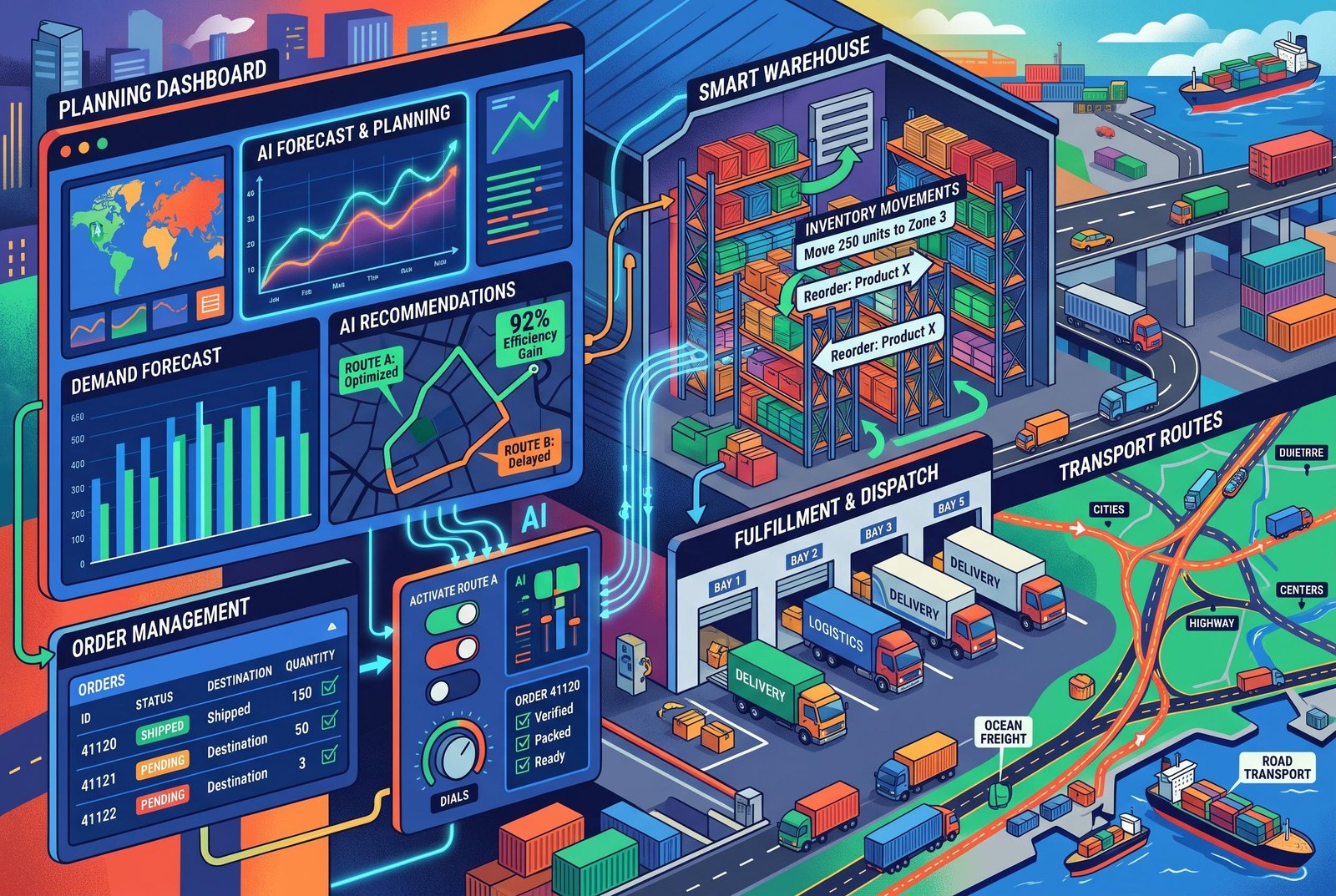
Blue Yonder’s 2026.3 software release brings together changes to planning, order management, warehouse and transport operations, and collaboration between supply-chain partners. The company presents the update as an effort to make AI recommendations more transparent and keep their use within operational controls, while connecting decisions across the supply chain.
A central element is Blue Yonder Orchestrator, which the company describes as a shared workspace for supply-chain...
Continue Reading This Article
Enjoy this article as well as all of our content, including reports, news, tips and more.
By registering or signing into your SRM Today account, you agree to SRM Today's Terms of Use and consent to the processing of your personal information as described in our Privacy Policy.
teams. It adds conversational access to personalised executive briefings, refreshed navigation and mobile functions, including a voice-only mode. The aim is to let users move from reviewing information to asking questions and taking action within the same environment.
The accompanying Blue Yonder Platform update introduces Mission Hub, a self-service interface for provisioning, configuration, onboarding, migration and system monitoring. Blue Yonder says contract-driven automation is designed to align deployments with the services customers have purchased. For warehouse users, the platform also supports customer-specific workflow logic as extensions, rather than requiring customised core code. The company says diagnostic tools and environment monitoring are intended to make deployment and ongoing management easier to track.
Planning updates span retail and manufacturing. Retail teams gain AI-assisted planogram design, explanations for forecasts and an audit trail of forecast overrides. Merchandise Financial Planning adds conversational scenario modelling, while weekly labour forecasts can extend up to 52 weeks and incorporate weather information.
For manufacturers, the release adds validated forecasting models, tools to manage conflicts between scenarios and dynamic supply constraints in Integrated Business Planning. Scheduling teams can simulate disruptions to explore possible responses before making operational changes. Blue Yonder frames these features as a way to help planners understand how changing conditions affect connected plans, rather than treating each planning activity in isolation.
In orders and returns, the company is consolidating B2B and B2C operations in a single Cognitive Order Management platform, with modular add-ons. Its persona-based console includes more than 100 configurable cards, while Fulfilment and Customer Service Agents are designed to recommend or carry out actions subject to operational controls. B2B functions include bulk order uploads from spreadsheets, supplier purchase-order management and bulk processing of return merchandise authorisations.
The release also expands return options for consumers through additional third-party drop-off locations and gives retailers more control over routing and policies across brands. Blue Yonder says the changes are intended to connect order management and returns more closely, as businesses handle exceptions across different customer and wholesale workflows.
Warehouse updates include a flexible integration layer for robotics and automation from multiple suppliers, along with explainable recommendations for product placement that account for several objectives. A Warehouse Ops Agent is designed to identify discrepancies in advance shipping notices, flag perishable goods and forecast trailer shortages. Allocation Shorts is available in beta.
For transport teams, a new award-decision dashboard is intended to show procurement spending and concentration among carriers. The release also makes MileMaker available alongside PC*MILER and allows planners to alter stacking orientations for the same stock-keeping unit when building loads. Blue Yonder says its Logistics Emission Calculator is embedded in transport and network decisions, bringing emissions information into operational planning.
Beyond individual applications, the company is developing Blue Yonder Network towards what it calls intelligent orchestration, with multi-party coordination, agents recommending or automating next steps, and broader visibility of in-transit risks across transport lanes. Its expanded Surround Services offering adds AI, machine-learning and data-science expertise for customers after implementation, with support that can be directed towards updating existing models or developing new ones.
The release is presented by Blue Yonder as a connected set of tools for planning and execution, rather than a collection of standalone features. Its stated emphasis is on reducing manual work and helping teams respond to change, while the practical results will depend on how customers configure and adopt the capabilities across their operations.
Source: Noah Wire Services