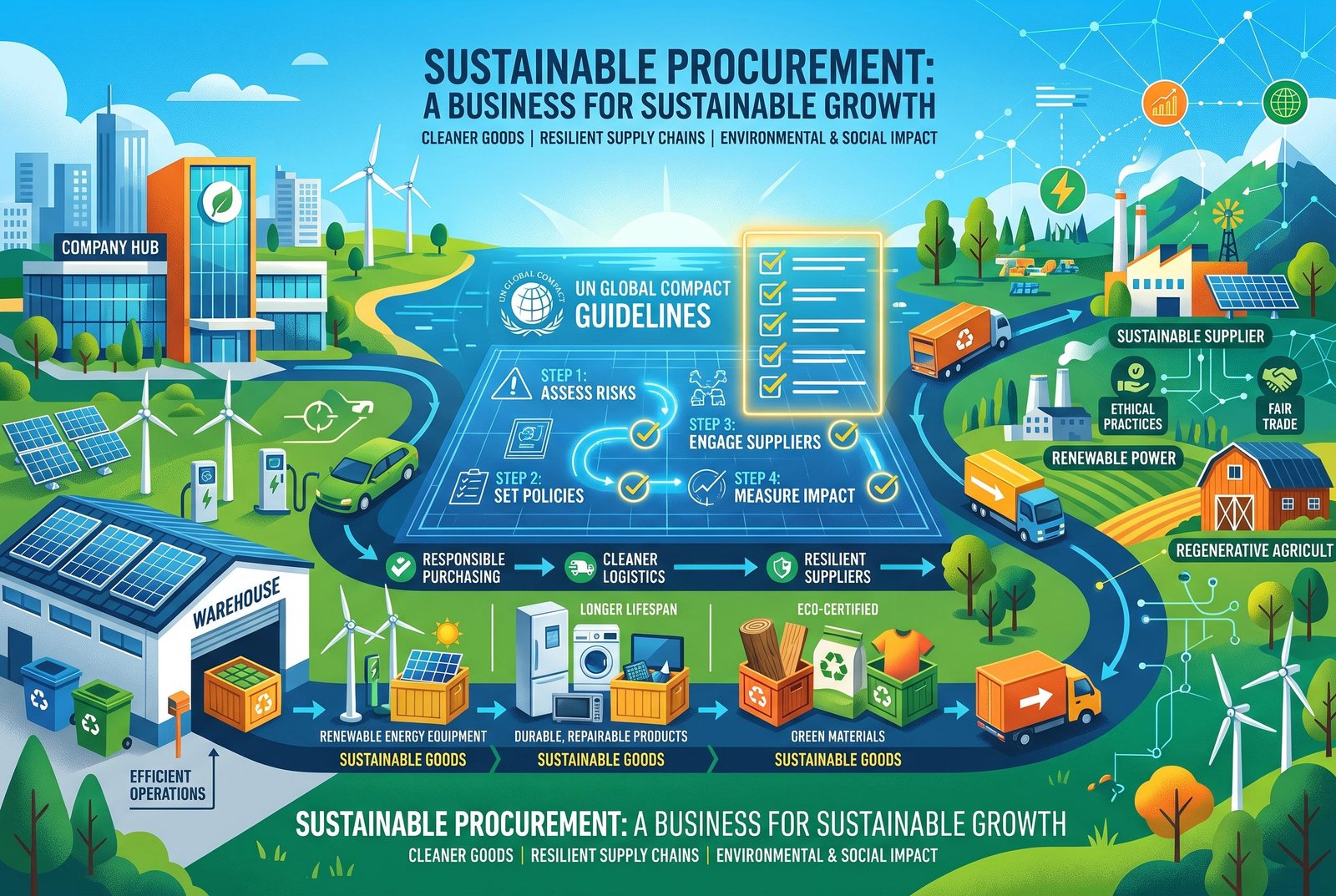
Every purchasing decision shapes more than price and quality. It influences how a business uses natural resources, how it treats workers in its supply chain and how resilient its operations will be when markets tighten or conditions change.
That is the central argument made by Sofia Efraimoglou-Kounenaki, who writes that sustainability belongs at the heart of procurement rather than at its margins. In her view, buying policies are not merely administrative choices; they are str...
Continue Reading This Article
Enjoy this article as well as all of our content, including reports, news, tips and more.
By registering or signing into your SRM Today account, you agree to SRM Today's Terms of Use and consent to the processing of your personal information as described in our Privacy Policy.
ategic levers that can improve competitiveness, support suppliers and generate wider economic value.
The timing of that argument is significant. In New York in September, during discussions linked to the 81st United Nations General Assembly, the UN Global Compact presented its Sustainable Procurement Implementation Framework. According to the UN’s announcement, the framework is designed to help companies turn sustainability commitments into routine purchasing decisions and supplier engagement, offering practical guidance across the procurement process. It was developed by the Coalition for Sustainable Procurement, an initiative launched in 2025.
The framework reflects a broader shift in how organisations are being asked to think about procurement. Cost and technical performance remain important, but they are no longer sufficient on their own. Businesses are increasingly expected to consider energy use, raw material consumption, emissions, circularity and labour conditions throughout their supply chains. Transparency in supplier selection and stronger governance are part of the same equation, helping to build trust and reduce hidden risks.
The scale of public purchasing gives that approach particular weight. The European Parliament says public procurement accounts for roughly 14 per cent of EU gross domestic product and more than €3 trillion a year, making it one of the most powerful tools available to shape markets. When public authorities favour energy-efficient equipment or products made with recycled materials, they send a clear signal to industry: sustainable production is no longer optional if firms want to compete for large contracts.
That buying power can also accelerate innovation. A procurement policy that rewards cleaner products, more efficient technologies and repairable designs gives companies a reason to invest in research, production capacity and new business models. In effect, the buyer becomes part of the market-making process.
For companies themselves, the case for sustainable procurement can be just as immediate. Looking only at the upfront price of a product can be misleading if that item consumes more energy, requires frequent maintenance or has a shorter useful life. A more efficient machine may cost more at the point of purchase, yet save money over years of operation. In that sense, life-cycle costing often turns sustainability into a source of financial discipline rather than an added burden.
The logic is similar in the circular economy. Eurostat’s latest figures show that 12.2 per cent of materials used in the European Union in 2024 came from recycled sources. That remains well below the European Commission’s ambition of reaching 24 per cent by 2030 under the Clean Industrial Deal, which links circularity to stronger industrial competitiveness, reduced waste and less dependence on external suppliers. Procurement can help close that gap by increasing demand for recycled content, repairable products and longer-lasting goods.
Supply-chain resilience is another reason sustainable procurement is gaining prominence. Remarks delivered at the UN Global Compact High-Level Forum on Sustainable Procurement stressed that companies are operating in an environment shaped by climate pressure, geopolitical uncertainty and economic disruption. In that context, knowing where key inputs come from, understanding supplier capacity and diversifying sources of supply become strategic necessities rather than optional safeguards.
Large organisations have a particular responsibility in this respect because their standards often shape entire value chains. By setting clear expectations, they can give smaller suppliers the certainty they need to invest in better processes, cleaner production and stronger reporting systems. That requires coordination between procurement, finance and sustainability teams, backed by leadership willing to make sustainability part of commercial decision-making rather than a parallel exercise.
The UN Global Compact framework is intended to support exactly that sort of internal alignment, helping teams move from broad commitments to measurable outcomes. Its wider value lies not only in improving purchasing practice but also in giving smaller suppliers a clearer route to competitiveness, as they learn which capabilities are increasingly required in modern supply chains.
For Greece, the implications are particularly relevant. Efraimoglou-Kounenaki argues that sustainable procurement could strengthen partnerships in tourism, manufacturing and construction, three sectors where purchasing decisions have a wide ripple effect across local businesses. Business associations, she adds, can play a useful role by helping both buyers and suppliers take practical first steps and by spreading workable examples of how sustainability can be built into contracts and tenders.
That matters in an economy characterised by a large number of small enterprises. When a major buyer embeds sustainability into its procurement policy, with clear targets and measurable results, it can help lift the capabilities of its suppliers as well as improve its own performance. The result is a more competitive chain from end to end.
Seen in that light, sustainable procurement is not simply a compliance exercise or a reputational tool. It is a way of directing demand towards better products, stronger suppliers and more resilient production systems. For businesses, governments and suppliers alike, it offers a route to growth that is more durable, more efficient and better aligned with the economic realities of the coming years.
Source: Noah Wire Services