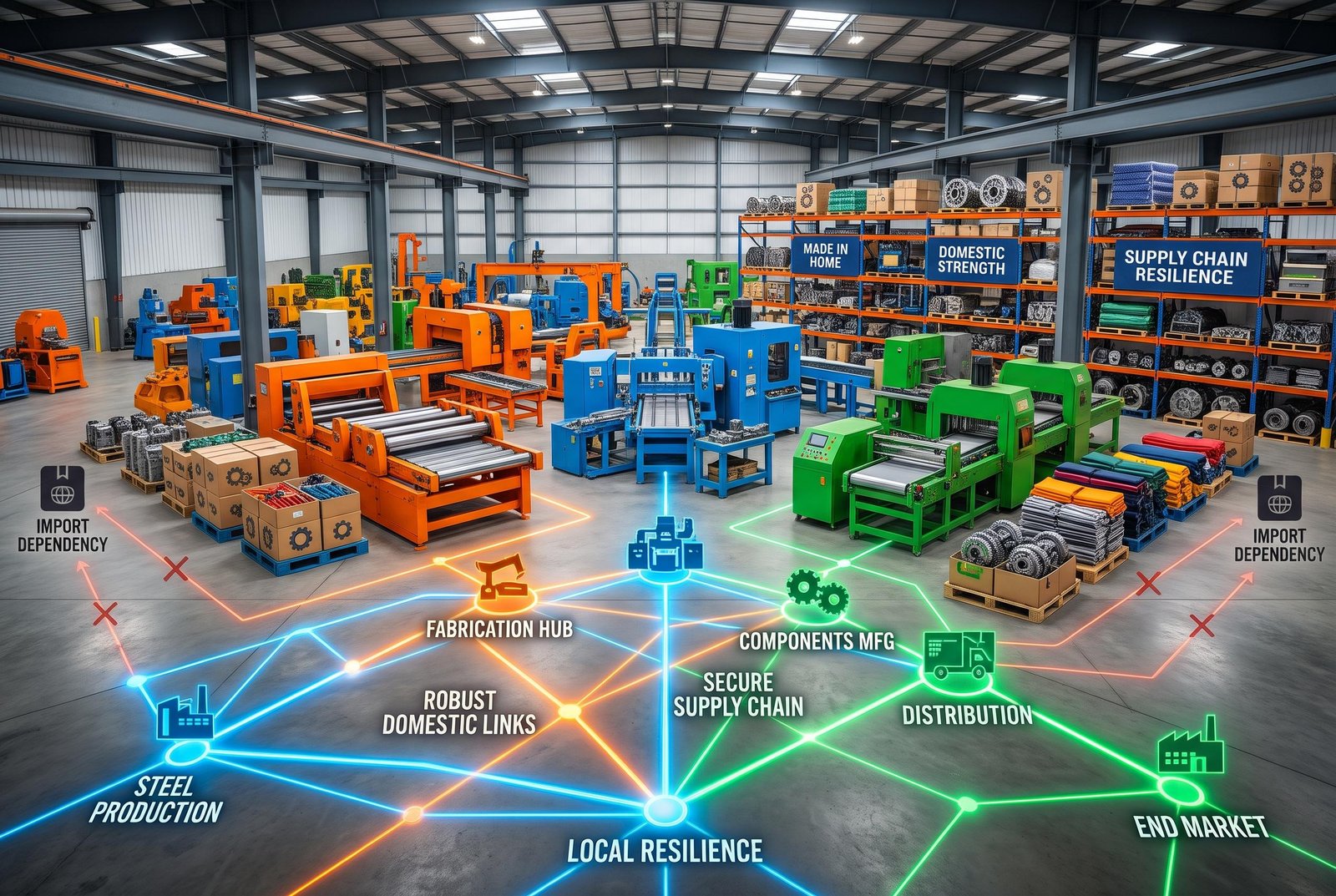
India’s campaign to localise more of its industrial supply chain is gathering pace, with officials now identifying a narrower list of about 100 critical inputs for domestic production and, more recently, broadening the exercise to roughly 120 products, according to Indian media reports. The move is designed to trim dependence on overseas suppliers, reduce pressure on the import bill and strengthen resilience in industries ranging from engineering goods and chemicals to pharmaceutica...
Continue Reading This Article
Enjoy this article as well as all of our content, including reports, news, tips and more.
By registering or signing into your SRM Today account, you agree to SRM Today's Terms of Use and consent to the processing of your personal information as described in our Privacy Policy.
ls, construction equipment and aerospace-linked components.
The latest step follows a wider government review of imports that can realistically be made at home. A senior official said the 100-item shortlist was drawn from a much larger basket of goods worth about $51 billion in annual imports. An internal assessment cited in earlier reporting suggested that as much as $398 billion of India’s imports could, in principle, be substituted by local manufacturing, although that figure reflects potential rather than an imminent shift in trade flows.
The scale of India’s import dependence is most visible in industrial goods. Analysis by the Global Trade Research Initiative has indicated that China’s share of India’s industrial goods imports has risen to 30% from 21% over 15 years, underscoring how closely the initiative is tied to supply-chain security as well as economic self-reliance. The categories most exposed include electronics, telecom equipment, machinery, electronic components, EV batteries, solar modules, active pharmaceutical ingredients and speciality chemicals.
That matters for shipping as much as for manufacturing policy. A large share of the goods under review currently arrives through India’s ports in containers, particularly on lanes linking the country with China and wider North Asia. If domestic production eventually replaces even part of that flow, the effect would be felt in inbound container volumes at ports such as Nhava Sheva, Mundra and Chennai, as well as in empty container repositioning patterns and hinterland logistics demand. But any such change would be gradual. The gap between a policy announcement and a meaningful shift in sourcing is usually measured in years, not quarters.
The government’s thinking is not new. In September 2025, commerce secretary Sunil Barthwal said the ministry would publish 100 import-dependent products so that existing and prospective manufacturers could assess where fresh capacity might be viable. By May 2026, Indian media reported that the exercise had widened to cover nearly 100 products that were either not made domestically or were produced only inadequately despite some local capability. In July, reporting indicated the list had already expanded to more than 300 products, with sectors including chemicals, pharmaceuticals and machine tools among those in focus. More recently, reports said about 120 products had been identified for a domestic manufacturing push.
Officials and industry watchers say the logic extends beyond trade statistics. The policy is also intended to cushion India against geopolitical shocks and reduce exposure to supply disruptions, particularly in sectors where imported inputs dominate production. Business Standard reported in July that the government was considering subsidies and other incentives to support the shift, while the broader policy discussion has also been shaped by lessons from the production-linked incentive schemes, which were designed to deepen manufacturing capability in selected sectors.
For ports and logistics providers, the implications are mixed. A successful substitution drive could temper growth in some import-led cargo streams, but it may also create new demand for bonded warehousing, free trade warehousing zones, inland distribution and industrial storage as domestic manufacturers build capacity near existing corridors. Gujarat, Maharashtra and Tamil Nadu are likely to remain the key geographies to watch, given their established industrial bases and proximity to major maritime gateways.
Financing is likely to be a central constraint. Greenfield projects in electronics, components and chemicals require long-tenor capital, stable offtake and technical partnerships. Domestic suppliers may find it easier to secure working capital if they sell into large local supply chains, but a broad shift away from imports will still depend on whether Indian manufacturers can match foreign rivals on cost, scale and consistency. In sectors such as solar modules and electronics, that remains a significant hurdle.
For now, the government appears to be signalling direction rather than imposing an immediate trade shock. No sweeping duty changes or new incentive package has yet been formally attached to the shortlist. Even so, the message is clear: India wants to reduce its reliance on imported industrial inputs, and the latest round of product identification suggests the push is becoming more detailed, more targeted and more ambitious.
Source: Noah Wire Services