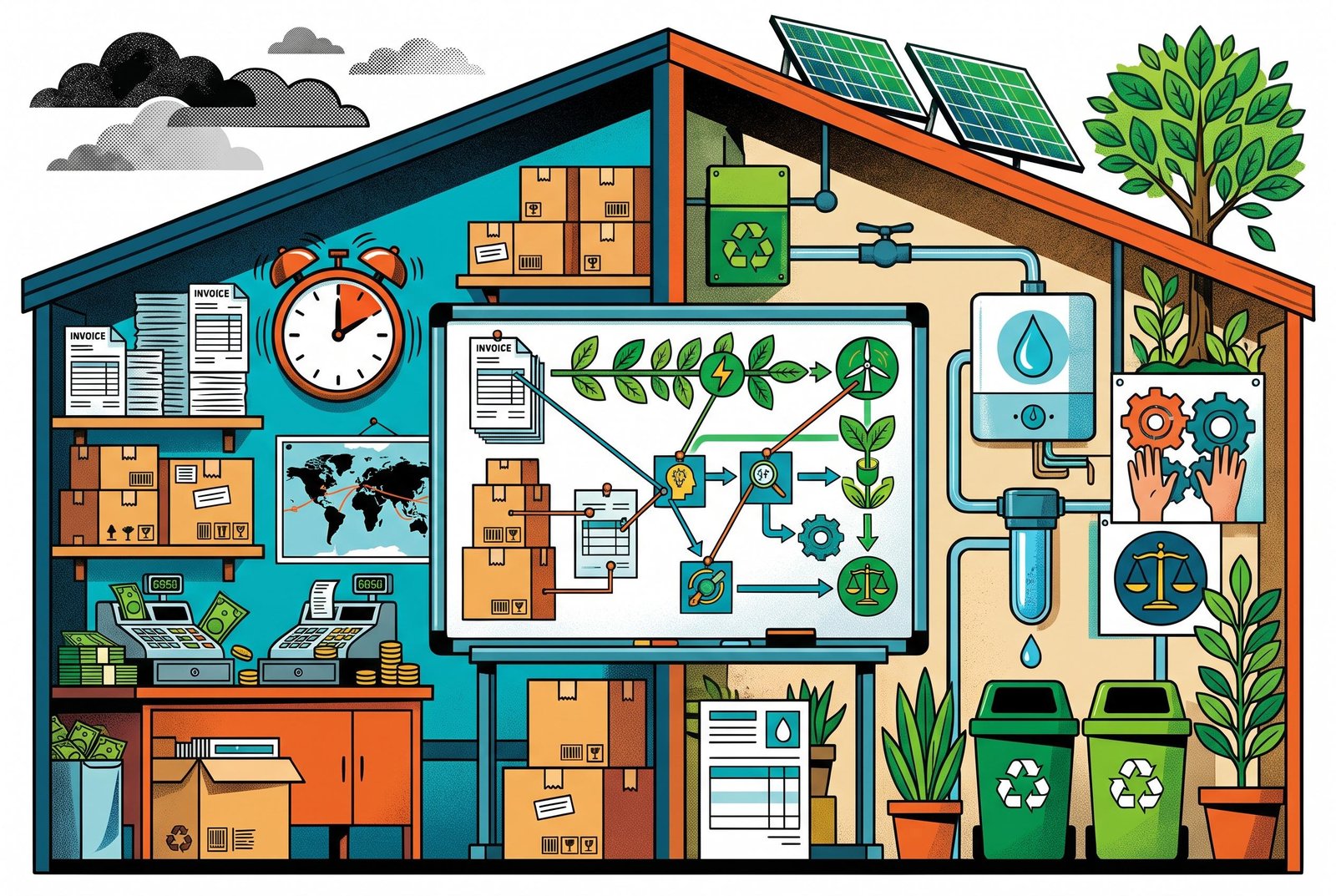
A new study of ESG-driven business model innovation in small and medium-sized enterprises suggests that sustainability requirements are not simply being added to existing commercial logics, but are often being filtered through them in ways that preserve economic primacy.
Drawing on a three-year qualitative investigation of 25 SMEs embedded in five industrial value chains, the research examined how environmental, social and governance demands were translated into business model ...
Continue Reading This Article
Enjoy this article as well as all of our content, including reports, news, tips and more.
By registering or signing into your SRM Today account, you agree to SRM Today's Terms of Use and consent to the processing of your personal information as described in our Privacy Policy.
reasoning over time. The evidence came from interviews, workshop observations, facilitation notes, survey material and company documents, allowing the authors to follow ESG discussions as they moved from abstract reporting obligations to practical questions of value, responsibility and viability.
The central finding is that many firms initially treated ESG as something external to the business model: an additional layer to be managed rather than a constituent part of what the business was. When ESG issues were brought into discussions of value proposition, value creation, delivery and capture, participants frequently resolved the resulting tensions by prioritising cost, sequencing decisions, deferring action until the market was ready, or recasting ESG as a compliance matter. In that sense, the research argues, dominant business model frameworks may unintentionally encourage closure rather than sustained engagement with contradiction.
This matters because ESG has become far more than a reputational concern. Under the European Union’s Corporate Sustainability Reporting Directive, sustainability information is becoming more formalised, auditable and comparable across value chains. The Directive and its accompanying reporting standards require firms to account for a broad range of environmental, social and governance matters, including impacts that reach well beyond the immediate boundaries of the reporting company. The result is that large customers increasingly cascade ESG expectations upstream to smaller suppliers, often with limited bargaining power and limited capacity to absorb new reporting demands.
The study situates these pressures within paradox theory, which treats contradiction not as a temporary management problem but as a durable feature of organising. From that perspective, the challenge is not simply to reconcile ESG with commercial imperatives, but to understand how organisations live with demands that remain interdependent even when they pull in different directions. The authors argue that in regulated industrial value chains, these tensions are especially likely to be closed through familiar managerial responses: prioritisation, commensuration, deferral and symbolic integration.
Yet the research also found that structured business model discussions could sometimes delay that closure. In facilitated workshops, participants occasionally kept economic, environmental and social concerns in view at the same time, rather than allowing one to dominate immediately. These moments did not amount to lasting organisational change, but they did show that the way business model conversations are structured can influence what remains discussable. The implication is that representational tools matter: they do not determine outcomes on their own, but they can shape whether ESG is treated as peripheral or constitutive.
To capture that possibility, the paper advances the E2SG Flower, an analytically grounded framework intended to support provisional paradox inhabitation in ESG-driven business model innovation. The idea is not presented as a finished solution, but as a proposition for further study. Its purpose is to keep economic, environmental, social and governance considerations in simultaneous view, rather than letting them be translated too quickly back into a single commercial criterion. The authors argue that such an approach may help firms sustain productive tension long enough to explore more genuinely integrated forms of business development.
The study is careful not to claim that the framework itself caused the observed patterns. Instead, it suggests that dominant business model models may reinforce the very closure they are meant to help manage, especially when they assume coherence must ultimately be restored around economic viability. In the settings examined, ESG was widely recognised as unavoidable and increasingly important, but it was still usually assessed through the lens of price, delivery, compliance and operational feasibility. That leaves open the question of whether firms can move beyond treating sustainability as an add-on and instead redesign business reasoning so that ESG is part of the business logic from the outset.
What the research shows most clearly is that the shift from reporting to business development is neither automatic nor straightforward. For smaller suppliers in particular, ESG demands arrive embedded in asymmetric commercial relationships, where responsibility often increases faster than authority. The study’s contribution is to show how that imbalance plays out inside business model thinking itself, and to suggest that the tools firms use to reason about strategy may be part of the problem as well as part of the solution.
Source: Noah Wire Services