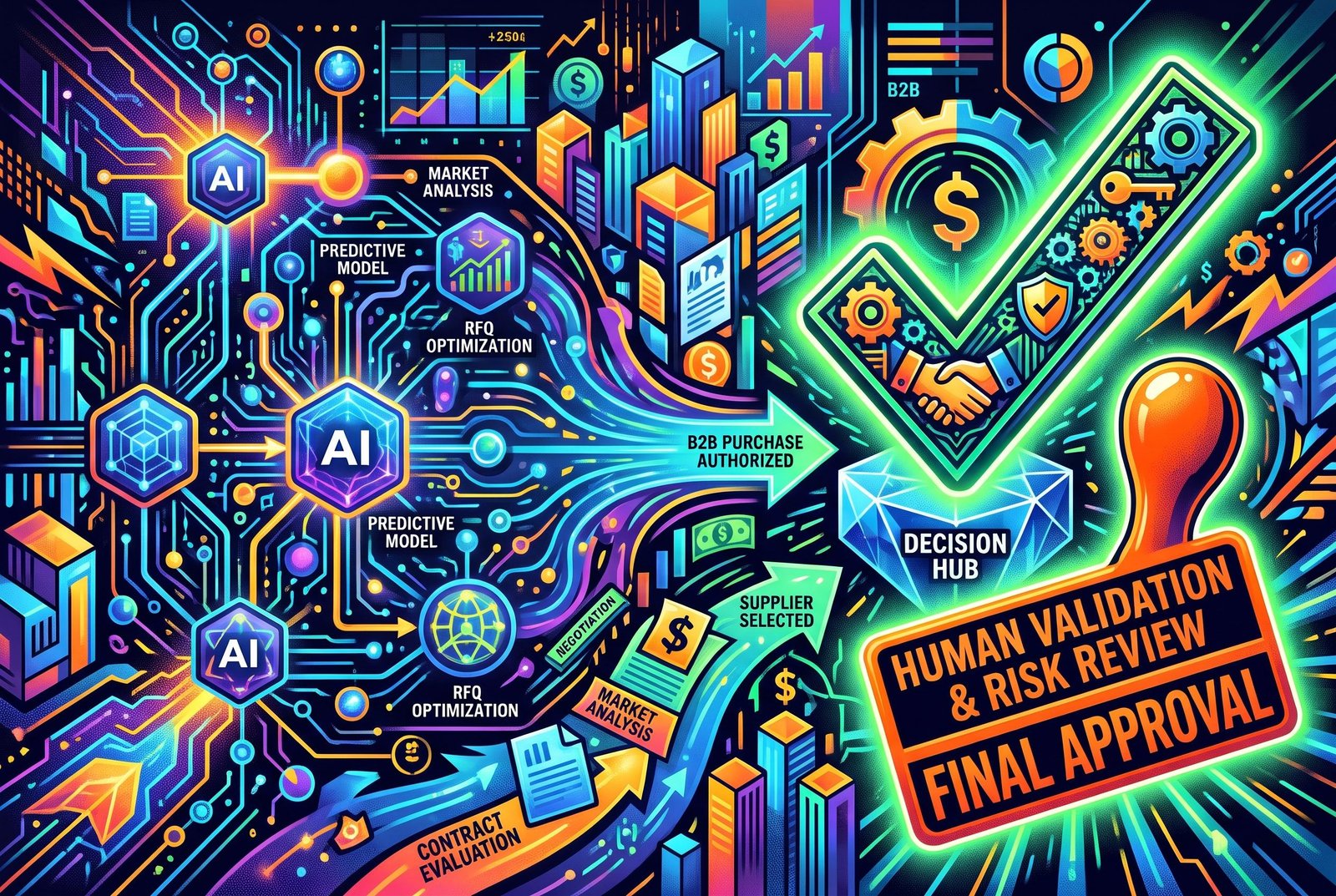
Artificial intelligence is moving from the sidelines of business purchasing into the middle of the process, but Forrester says the final say will still rest with people.
In its latest predictions for 2027, the research firm argues that AI will increasingly help buyers discover suppliers, compare options, assess risk and negotiate value. Yet rather than surrendering control to machines, business customers are expected to become more deliberate about where AI is used and more dem...
Continue Reading This Article
Enjoy this article as well as all of our content, including reports, news, tips and more.
By registering or signing into your SRM Today account, you agree to SRM Today's Terms of Use and consent to the processing of your personal information as described in our Privacy Policy.
anding about when it should be trusted.
Forrester said in its Business Buyers’ Insights Survey, 2026, that 82% of buyers had already encountered some form of AI functionality in a purchase, whether they wanted it or not. The firm believes that by 2027 the balance will shift further: buyers will delegate more routine work to AI agents, but will grow less willing to accept AI features that do not clearly improve the buying process.
That shift, Forrester says, will leave procurement in a paradoxical place. Machines will do more of the labour, but human judgement will become even more important when decisions carry risk or require accountability. Buyers are likely to use AI to widen the field of possible suppliers and accelerate early analysis, then turn to human experts for reassurance, interpretation and final approval.
One of Forrester’s central forecasts is that agentic buying will influence 75% of B2B purchases. In practice, that means AI agents will no longer be limited to narrow automation tasks. Instead, they will be used for activities such as spend analysis, contract-renewal reviews, supplier discovery, and the drafting of RFIs and RFPs. Forrester expects fully autonomous purchasing to remain confined mainly to high-volume, low-risk and repetitive transactions, but says agents will carry out a meaningful share of the overall buying journey.
The consultancy also expects buyers to increase their reliance on people, not decrease it. As AI-generated recommendations become more common, Forrester predicts that human interactions used to validate those recommendations will double. That is because AI can speed up comparison and surface possibilities, but it cannot fully judge whether a supplier fits an organisation’s culture, whether a proposal is workable in practice, or whether a risk is acceptable.
Forrester says this growing dependence on validation will elevate the importance of product specialists, customer references, partners and industry analysts. Those voices will be needed to test whether AI-produced suggestions stand up to scrutiny, especially as buyers face more synthetic content, automated outreach and agent-to-agent interactions.
A further complication is risk. Forrester predicts that risk reviews will delay or block one-third of enterprise AI software purchases. The firm says AI may shorten the search phase, but it is likely to lengthen the approval phase, particularly in larger organisations. More than half of AI purchases already involve four or more departments, compared with 26% of non-AI purchases, and internal buying groups have grown from an average of eight stakeholders to 13, according to the company’s research.
That widening circle brings legal, security, compliance, procurement and technology teams more deeply into the decision-making process. Those stakeholders will want clear evidence that any AI system can operate within governance frameworks, audit requirements and internal controls. If vendors cannot supply that proof, Forrester warns, enthusiasm from users may not translate into sign-off from gatekeepers.
The message for providers is clear: they will need to persuade both software agents and human decision-makers. Forrester says that means making product details, pricing, privacy, security, compliance and performance information easy for machines to process, while also strengthening the human relationships around the deal.
That will require subject-matter experts who can explain where AI adds value and where it does not, as well as credible customer advocates who can corroborate claims. It will also mean giving risk owners concrete evidence rather than broad assurances. Above all, Forrester says, suppliers should ensure that AI capabilities are tied to genuine customer needs rather than added simply because the technology is available.
Forrester’s broader 2027 predictions suggest that AI will increasingly shape how companies buy, but not remove people from the process. The firm also says AI will take a larger share of business technology spending and that digital commerce is moving towards a more conversational, less click-driven model. Taken together, those forecasts point to a future in which AI helps buyers work faster and look more broadly, while human judgement remains the decisive check on what gets bought, and why.
Source: Noah Wire Services