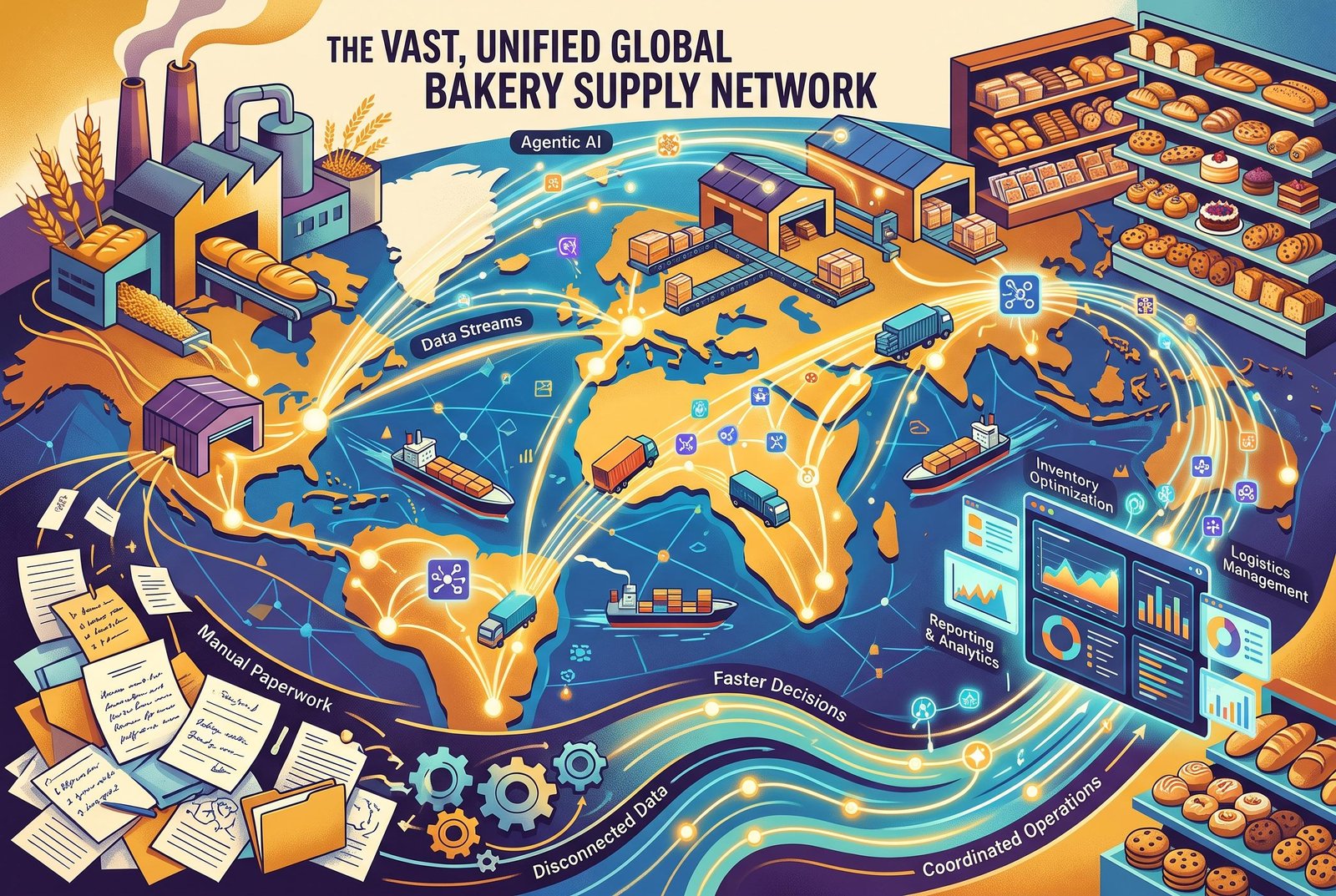
Grupo Bimbo’s size alone explains why its technology leaders are paying close attention to the next wave of enterprise AI. The Mexican baking giant operates in 102 countries, runs 250 bakeries and snack factories, and sells more than 10,000 products through a network that includes over 1,600 sales centres and tens of thousands of delivery routes, according to the company’s own figures. For a business that must move fresh bread and other short-shelf-life products every day, complex...
Continue Reading This Article
Enjoy this article as well as all of our content, including reports, news, tips and more.
By registering or signing into your SRM Today account, you agree to SRM Today's Terms of Use and consent to the processing of your personal information as described in our Privacy Policy.
ity is not a side issue but the core operating challenge.
Antonio Parra, Grupo Bimbo’s global business technology leader, has described the company as a highly distributed operation serving more than 4 million customers each week. He says the business has spent years trying to turn a patchwork of inherited systems into a single operating model, after years of acquisitions left different units using different platforms and different definitions of the same data. The aim, he argues, has been to replace multiple versions of the truth with one shared view of the business.
That standardisation effort has been built largely around Oracle. Grupo Bimbo has used Oracle cloud applications across finance, supply chain, human capital and customer experience since 2017, and Oracle says the company has also used integration tools to connect SaaS, custom and on-premises systems on Oracle Cloud Infrastructure. The programme began with finance and gradually expanded, with Parra arguing that the real prize lies in supply chain performance rather than simply faster accounting closes.
In that telling, the value of cloud software is not only administrative efficiency. Parra says the bigger gains come from reducing operational waste in a business where small improvements in inventory, transport and planning can translate into hundreds of millions of dollars a year. Oracle’s own account of the relationship says Grupo Bimbo has used supply chain and manufacturing tools to improve visibility across factories, warehouses and delivery routes, with the objective of strengthening freight planning, load use, on-time delivery and inventory accuracy.
The company’s operational model helps explain why. Fresh baked goods must be produced, moved and sold quickly, and that leaves little room for slow decision-making or fragmented data. Oracle’s customer case study says connected logistics tools have helped Grupo Bimbo cut manual work and make operational decisions faster, while also supporting efforts to reduce fuel use, empty miles and waste. Those kinds of improvements matter in a business that must balance service levels, product freshness and cost control across a sprawling international footprint.
Parra says that, in practice, the company has already learned to mine Oracle systems for information in ways the vendor had not anticipated. Grupo Bimbo then layered its own AI capabilities on top to interpret the enormous volume of data produced each day. The point, he says, is not technology for its own sake but better judgement about where to invest capital, how to allocate resources and when to act across a global enterprise that can spend billions on assets.
That is why Oracle’s recent push into agentic AI has drawn the company’s attention. Oracle has positioned Fusion Claw as a governed runtime for agentic applications, designed to combine AI reasoning with deterministic enterprise computing while preserving policies, permissions, approvals and auditability. Parra says such tools could materially reduce the manual planning and reporting work still required across Grupo Bimbo’s network of more than 200 bakeries and more than 2,000 local distribution centres. In his view, the wider opportunity is to move people away from assembling reports and towards actual decision-making.
Oracle’s broader description of Grupo Bimbo’s AI journey suggests the company is already exploring uses beyond planning, including forecasting, quality controls, driver safety and image recognition for spotting production defects. But those capabilities are presented as developing initiatives rather than finished outcomes. As Parra sees it, the challenge is still the same one that has shaped Grupo Bimbo’s digital strategy for years: using consistent, trusted data to make a vast and fast-moving business behave as if it were far smaller, and far simpler, than it really is.
Source: Noah Wire Services