


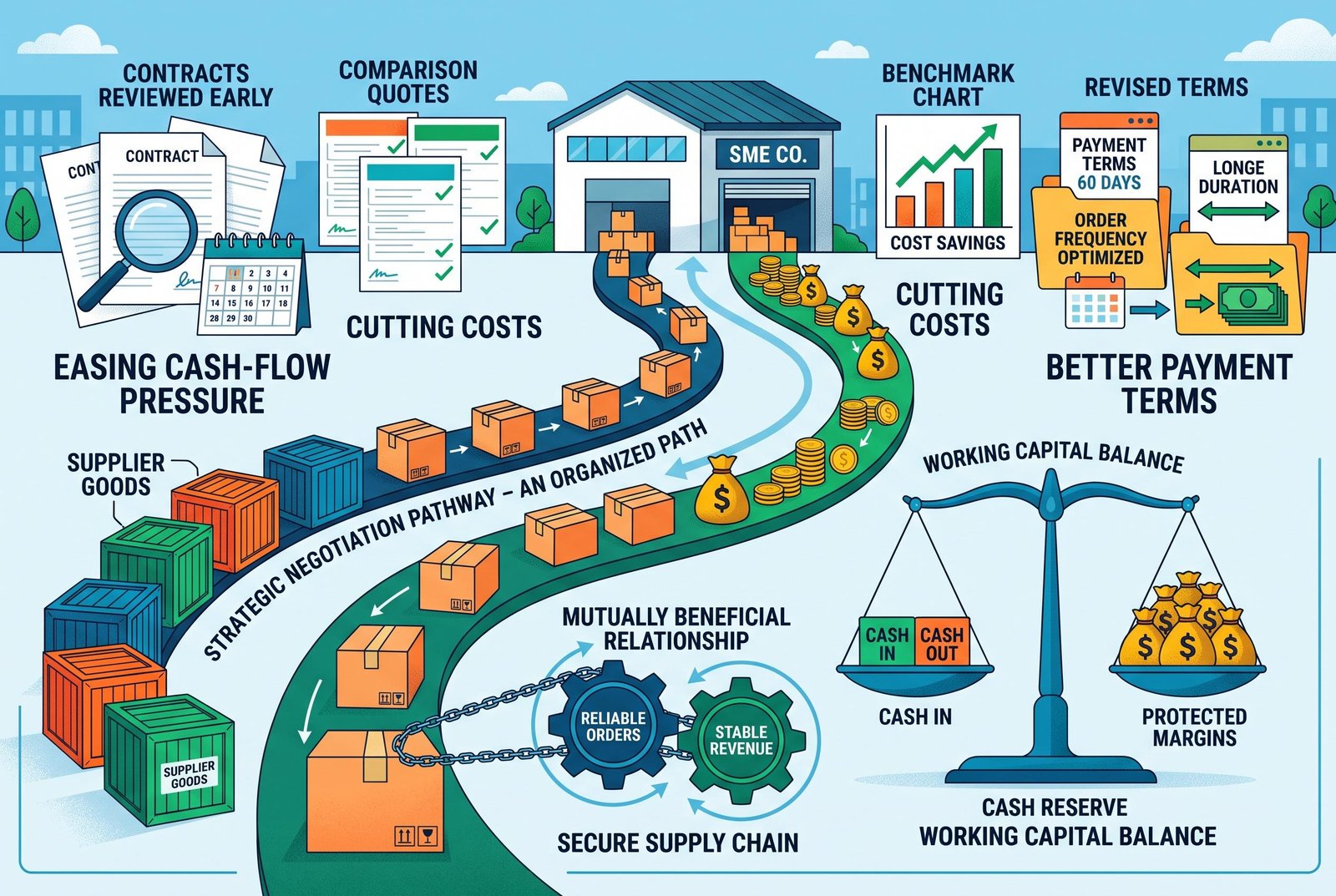
Negotiating with suppliers is one of the quickest ways a small business can protect profit, and it can do far more than shave a little off an invoice. For many owners, the real value lies not only in lower prices, but in better cash flow, more flexible ordering and terms that reduce pressure on working capital. In a business where every pound counts, those gains can matter more than a modest rise in sales, because they fall straight through to the bottom line.
Yet supplier conv...
Continue Reading This Article
Enjoy this article as well as all of our content, including reports, news, tips and more.

By registering or signing into your SRM Today account, you agree to SRM Today's Terms of Use and consent to the processing of your personal information as described in our Privacy Policy.
For women founders, the stakes are frequently even higher. The British Business Bank says female-led firms continue to face a substantial funding gap, while the House of Commons Women and Equalities Committee has reported that women-led businesses begin with significantly less capital on average than their male counterparts. That makes supplier terms more than an administrative detail; they can act as a practical source of financing. A longer payment window, a lower minimum order or a more predictable delivery schedule can ease pressure on cash far more effectively than a small cut in headline price.
The wider procurement environment also makes active negotiation more important. According to the 2026 Indirect Procurement Report produced with the Chartered Institute of Procurement & Supply and referenced by RS, reduced operational budgets are among the biggest pressures on organisations, while many are responding by renegotiating contracts and trimming their supplier base. That same report shows that half of organisations are consolidating suppliers, a sign that procurement is becoming more strategic in the face of uncertainty, inflation and supply-chain risk.
Ivalua’s survey of 300 UK procurement and supply-chain decision makers points in a similar direction. It found that many businesses are choosing to work more closely with suppliers rather than simply demanding lower prices, with cost control increasingly linked to partnership, resilience and flexibility. The message for smaller firms is straightforward: the best negotiations are rarely about squeezing every last penny from the other side; they are about building an arrangement that supports both sides over time.
Preparation is what separates a useful conversation from a vague complaint. Before approaching a supplier, a business needs a clear picture of its own spending and a sense of what the market will bear. That means looking back over the previous 12 months and totalling what was really spent with each supplier, including delivery charges, penalty fees and any other extras that might otherwise be overlooked. It also means gathering one or two comparable quotes from alternative suppliers so there is a genuine benchmark. The point is not necessarily to switch, but to know whether the current deal remains competitive.
It is equally important to examine the contract itself, not just the invoice. Minimum order quantities, notice periods and auto-renewal clauses can be just as significant as the unit price. A supplier offering an apparently attractive rate may still be expensive if the contract ties the business in for another year on unfavourable terms. Owners should also think about how much of the supplier’s revenue they represent, how predictable their ordering pattern is and whether their business structure affects how they are viewed as a customer. Suppliers often prefer reliable accounts with visible growth potential, even if those customers are not the largest on paper.
Timing matters almost as much as preparation. Leverage weakens as a renewal date approaches. Six months before a contract ends, there is usually enough time to compare offers, test the market and begin a proper discussion with the incumbent supplier. A few weeks before expiry, the balance shifts sharply in the supplier’s favour, particularly if an auto-renewal clause is involved. For that reason, expiry dates should be tracked well in advance, ideally with reminders set months ahead rather than weeks.
Price is only one lever, and often not the most useful one. A supplier may be more willing to adjust terms than to reduce the headline figure. Extending payment from 30 days to 45 or 60 days can improve cash flow without forcing the supplier to cut margin. Consolidated deliveries can reduce handling time and administration. Lower minimum order quantities can free up cash that would otherwise be trapped in stock. Bulk purchasing may unlock better rates, while early payment can sometimes justify a discount if the business has the liquidity to support it. Businesses can also ask for a price hold or a price-match arrangement, which offers predictability without forcing a fresh negotiation every year.
The most effective negotiations tend to focus on two or three priorities rather than a long shopping list. That approach makes it easier for the supplier to respond constructively, and it gives the buyer a better chance of obtaining meaningful movement where it matters most. It is also worth remembering that negotiation is meant to be a two-way process. The Small Business Commissioner advises firms to understand their own limits, make sure any agreement is recorded clearly in writing and recognise that the first offer is rarely the final one. If a contract would cause serious financial difficulty, the guidance says businesses should be willing to walk away and seek advice where needed.
There is also value in offering something in return for better terms. One of the strongest bargaining positions comes from giving a supplier a larger share of your business. Half of the organisations surveyed for the 2026 procurement report are consolidating suppliers to improve their negotiating position, and smaller firms can use the same principle. Bringing several categories under one account, or reducing the number of suppliers used for similar purchases, can create the volume and predictability that justify a better deal.
That does not mean every negotiation should be hard-edged. The evidence suggests that many businesses are increasingly collaborating with suppliers because they understand the risks of pushing too hard. Ivalua found that a majority of UK firms were working more closely with suppliers in response to cost pressures, while many were also concerned about the financial fragility of key partners. In practice, that means a strong negotiation is one that protects margins without undermining the supplier relationship. A bargain that leaves the other side unable to deliver reliably is no bargain at all.
The conversation itself need not be confrontational. A direct and respectful approach is usually enough. A business might say that it has been happy with the relationship, that it has reviewed annual spend, and that competing quotes suggest there may be room to improve either price or payment terms. It is better to be specific than vague. If another supplier has genuinely quoted a lower figure for the same specification and volume, that fact should be put on the table honestly. Bluffing is risky; suppliers may well know one another, and a claim that cannot be supported can damage trust long after the discussion ends.
There will be times when switching supplier is the sensible option. If the gap between the current price and the market rate is persistent and significant, if service problems have become routine, or if the supplier shows no interest in discussing terms, it may be time to move on. But switching has its own costs: onboarding a new supplier takes time, administration and effort, and it can introduce short-term disruption. The decision should therefore be made carefully, not as a reaction to a single disappointing quote.
Ultimately, the best negotiators are not the loudest or the toughest. They are the ones who prepare properly, begin early, know exactly what they want and understand the pressures on the other side of the table. They ask for more than a better price, they keep the relationship professional and they treat negotiation as part of running a resilient business rather than as an awkward annual chore. Used well, supplier negotiation is one of the simplest tools a small company has for strengthening margin, improving cash flow and making growth easier to sustain.
Source: Noah Wire Services
Subscribe to Industry Updates
Get the latest news and updates directly to your inbox.

