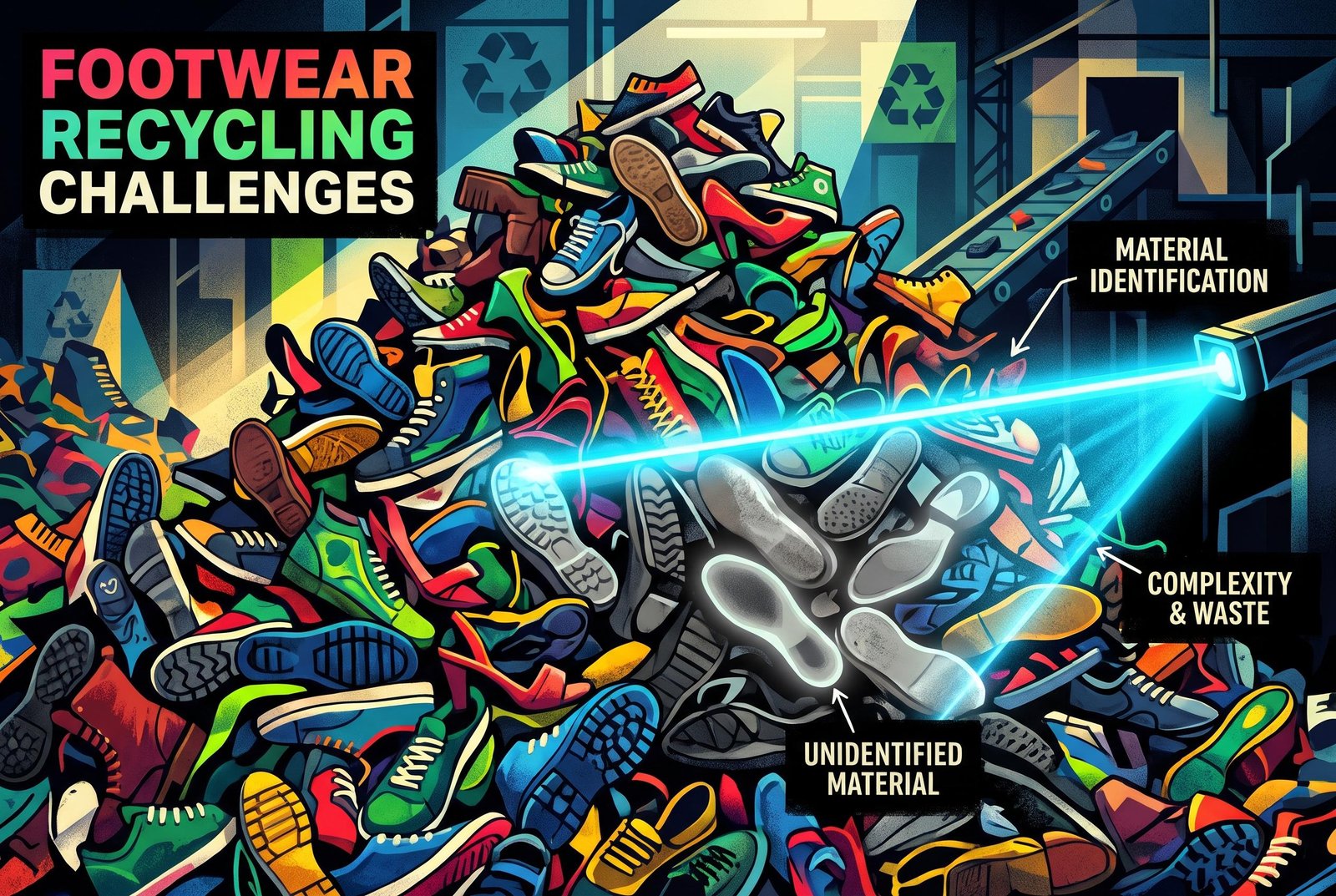
Fashion for Good has released the first phase of its “Closing the Footwear Loop” project, a multi-brand initiative that brings together major names in fashion and footwear to examine how the sector might move away from a linear take-make-dispose model. The Netherlands-based organisation, which says it works to connect the fashion ecosystem around regenerative change, led the project alongside Circle Economy and a group of technology partners including CETIA, Matoha, Picvis...
Continue Reading This Article
Enjoy this article as well as all of our content, including reports, news, tips and more.
By registering or signing into your SRM Today account, you agree to SRM Today's Terms of Use and consent to the processing of your personal information as described in our Privacy Policy.
a and The 8 Impact.
The report examines the material flow, composition and condition of post-consumer footwear waste, drawing on pilot work intended to test whether better sorting and recycling routes can be scaled. Fashion for Good says the project was designed not only to identify what happens to discarded shoes, but also to translate that evidence into practical guidance for brands and recyclers.
Its findings point to a market still struggling with the basic problem of footwear recovery. Half of post-consumer footwear analysed in the project was deemed non-rewearable, while 46% could still be worn again. The remaining 4% was contaminated, making both reuse and recycling more difficult. Among the rewearable shoes, 90% were exported, mainly to the UAE, China and Pakistan, underscoring how much of Europe’s used footwear still leaves the region rather than being processed locally.
The study also highlights the limits of current sorting systems. Fashion for Good said 24% of shoes classified as non-rewearable showed no visible physical damage, suggesting that condition alone is not always enough to determine whether footwear can be reused. In addition, 37.7% of non-reusable sole materials could not be identified by near-infrared scanning, indicating that material complexity remains a significant obstacle for automated sorting and recycling.
The project’s pilots included what Fashion for Good described as three dedicated footwear sorting technologies developed by Matoha, CETIA and Picvisa. It also worked with The 8 Impact on recycling sports shoes and sneakers through extended producer responsibility feedstock, a trial that the organisation said demonstrated that closed-loop recycling for those product types is technically possible.
The broader initiative aims to help address several structural barriers in the footwear sector, including the lack of end-of-life infrastructure, the difficulty of separating multi-material products and the absence of shared design rules across the industry. According to Fashion for Good, participating companies include Adidas, Deichmann, Dr. Martens and Inditex, among others, reflecting a growing industry interest in finding common approaches to circularity.
The report is being presented as a practical starting point rather than a finished solution. Fashion for Good says the work will inform future design principles and further testing, with the ultimate aim of creating a more coherent system for collecting, sorting and recycling shoes at scale. It has also released a footwear circularity guidance sheet as part of the next phase of the project, setting out design considerations such as circular inputs, longevity, recyclability and circulation.
Source: Noah Wire Services