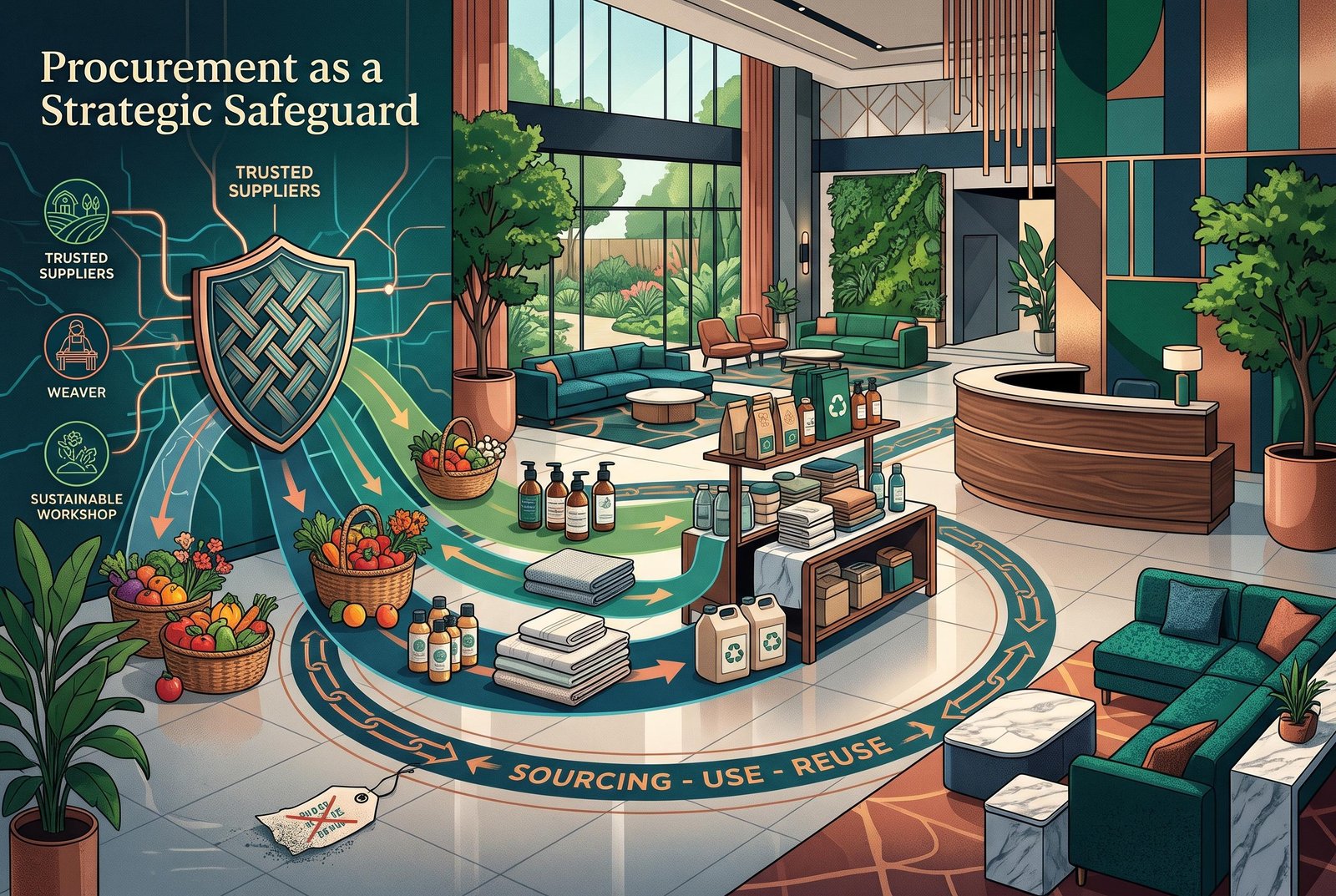
Procurement in hospitality has moved well beyond the narrow pursuit of lower prices, according to Ruth Duggan, Head of Group Procurement and Sustainability at The Doyle Collection and a founding member of the Hotel Procurement Association. In her view, the function now sits much closer to the centre of business strategy, influencing profitability, risk, service standards, sustainability and the guest experience.
Duggan was among the figures involved in establishing the Hotel Pr...
Continue Reading This Article
Enjoy this article as well as all of our content, including reports, news, tips and more.
By registering or signing into your SRM Today account, you agree to SRM Today's Terms of Use and consent to the processing of your personal information as described in our Privacy Policy.
ocurement Association in the UK, a body created to give procurement professionals in hospitality a place to exchange ideas, compare challenges and build their professional profile. The need for such a forum, she says, came from the fact that procurement had often been treated as a back-office discipline, despite its direct effect on commercial performance and operational resilience. She also sees potential for the association to extend into Ireland, where she is based and where she oversees procurement and sustainability across The Doyle Collection’s hotels in Ireland, the UK and the US.
The profession’s growing visibility is being reinforced elsewhere in the sector. The introduction of a Procurement Professional of the Year category at the Hotel Cateys has been presented as a sign that hotel operators are beginning to recognise the breadth of the role, from managing supply risk to supporting sustainability and operational excellence. The Caterer has reported that the award is intended to acknowledge the contribution procurement specialists make to hotel performance and guest experience.
Duggan argues that the biggest shift in recent years has been cultural as much as operational. Where procurement was once judged mainly on savings, it is now expected to deliver value through supplier partnerships, innovation, reliability and resilience. At The Doyle Collection, she says suppliers are treated as extensions of the team, with long-term relationships valued for the efficiencies and improvements they can unlock. In this model, success is measured not simply by price but by quality, continuity, alignment with company values and the ability to support new ideas.
That approach reflects a wider change across the hotel sector. Operators are under pressure from rising food, labour and energy costs, as well as geopolitical uncertainty and more complicated supply chains. Industry guidance from the Chartered Institute of Procurement & Supply and Deloitte has emphasised that organisations can reduce vulnerability by diversifying suppliers, improving visibility across supply networks and investing in technology and contract management. Duggan’s comments point in the same direction: she says hotels can no longer rely on purely price-led purchasing decisions if they want to protect service levels and continuity of supply.
Sustainability has become another defining issue. Duggan has previously described The Doyle Collection’s approach as a coordinated effort across properties, supported by local leaders and a steering structure that brings together common environmental priorities. These include reducing electricity, gas and water use, increasing recycling and cutting plastics in meetings and events. The company has also moved away from smaller bathroom toiletries towards larger dispensers, a change that reduces waste and lowers storage and disposal costs.
That example illustrates Duggan’s broader argument that responsible buying need not conflict with commercial discipline. She believes the best procurement decisions are those that consider whole-life value rather than upfront cost alone. A product may be more expensive initially, but if it lasts longer, generates less waste, uses less energy or proves easier to manage through the supply chain, it may ultimately be the better business choice. In her view, sustainability should not be bolted on at the end of the process but built into procurement from the outset.
Other hotel groups are taking similar steps. Accor, for example, has described supplier assessments, training and procurement requirements designed to improve environmental, social and ethical performance throughout its supply chain. The company says purchasing decisions can be used to support lower-impact products, supplier innovation and carbon reduction goals. Such examples underline a broader industry trend: procurement is increasingly being used as a lever for both operational efficiency and environmental progress.
Looking ahead, Duggan believes technology and artificial intelligence will have a major impact on procurement over the next three to five years. Digital tools are already making it easier to track spending, identify efficiencies and automate routine tasks, freeing professionals to focus more on strategic work, relationship management and decision-making. But she is clear that procurement remains a people-led discipline. Technology may improve visibility and speed, yet trust, negotiation and collaboration will continue to determine the quality of supplier relationships.
She also expects resilience and sustainability to remain central themes. Recent disruptions have highlighted the risks of over-dependence on single suppliers and the value of stronger mapping and oversight across the supply chain. At the same time, investors, regulators and guests are continuing to raise expectations around environmental responsibility. Procurement, Duggan says, sits at the point where those pressures meet, making it a critical function in helping hotels balance commercial realities with longer-term goals.
For hotel operators, the message is straightforward: invest in data, deepen supplier partnerships, understand risk and make sustainability part of purchasing decisions from the beginning. Duggan’s central point is that procurement should no longer be seen as a narrow buying function. It is a strategic discipline capable of supporting profitability, safeguarding operations, driving innovation and improving the guest experience.
Ultimately, she says, the work depends on relationships, both inside the business and beyond it.
Source: Noah Wire Services