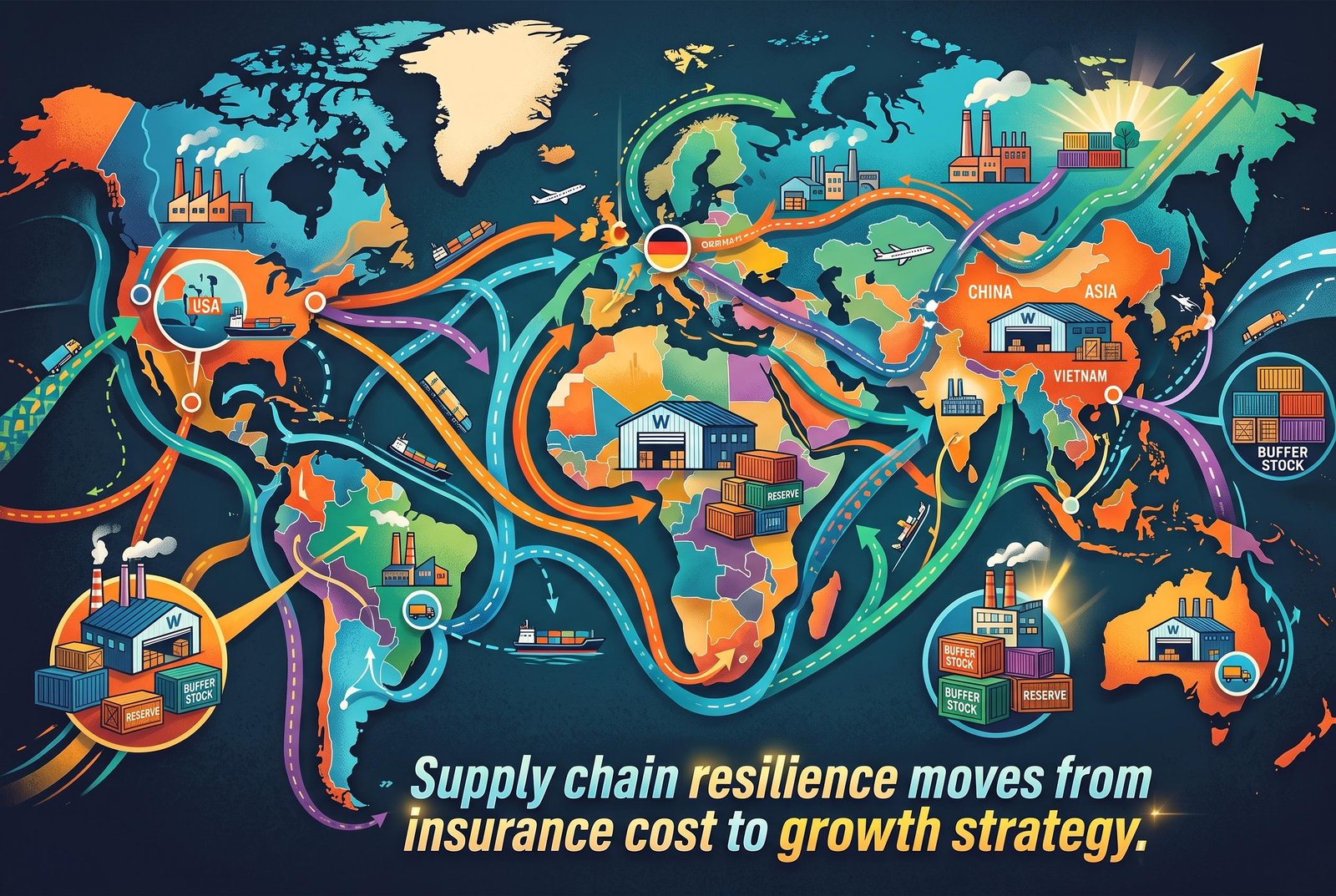
Supply chain resilience has moved from an operational concern to a boardroom question, as executives weigh the cost of disruption against the price of keeping options open. Research from DP World suggests that many companies are now prepared to spend more on supplier diversity, alternative transport corridors and inventory buffers, even if the financial return is not always immediate.
The company’s August survey, which covered 103 respondents across 14 markets and nine indust...
Continue Reading This Article
Enjoy this article as well as all of our content, including reports, news, tips and more.
By registering or signing into your SRM Today account, you agree to SRM Today's Terms of Use and consent to the processing of your personal information as described in our Privacy Policy.
ries, points to a marked shift in attitude. Some 71% of executives said they plan to diversify suppliers within the next year, while 86% said access to alternative and multimodal routes gives them a competitive advantage. That appetite for flexibility reflects a trading environment shaped by tariffs, geopolitical friction, weather-related disruption and lingering capacity constraints.
Yet resilience is not free. A second supplier may involve qualification work, minimum volume commitments and extra oversight. Switching to another port or carrier can bring higher freight rates or longer inland haulage. Holding more stock can protect service levels, but it also ties up cash that could otherwise be deployed elsewhere in the business.
That is why the investment case for resilience is becoming more rigorous. Finance, procurement and logistics teams are increasingly being asked to judge whether an alternative route or supplier genuinely reduces exposure to disruption, or simply adds another layer of cost. In practice, that means scrutinising switching times, available capacity, customs readiness and the capital needed to activate each back-up option when needed.
Tariffs are adding further pressure to those calculations. DP World found that 90% of respondents believe duties are already reshaping sourcing, investment and network decisions, while 83% expect uncertainty to continue influencing strategy. Deloitte has similarly argued that tariff policy is forcing companies to revisit where they source, how they distribute and where they place capital, with resilience now taking precedence over simple cost minimisation.
The maritime network remains particularly exposed. United Nations trade data shows that sea transport carries more than four-fifths of global merchandise by volume, leaving many firms vulnerable to congestion at ports, canal bottlenecks and regional conflict. But having an alternative route on paper does not mean it can absorb diverted cargo in practice. Contractual access, inland links, customs processes and spare capacity all determine whether a reroute is commercially workable.
DP World’s survey also suggests that supply chain leaders now see their role as more closely tied to corporate growth than they did three years ago. Ninety-three per cent of respondents said their function is more central to business growth than it was three years ago, and 87% said supply chain management has become more important in corporate decision-making. That reflects a broader change seen across global industry: supply chains are no longer just built to lower costs, but to support expansion, market entry and customer confidence.
Growth ambitions, however, can only be realised if the underlying network is ready. Entering a new market depends on supplier availability, transport infrastructure, inventory capacity and regulatory approval. Alternative sourcing and distribution arrangements can help reduce dependence on individual facilities or corridors, but they do not automatically speed up market entry. New suppliers may still need lengthy approval, while extra warehousing or transport capacity can be constrained by local labour shortages or infrastructure limits.
The investment challenge, then, is to measure resilience in portfolio terms rather than treating each safeguard in isolation. Companies need to assess how much revenue might be protected, how much recovery time could be saved, how much extra operating cost would be incurred and how much capital would be committed. That framework can reveal when redundancy is worthwhile, and when it simply duplicates existing cover.
DP World’s survey also found that 97% of respondents remain optimistic about the trade outlook over the next year, a sign that companies are not retreating from growth despite persistent uncertainty. Morgan Stanley has described this as a broader resilience boom, with governments and businesses directing capital towards more secure and dependable supply chains, while S&P Global says that risk is increasingly being shaped by scarce materials, compressed decision-making and regional shocks rather than by a single chokepoint.
For businesses trying to expand, the lesson is clear: resilience is becoming a competitive capability in its own right. But the goal is not to eliminate disruption altogether. It is to build enough flexibility to respond quickly, without overpaying for protection that may never be used. Regular reviews of suppliers, inventory, transport routes and regional capacity can help identify overlaps, shared dependencies and arrangements that no longer justify their cost.
As tariffs, transport conditions and demand patterns continue to shift, companies will need to decide which contingencies are essential and which are simply expensive insurance. The winning strategy is likely to be the one that balances readiness with discipline, preserving agility while keeping the cost of resilience firmly in check.
Source: Noah Wire Services