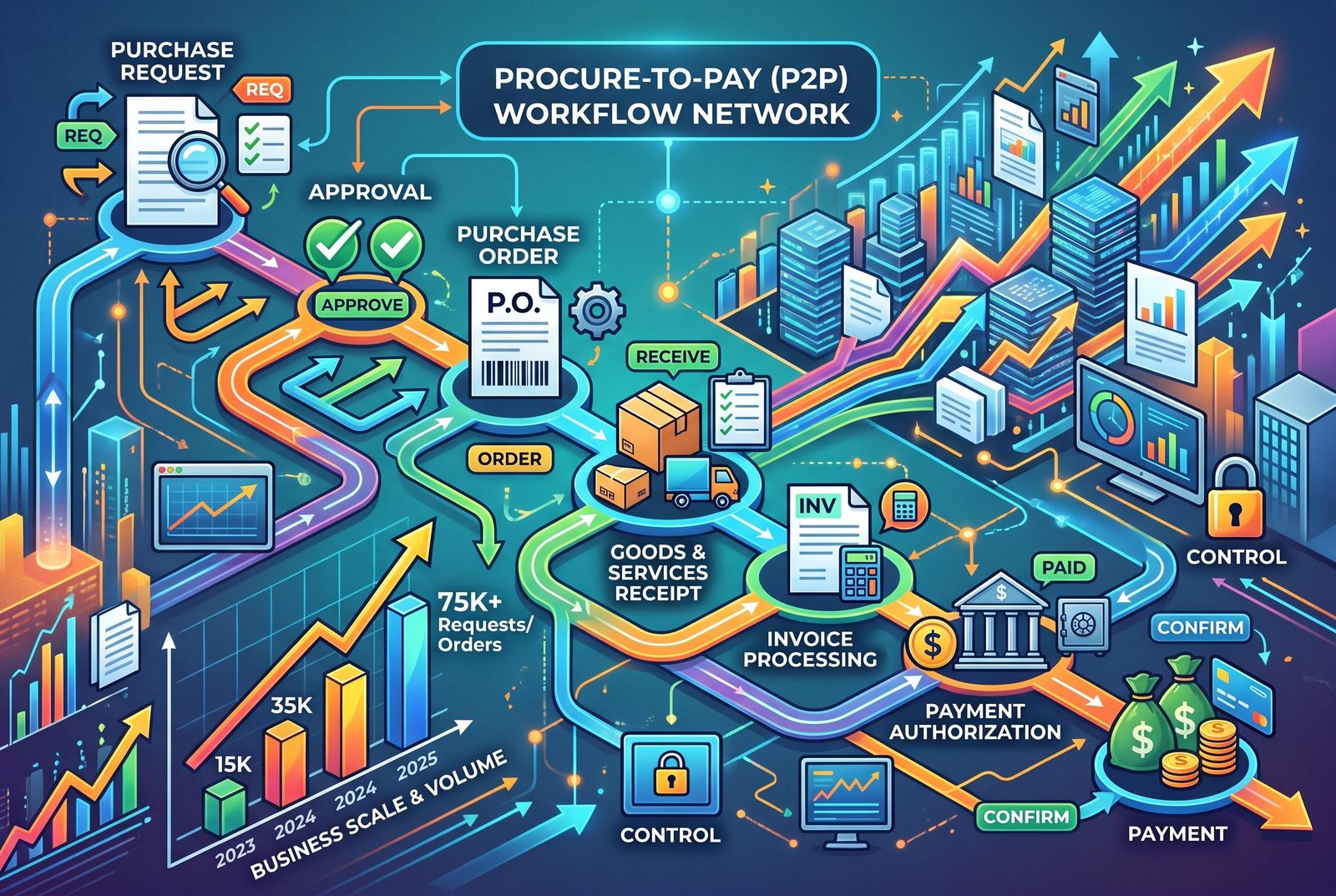
As businesses expand, the seemingly simple task of keeping track of what has been ordered, approved, received and paid can quickly become a source of friction. More employees place more requests, more suppliers enter the picture and finance teams are left handling a far larger flow of invoices, commitments and exceptions. Without a clear line of sight across that chain, delays, duplicated work and missed information become more likely. That is why procure-to-pay visibility has become ...
Continue Reading This Article
Enjoy this article as well as all of our content, including reports, news, tips and more.
By registering or signing into your SRM Today account, you agree to SRM Today's Terms of Use and consent to the processing of your personal information as described in our Privacy Policy.
a practical necessity rather than a back-office luxury.
At its core, purchase-to-pay visibility gives procurement and finance a shared view of the same activity. Instead of treating requisitions, approvals, purchase orders, receipts and payments as separate events, a connected system ties them together so teams can see where each transaction stands and who is responsible at each stage. Consultport describes purchase-to-pay as the process that links procurement and finance to manage purchasing, invoicing and payments more efficiently, while IBM says manual handling of each step becomes increasingly error-prone as organisations grow.
That visibility matters most when purchasing becomes too fragmented to manage through spreadsheets, email trails and isolated files. Procurify says a unified procure-to-pay system can bring purchasing and accounts payable into a single workflow, giving businesses control from request to payment. Amazon Business similarly argues that automation reduces bottlenecks by replacing manual approval routing and purchase-order chasing with a faster, more consistent process. In practice, that means fewer status queries, fewer lost documents and less time spent reconciling records after the fact.
One of the biggest gains is earlier clarity around purchase requests. When teams submit requests through an organised process, procurement can immediately see what is needed, whether the request fits policy and whether anything is missing. That helps prevent late-stage surprises and makes it easier to distinguish between routine buying and exceptions that need closer scrutiny. The same applies to approvals: once the status of each request is visible, managers and finance staff can act more quickly and avoid the confusion that comes from multiple people chasing the same update.
The benefits extend into purchase-order tracking and invoice management. A central platform lets companies monitor open orders, supplier commitments and related documents without having to search across systems. Zycus notes that modern procure-to-pay tools can standardise and control the process while supporting real-time contract monitoring and better spend categorisation. For accounts payable teams, the value lies in matching invoices to the correct order and receipt information, which reduces delays and makes it easier to spot discrepancies before they become payment problems.
That same connected view also improves decision-making. Amazon Business points to better spend visibility, stronger supplier relationships and improved working capital management as major advantages of procure-to-pay automation. When a business can see patterns in what it buys, how often it buys and where approvals tend to slow down, it is better placed to negotiate with suppliers, tighten controls and cut unnecessary spend. IBM argues that technologies such as artificial intelligence, machine learning and robotic process automation can further reduce errors and bottlenecks by bringing more of this work into a unified digital workflow.
For growing organisations, the strategic value is control. As departments adopt different suppliers, buying habits and communication channels, the risk of inconsistency rises. A mature purchase-to-pay process helps bring those differences back into a common framework, improving compliance, budget oversight and audit readiness. Vertice says a modern P2P setup can also reduce invoice discrepancies, leakage in spend and low user adoption, all of which become more problematic as purchasing volume rises.
In that sense, visibility is not just about seeing transactions more clearly. It is about turning procurement data into something usable by both buying and finance teams, from approval status and supplier activity to invoice follow-up and spending trends. A business that can connect those dots is in a stronger position to grow without losing control of how it spends.
Source: Noah Wire Services