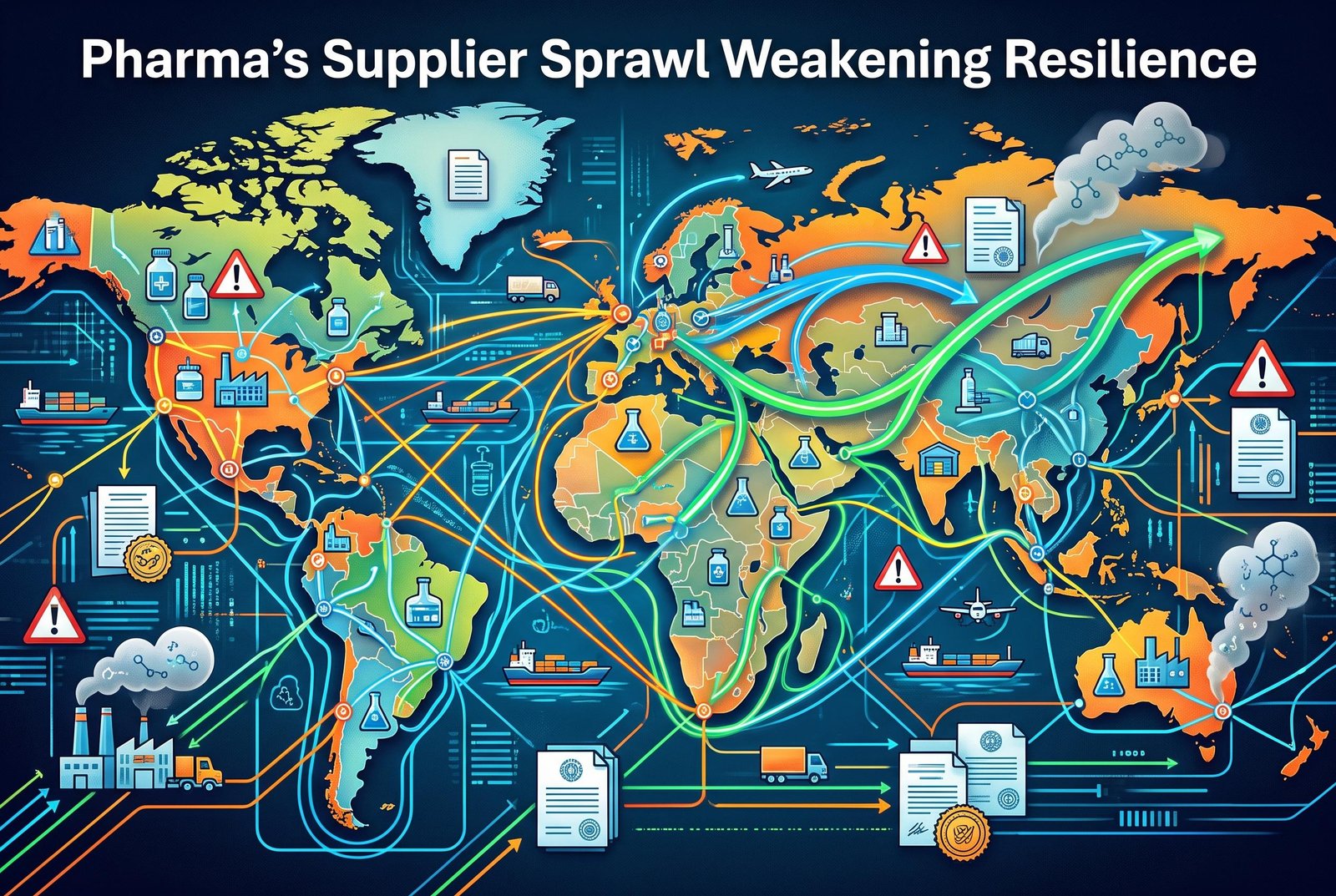
For many pharmaceutical manufacturers, the logistics network they rely on today was not designed in one deliberate act. It grew layer by layer as new products were launched, markets were entered and businesses were acquired. What began as a sensible effort to avoid overdependence on a single supplier has, in many cases, hardened into something far harder to manage: supplier sprawl.
The result is a fragmented system of third-party logistics providers, freight forwarders and spec...
Continue Reading This Article
Enjoy this article as well as all of our content, including reports, news, tips and more.

By registering or signing into your SRM Today account, you agree to SRM Today's Terms of Use and consent to the processing of your personal information as described in our Privacy Policy.
That tension is familiar across life sciences. McKinsey has noted that more complex supply chains, driven by outsourcing and newer modalities, are increasing exposure to disruption. In its analysis of pharma resilience, nearly half of executives surveyed identified sole sourcing of inputs as a major vulnerability, while a quarter pointed to poor visibility into supplier risk. Yet in practice, the answer is not always to add still more vendors.
Much of the problem starts locally. Country teams often select their own logistics partners, while procurement organisations encourage multi-vendor set-ups to preserve competition and limit dependency. Each decision may appear rational in isolation. Taken together, they can produce a global network that is expensive to oversee and difficult to control.
One anonymised example shows how quickly this can escalate. After a major portfolio acquisition, a European generics and biosimilars manufacturer inherited the previous owner’s logistics arrangements and found itself with dozens of warehousing and transport partners across Europe and Asia. Procurement teams were left managing a maze of stakeholders, with each shipment prompting a chain of emails among warehouses, carriers and receiving sites, and further rounds of coordination whenever plans changed.
Koen Lieffering, Regional Head of Key Accounts Europe at Cencora, which worked with the company, said the manufacturer ended up with an exceptionally dense supplier base. In one region alone, he said, there were about 30 providers handling storage and distribution and more than 20 involved in inbound air freight, leaving finance, quality and procurement without a clear end-to-end view of the supply chain.
The quality burden is significant as well. In GDP-regulated environments, every additional vendor must be qualified, audited and monitored, often across multiple countries. For quality assurance teams, that means repeating very similar checks again and again, while still trying to maintain oversight across a sprawling network.
The manufacturer in the example simplified its set-up by moving to a more integrated hub-and-spokes model under a single umbrella. Products were imported into the EU by World Courier, part of Cencora, and held in Cencora’s warehouse hub in the Netherlands. Distribution then flowed through Cencora’s wider 3PL network in Europe, including last-mile delivery. The practical effect was to give the company one main operational and quality interface rather than dozens of separate ones.
That consolidation brought more than administrative tidiness. By pooling volumes, the company was able to reduce transport costs, strengthen buying power and cut the amount of day-to-day coordination required. It also eased the audit load on quality teams. For procurement, the business case became easier to defend because the savings were not just direct ones on freight and warehousing, but also indirect gains from simpler management and better control.
Cost remains the most obvious reason companies keep a wide pool of providers. But as Karan Suri, Commercial Strategy & Revenue Growth at World Courier, argued, broader consolidation can often produce better economics than chasing small price advantages across many suppliers. He said that when customers bring more volume to one partner, routing and consolidation can be optimised, allowing lower overall pricing as efficiency improves.
A more integrated approach can also make pricing more transparent. Instead of dealing with separate tariffs and commercial terms in each country, companies can move towards harmonised arrangements across markets. That makes budgeting simpler, eases negotiations and gives procurement a clearer picture of the total value being delivered.
The benefits are not confined to commercial management. Supplier sprawl also makes it harder to address newer reporting and compliance demands, particularly around emissions. For large listed companies, the bulk of Scope 3 emissions typically sits deep in the supply chain, which means credible reporting depends on accurate data from many logistics partners and service providers.
Markas Ąžuolas, Environmental Sustainability Manager at World Courier, said that for large pharma groups, most emissions are tied up in the supply chain and the challenge is obtaining reliable primary data when thousands of vendors are involved. Fewer, more integrated relationships make it easier to establish consistent data flows, improve reporting and reduce dependence on estimates and averages.
That fits with a broader shift in the sector. According to Pharmaceutical Commerce, trust remains a major barrier to supply chain transparency, even as companies move beyond compliance-led networks towards systems that are more responsive and patient-focused. The industry is increasingly looking at technology that can connect quality, manufacturing, regulatory and operational data in real time, rather than relying on monthly or quarterly reviews after the fact.
There is also a growing recognition that resilience is not simply a function of vendor count. McKinsey has argued that pharma companies need better risk assessment, stronger visibility and more disciplined planning, rather than just more suppliers. In that context, a single partner with broad geographic coverage, backup options and multiple service capabilities may provide more resilience than a long list of disconnected providers.
That is the direction Cencora says it is trying to support through its global network across North and South America, Europe and Asia. By combining warehousing, transport, distribution and consulting capabilities under one roof, it presents itself as a single strategic partner rather than a patchwork of local suppliers. The attraction for pharmaceutical companies is straightforward: fewer interfaces, more consistent quality oversight, a more unified view of performance and risk, and a supply chain that is easier to manage in a highly regulated environment.
For an industry under pressure to cut costs, improve transparency and strengthen resilience at the same time, the lesson is increasingly clear. More vendors do not automatically mean more security. In many cases, they simply mean more complexity, more blind spots and less control.
Source: Noah Wire Services
Subscribe to Industry Updates
Get the latest news and updates directly to your inbox.