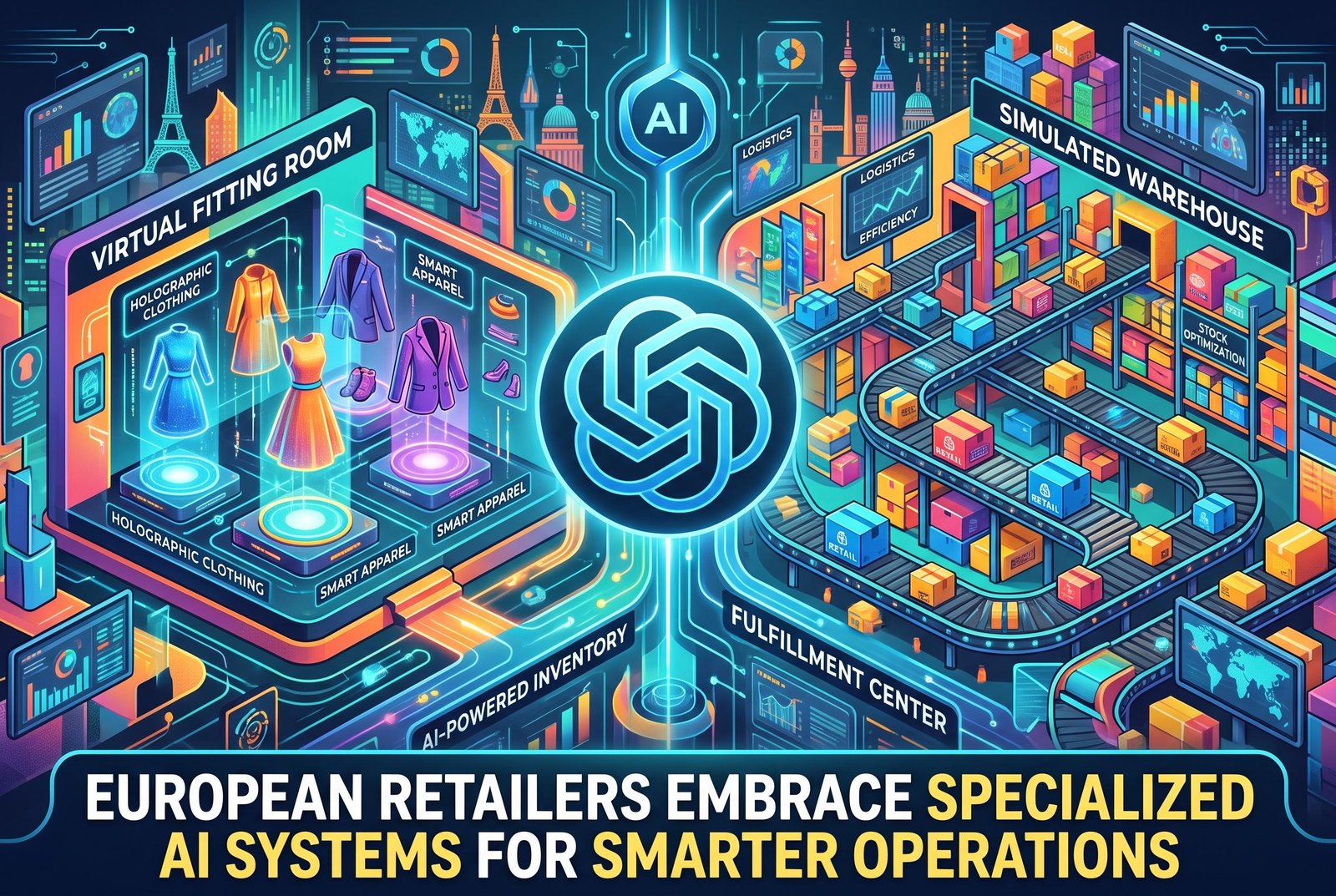
European retailers are increasingly turning to open models, digital twins and physical AI to trim costs, speed up workflows and make shopping systems more adaptive, according to NVIDIA. The company says the shift is already moving beyond experimentation, with retailers and consumer brands using its software stack to support everything from merchant assistants and product search to warehouse planning and virtual try-on.
One of the clearest examples comes from Shopify, which has ...
Continue Reading This Article
Enjoy this article as well as all of our content, including reports, news, tips and more.
By registering or signing into your SRM Today account, you agree to SRM Today's Terms of Use and consent to the processing of your personal information as described in our Privacy Policy.
been post-training NVIDIA Nemotron 3.5 Lightning for a GraphQL subagent embedded in Sidekick, its AI assistant for merchants. According to Shopify’s engineering team, the model was tuned with NVIDIA Megatron Bridge and reinforcement learning tools from NVIDIA NeMo, allowing the company to build a task-specific system that outperformed a leading frontier model on its internal benchmark while reducing serving costs by 90% and producing responses seven times faster. Shopify also says NVIDIA CCluster vLLM inference optimisation software helped it cut inference costs by as much as 12 times across additional applications including catalog enrichment, shopping simulation, taxonomy classification and recommendations.
The same push towards more efficient, specialised models is being echoed elsewhere in European retail. Zooplus, Europe’s biggest online pet retailer, has rebuilt its product discovery system with Infosys and NVIDIA, deploying a prototype within its Amazon Web Services environment that the companies say reached 86% search accuracy. That system uses NVIDIA’s Nemotron Retriever library for semantic search, alongside a blueprint for retail catalog enrichment designed to generate structured, search-ready product attributes from messy catalog data.
In fashion resale and image-led commerce, Photoroom’s work with Vestiaire Collective illustrates how AI can be inserted directly into the listing process. NVIDIA says the Image Editing API now standardises primary images at the point of upload, handling around 40,000 images a day across 70 countries. Listings processed through the pipeline reportedly achieved a 5% higher liquidity rate, with 3% to 7% more unique views per product page. The workflow runs on NVIDIA GPUs and uses TensorRT and Triton Inference Server, with NVIDIA Dynamo Snapshot positioned to help absorb traffic spikes.
Brands are also using the same infrastructure to reduce creative bottlenecks. Omi has launched ProductDrop, a workflow that ties each generated image back to an approved digital twin so companies can scale product imagery without introducing errors. L’Oréal is said to be using the approach within its CreAItech programme, combining digital twins with generated brand environments. Omi runs its TRELLIS 3D asset generation on NVIDIA RTX PRO 6000 Blackwell Server Edition GPUs, which it says has accelerated inference tenfold and reduced pipeline latency by four times.
L’Oréal is also using NVIDIA technology beyond marketing and content production. According to the company’s account, it has integrated NVIDIA ALCHEMI into research workflows to compress ingredient discovery from months of lab experimentation into hours of computational screening. It is also testing CurieOS, Orbital Industries’ operating system for science and engineering, with OrbMol-v2, an open source molecular simulation model that the company says is five times faster than comparable systems and 21% more accurate than the next best model of its kind.
Mirakl, which builds software for intelligent commerce, is another example of a company leaning on open models to preserve control over its own stack. NVIDIA says Mirakl runs open models on its own GPUs and through European cloud providers such as Scaleway, a strategy it describes as a way to maintain sovereignty, avoid lock-in and scale efficiently. Its Catalog Transformer has reportedly processed more than 70 million products, helping convert irregular vendor data into cleaner catalogues.
NVIDIA is pairing those language-model applications with a broader push into physical AI. The company says retailers are increasingly using simulation to test warehouse layouts, model store environments and support virtual fitting experiences before committing to real-world changes. Otto Group, working with Reply and NVIDIA Omniverse libraries on Google Cloud, has taken its autonomous warehouse project to its largest fulfilment centre in Haldensleben, Germany, where logistics teams can design and optimise operations in simulation before implementation.
In another example, ALLSIDES has launched what it calls a 3D Digital Twin Factory, an automated pipeline that converts physical objects into SimReady digital twins in minutes. The company says the resulting assets capture sub-millimetre geometry, measured physical properties and relightable materials, allowing retailers to simulate store layouts and track products more reliably through the shopping journey. The platform, which is built on CUDA, OptiX and TensorRT, already counts adidas, Amazon, Nike, Zalando and Zara among its users.
Virtual try-on is also gaining traction as a commercial tool rather than a novelty. CATCHES says its RealFit deployment with AMIRI delivered a 55% increase in conversion, an 80% rise in add-to-cart rates and a 56% lift in gross sales after seasonal adjustment. The company has since introduced PredictiveFit for retailers and CASI, a personal fashion agent that shops, styles and sizes customers over WhatsApp using open-weight models, including NVIDIA Nemotron 3, together with NVIDIA Omniverse and the Newton Physics Engine.
At GTC Berlin, Nebius is showing three retail blueprints built on NVIDIA technology and made available in early access on its infrastructure. They include an agentic assistant for store managers, an inventory simulation tool intended to reduce overstock and stockouts, and an agentic fine-tuning loop that continuously generates training data and feeds real-world performance back into the next model cycle.
Taken together, the examples suggest that Europe’s retail technology race is shifting towards systems that are smaller, more task-specific and more tightly tied to operational reality. Rather than relying solely on large, general-purpose models, retailers and consumer brands appear to be using open models, synthetic data and digital twins to make AI cheaper to run, easier to adapt and more useful across the full chain, from product discovery to fulfilment.
Source: Noah Wire Services