


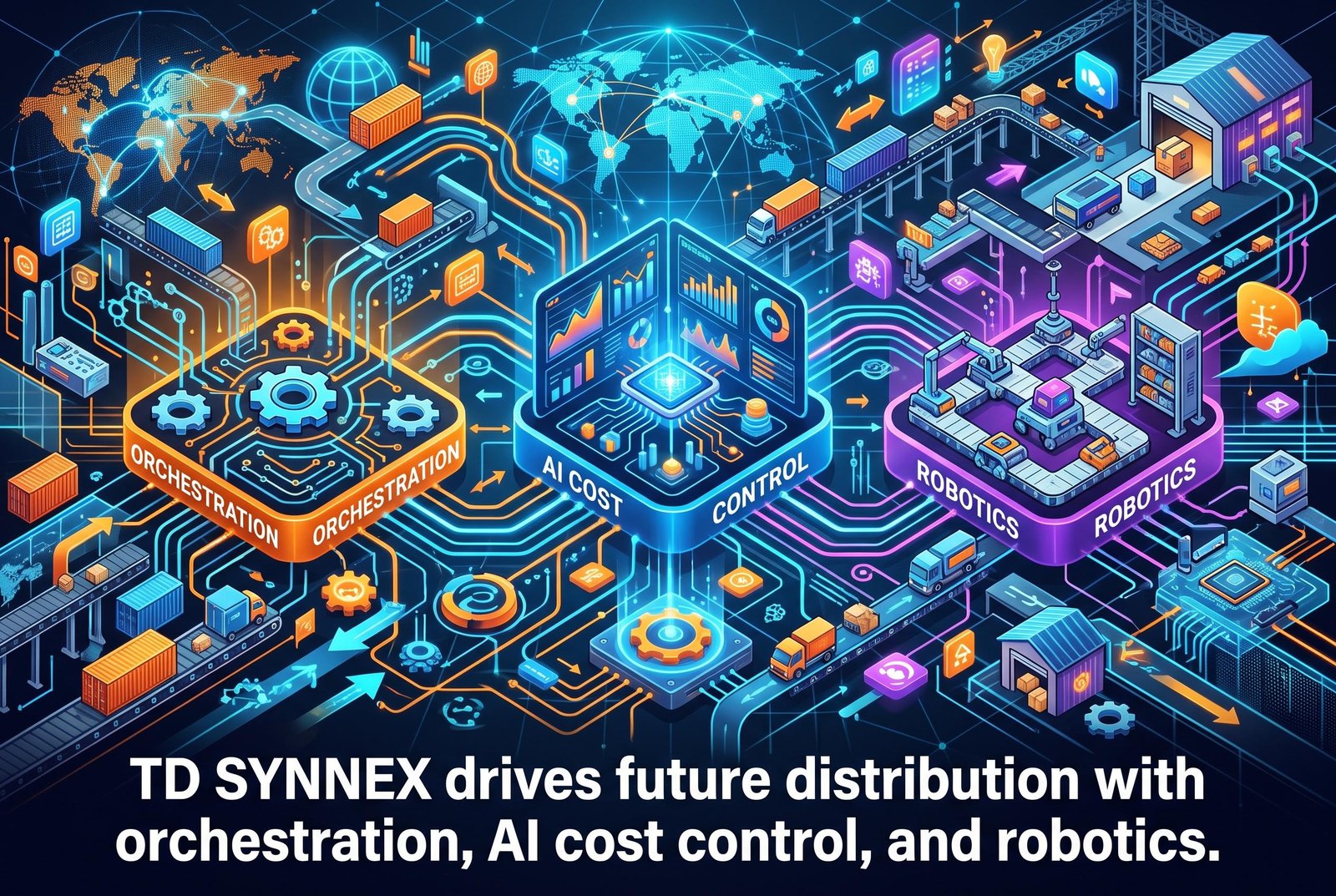
At TD SYNNEX’s recent Inspire conference, North America president Reyna Thompson shared the stage with an unexpected co-presenter: Nylo, a 152-pound robot standing 5ft 7in tall. The pairing was more than a theatrical flourish. It captured the company’s argument that distribution must move beyond simply supplying products and services, and towards a more deliberate role in guiding partners to business results.
That shift matters because the old model of broadline distributio...
Continue Reading This Article
Enjoy this article as well as all of our content, including reports, news, tips and more.

By registering or signing into your SRM Today account, you agree to SRM Today's Terms of Use and consent to the processing of your personal information as described in our Privacy Policy.
“The next evolution of distribution is orchestration,” Thompson told attendees, arguing that the role now involves anticipating demand, removing operational friction and, most importantly, delivering measurable outcomes. The language reflects a broader change in the channel, where end users are less interested in bundles of hardware and software than in the business results those tools can produce.
That emphasis on outcomes runs through TD SYNNEX’s strategy. Robert Abramitis, the company’s North America chief financial officer, told the conference that the competitive advantage is shifting away from those who can simply sell technology and towards those who can translate it into recurring value for customers. In that model, the distributor is not just a middleman but a structured path from product discovery to revenue-generating use cases.
Robotics offered a useful example. IDC has forecast that the global robotics market will exceed $40 billion, and Thompson argued that a robot alone is not a complete solution. A usable deployment also needs compute, sensors, networking, security, integration, services and financing. TD SYNNEX’s pitch is that it can line those pieces up in the right sequence and package them in ways that reduce complexity for partners.
The company is making the same case for artificial intelligence, where enthusiasm has been matched by an equally familiar cost problem. Boston Consulting Group has said AI spending has doubled in the past year, while Pax8’s latest SMB AI report found that 71% of small and mid-sized businesses worldwide are already using AI. Yet the same survey also found that 57% of US SMBs had been surprised by an unexpectedly high AI bill in the last year, and a quarter had faced that problem more than once.
Francisco Criado, TD SYNNEX’s senior vice-president for security, cloud and AI, framed that as a repetition of the cloud spending problem that channel firms have wrestled with for years. The difference, he said, is that AI usage can create cost pressure even faster, and across more environments. Businesses are now managing consumption charges not only in public cloud but also on premises and even on local devices running models directly.
To answer that, TD SYNNEX has introduced FinOps Fusion, a service designed to give partners a single view of spending across cloud, AI and core infrastructure. According to the company, the offering brings together visibility dashboards, recommendations for reducing waste, expert-led enablement, a managed FinOps service and an assessment of AI token consumption. Criado said the aim is to help partners see where money is being spent, understand it in context and build governance around it before the bills get out of hand.
The company is not presenting FinOps Fusion as a standalone product, but as part of a wider effort to tie financial control to the commercial case for AI. TD SYNNEX says the service can help partners cut waste, improve forecasting and support AI projects that might otherwise stall because finance leaders fear runaway consumption costs. That pitch is particularly relevant in a channel where partners are increasingly expected not only to sell AI tools, but to help customers prove they are worthwhile.
TD SYNNEX is also trying to modernise how partners interact with it. Its PartnerFirst platform, which debuted at last year’s Inspire, is being expanded with API connections, a mobile app, an online portal and a new MCP server that allows access through AI chatbots including Claude and ChatGPT. Nate Herz, the company’s regional chief information officer for North America, said usage of the MCP option had exceeded expectations, suggesting partners are moving quickly towards more conversational, AI-enabled access to distributor services.
Another addition, called Agent Bridge, is intended to let less technical partners build and deploy agents for tasks such as quote handling and order tracking. Herz said the tool has already been used for deeper product discovery than the company anticipated, including configurations that resemble early-stage solution design. That indicates not only demand for automation, but a willingness among partners to let AI do more of the front-end thinking.
The balance between digital self-service and human expertise remains central to TD SYNNEX’s message. Chief executive Patrick Zammit said the business needs platforms that work around the clock, but insisted that people will remain essential to the company’s model. Thompson echoed that sentiment, arguing that AI should enhance judgement, trust and creativity rather than replace them.
There are signs that TD SYNNEX is backing that philosophy with continued investment beyond software. In a separate development, the company has agreed to acquire BlueStar, the Kentucky-based distributor focused on technologies including digital identification, point of sale, RFID, mobility, digital signage, IoT and robotics. BlueStar said it would continue to operate with its specialist, partner-first approach, while gaining access to TD SYNNEX’s broader global resources and technology portfolio. Financial terms were not disclosed, and the transaction remains subject to customary approvals.
Taken together, the moves suggest a distributor trying to position itself for a market in which partners increasingly want more than access to stock. They want help identifying opportunities, building solutions, controlling costs and proving value after deployment. TD SYNNEX’s answer is that distribution itself must become a guided process, one that begins with anticipation, moves through integration and ends with outcomes that customers can measure.
That is a more ambitious proposition than the old warehouse-and-credit image of broadline distribution, but it is also a logical response to a channel environment in which technology buyers are asking harder questions about return on investment. As TD SYNNEX sees it, the future belongs to those who can turn complexity into something useful, repeatable and profitable.
Source: Noah Wire Services
Subscribe to Industry Updates
Get the latest news and updates directly to your inbox.

