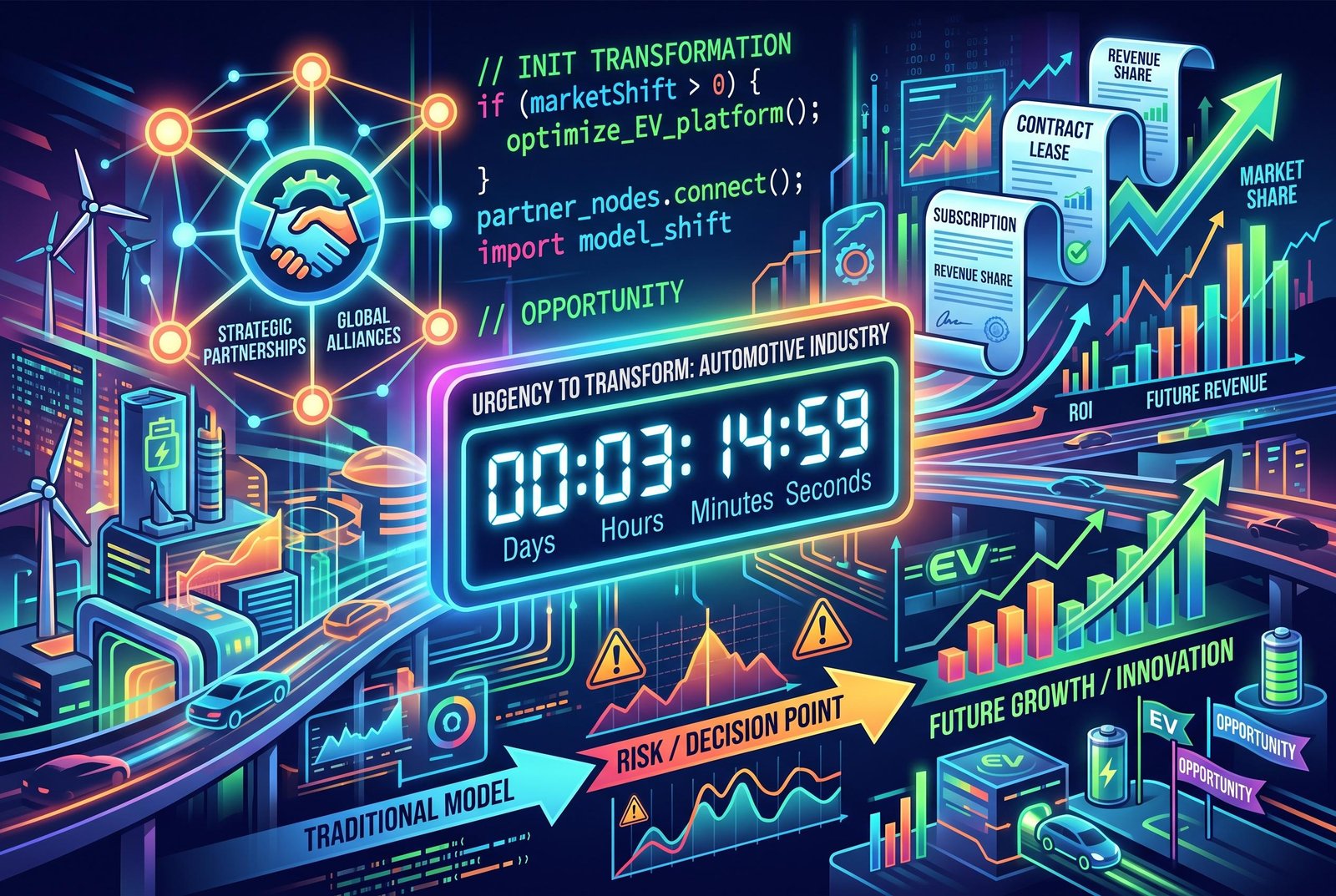
Standing still is rarely as harmless as it appears. In automotive, manufacturing and branding alike, delay tends to look temporary right up until the moment it becomes structural. What begins as hesitation over positioning, software, go-to-market strategy or transformation can harden into lost relevance, weaker margins and missed opportunities that are hard to reverse.
That is the warning at the heart of the final part of CMB Automotive’s series on the “Commercial Identity ...
Continue Reading This Article
Enjoy this article as well as all of our content, including reports, news, tips and more.
By registering or signing into your SRM Today account, you agree to SRM Today's Terms of Use and consent to the processing of your personal information as described in our Privacy Policy.
Gap”: the distance between how a business sees itself and how the market now sees it. The argument is not simply that brands should refresh their messaging. It is that the market can move on while leadership teams are still debating whether change is necessary. By the time the internal consensus arrives, the external opportunity may already have gone elsewhere.
The automotive sector is particularly exposed to that risk because the pace of change is no longer limited to product cycles. Vehicle programmes are increasingly shaped by software, digital ecosystems, supply-chain alliances and new forms of collaboration between OEMs, Tier 1 suppliers and technology partners. TechRadar has argued that software strategy can determine whether a software-defined vehicle succeeds or fails, especially when safety, cybersecurity and reliability are on the line. In that environment, a company that is seen as yesterday’s answer may struggle to find a place in tomorrow’s programme architecture, regardless of its engineering heritage.
This is where brand and commercial strategy meet. A business can have strong capabilities and still lose ground if buyers no longer understand why it matters. Adapt Brand Consultants has warned that brands often drift into parity gradually, until their messaging sounds much the same as everyone else’s and price becomes the main way to close a sale. Once that happens, differentiation weakens, procurement gains leverage and the organisation finds itself competing on terms it did not choose.
The consequences are broader than lost sales. VML has reported that a large majority of automotive leaders fear digital transformation is eroding brand identity, reflecting a real tension inside the sector: companies are modernising their operations and customer touchpoints while trying to preserve what made them distinctive in the first place. If that balance is not managed carefully, transformation can blur the very qualities that made a business credible.
CMB’s article imagines two futures. In one, the business delays action. Five years on, it has been left off key programme shortlists, margins have compressed and its strongest people have gone to organisations that looked more connected to the future. Partnerships form without it, and any eventual sale or investment conversation is shaped by a valuation that reflects stagnation rather than potential. The message is blunt: buyers do not pay for what a company used to be; they pay for where they believe it is going.
That warning also has a manufacturing logic. Trusted Insite has pointed out that downtime is not neutral, because small inefficiencies such as slow changeovers and minor stoppages compound into lost capacity and lost competitiveness. The same principle applies to strategy. Delay is rarely a single dramatic failure; more often it is a series of deferred decisions, each one small enough to justify, but together large enough to reshape the business.
The more dangerous problem is that many leadership teams recognise the gap without closing it. As CMB notes, repositioning a business while continuing to run it is effectively two jobs at once, which is why the work so often gets pushed to the margins. Yet the margins are exactly where it stalls. Boards tend to think in terms of growth, risk and return, but brand work is often presented as a creative exercise rather than a commercial one. When that happens, decisions are postponed, even though postponement may be the costliest response of all.
There is also a governance issue. Different parts of the organisation often see different versions of reality. Engineering may focus on capability, sales on pipeline pressure, regional teams on local competition and the board on valuation. Without a neutral process to reconcile those views, repositioning can turn into compromise, and compromise in a crowded market usually produces something forgettable.
The alternative future, however, is equally clear. If a business defines its position early and in commercial terms, it can become easier to short-list, easier to buy, easier to partner with and harder to replace. Buyers see a reason to pay for value rather than volume. Talent sees a company with direction. Partners see an organisation that is helping shape where the industry is heading. In that version of events, momentum becomes an asset in itself.
That is why the article’s practical advice starts with perception, not polish. Businesses are urged to discover how they are genuinely seen by customers, by lost bids and by the prospects who never responded. They are then advised to agree a single position that the whole leadership team can own, and to frame the case in terms the board will recognise: margin, win rate and valuation. In short, brand has to be treated as a business decision, not an aesthetic one.
CMB says this is the work it does for automotive clients, positioning itself as a specialist brand and commercial marketing agency serving OEMs and Tier 1 suppliers internationally, with teams in the UK and Detroit. The company presents its role as helping leadership teams see the market from the outside, align around a new position and build the case for change in financial terms. It points to GENIVI’s transition to COVESA as an example of that kind of repositioning.
The broader lesson extends beyond one agency or one sector. In industries being reshaped by software, electrification, digital transformation and new partnership models, standing still is not a safe default. It is an active choice with a cost. The businesses that recognise that early may still face disruption, but they are at least more likely to meet it with a position the market understands, rather than one it has already left behind.
Source: Noah Wire Services