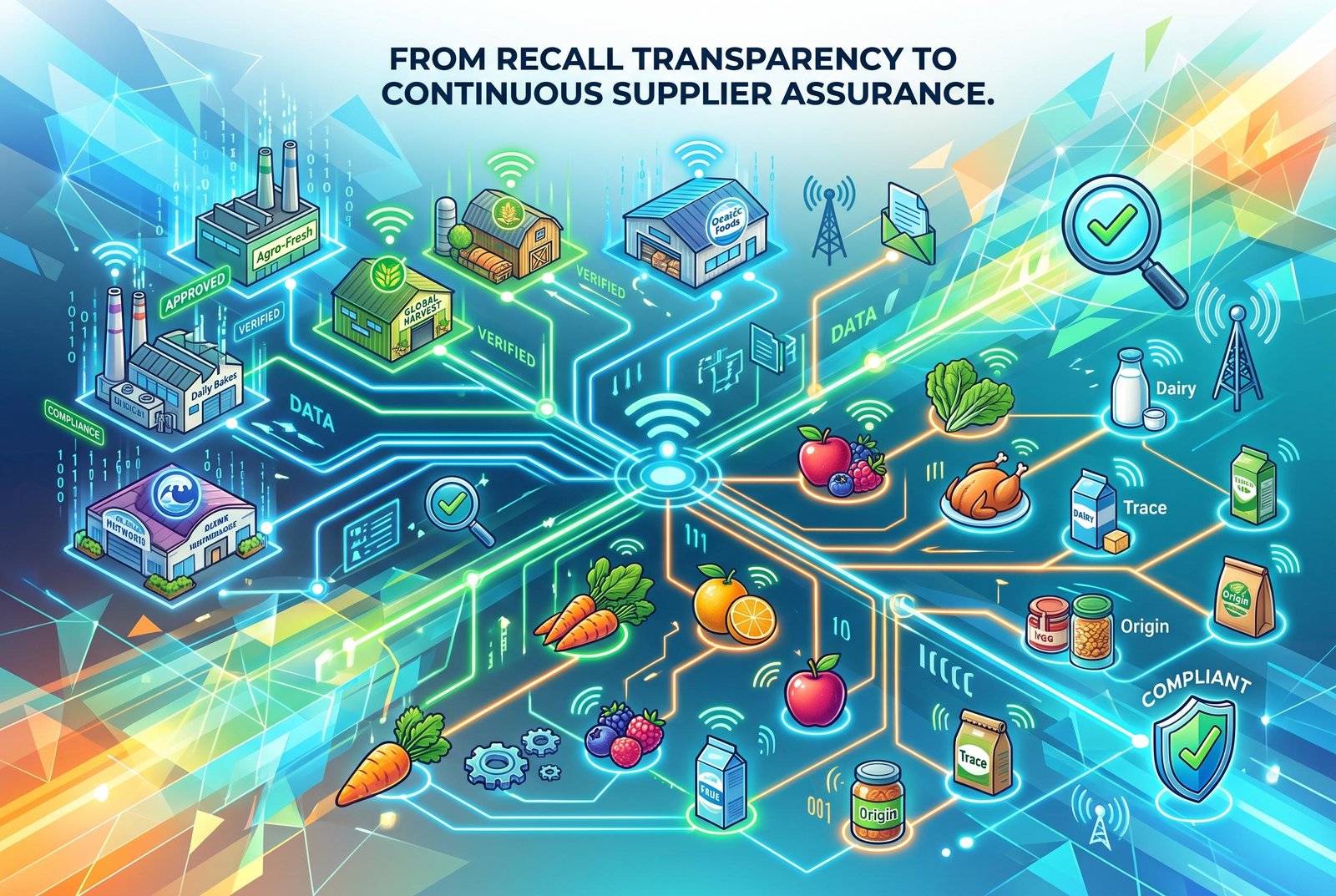
Food brands that want to preserve consumer confidence may need to rethink what transparency actually means. According to a recent GS1 US survey, 94% of U.S. adults are worried about how often food recalls occur, while 66% say they would hesitate to buy the same product or brand again after a recall. That sentiment reflects a broader strain on trust in the food system, especially as high-profile recalls continue to make headlines and raise questions about whether problems are being cau...
Continue Reading This Article
Enjoy this article as well as all of our content, including reports, news, tips and more.
By registering or signing into your SRM Today account, you agree to SRM Today's Terms of Use and consent to the processing of your personal information as described in our Privacy Policy.
ght early enough.
The challenge for brands is that the weakest point in a recall chain is often not on the shop shelf but much earlier, at supplier level. That is why simply publishing information after an incident, or disclosing a supplier list once a problem has already surfaced, rarely repairs the damage. By the time a recall is announced, the reputational harm has usually been done.
A more effective response, industry observers argue, is to treat supplier assurance as an ongoing discipline rather than a periodic compliance exercise. In practice, that means brands need to be able to show not just where a product came from, but whether the businesses behind it are meeting safety, quality, labour and sourcing expectations in real time. The distinction matters: traceability can explain a product’s path after an event, but continuous supplier monitoring is intended to prevent that event from reaching consumers in the first place.
That shift requires more than a stack of certificates and audit files. In many organisations, proof of compliance is scattered across supplier portals, email chains, spreadsheets and PDF attachments, making it difficult to form a clear view of risk at any given moment. In that model, a company may eventually be able to gather the paperwork it needs, but it cannot easily answer the more important question of whether a supplier is compliant today, or likely to remain so in the months ahead.
The pressure is increasing because due diligence now reaches far beyond basic food safety. Brands are being asked to account for worker welfare, human rights and environmental performance as well as product quality and origin. At the same time, suppliers are being pulled in different directions by overlapping standards and multiple customer demands, which can create audit fatigue and, in turn, reduce the reliability of the information brands receive.
That is why continuous monitoring is gaining traction as a practical business tool rather than a public-relations fix. Instead of waiting for an annual review or a crisis, companies can build supplier assurance into day-to-day operations. A more connected system can bring records into one place, reduce duplication and give compliance, sourcing and sustainability teams a shared view of the same data. It can also help companies focus scrutiny where the risk is highest, rather than applying the same level of oversight to every supplier regardless of category, geography or past performance.
When issues do emerge, the value of a structured response becomes clearer still. Standardised corrective-action processes allow brands to assign responsibilities, follow progress and document closure, rather than simply noting that a problem occurred. Over time, those records can reveal patterns: which suppliers respond quickly, which repeatedly fall short and where extra controls are needed. That kind of intelligence can be used to direct sourcing decisions, reduce wasted effort on duplicate audits and accelerate onboarding when a business moves into a new category.
The wider context helps explain why this approach is becoming harder to ignore. GS1 US reported that concern over recalls is now widespread among American consumers, and the willingness to repurchase after a recall has weakened. In that environment, brands that can prove they are actively monitoring suppliers, and not merely reacting after the fact, may be better placed to defend both their products and their reputation.
No supply chain is ever completely free of risk. But companies that make supplier assurance continuous, data-led and integrated across their operations may be able to identify problems earlier, respond more quickly and give shoppers a stronger reason to trust the name on the label.
Source: Noah Wire Services