


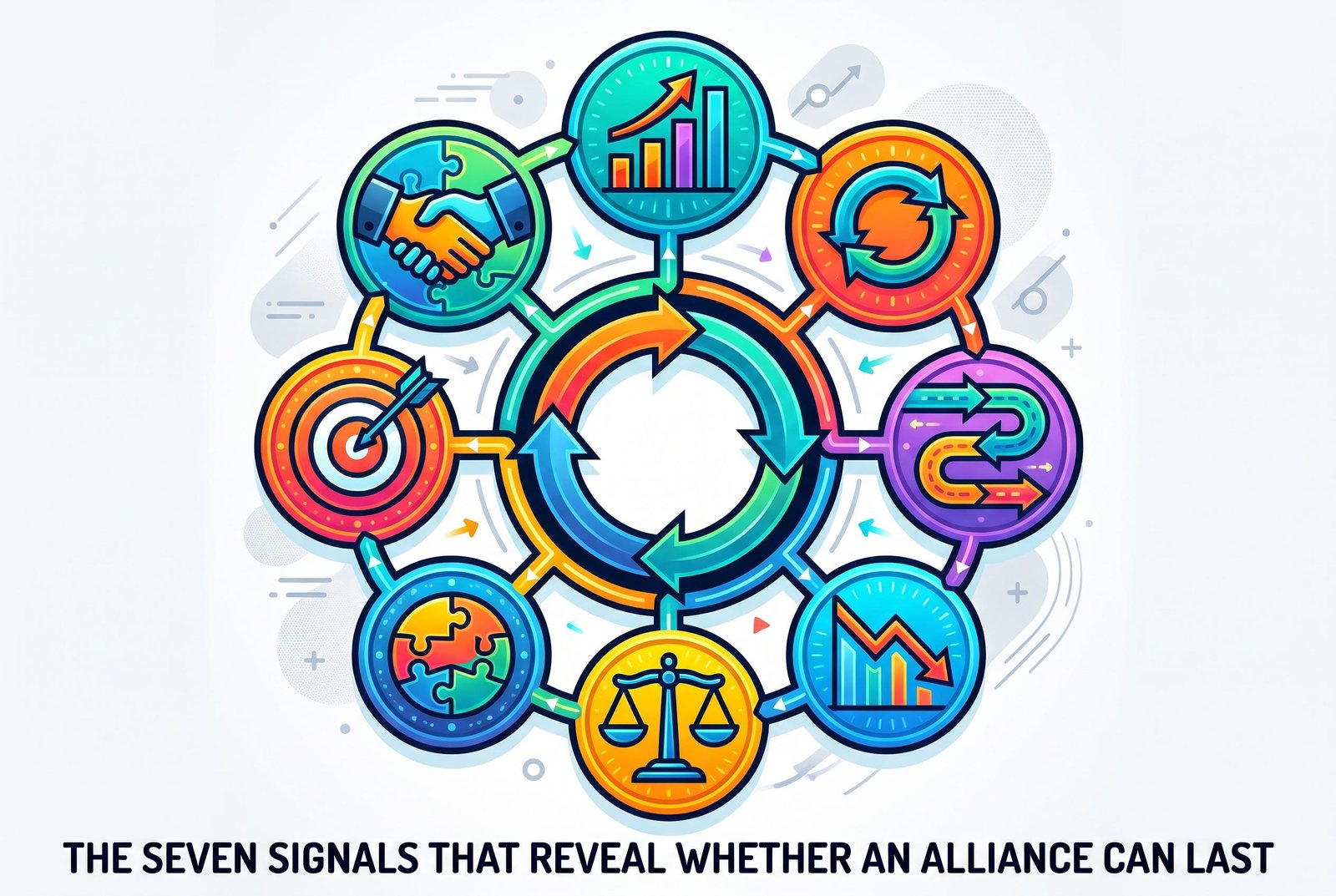
Many alliances fail not because they never generate revenue, but because nobody measures whether that revenue is sustainable. A partnership can look healthy in one quarter and still be quietly weakening through poor governance, rising costs, low trust or unresolved risk. The most useful scorecard, therefore, is not a single growth metric but a balanced view of how the alliance is performing now and whether it can keep performing later.
A disciplined approach begins long before ...
Continue Reading This Article
Enjoy this article as well as all of our content, including reports, news, tips and more.

By registering or signing into your SRM Today account, you agree to SRM Today's Terms of Use and consent to the processing of your personal information as described in our Privacy Policy.
The seven measures that matter most are revenue share, partner retention, joint pipeline, cost control, risk levels, goal progress and trust signals. Taken together, they show whether an alliance is growing, efficient, resilient and still worth extending. No one metric should be allowed to excuse weakness elsewhere: strong sales do not compensate for poor trust, escalating risk or a partner that is gradually disengaging.
The first step is to agree definitions, targets and ownership. A one-page measurement charter should set out what each KPI means, the baseline period, the target, the deadline, the data source, the attribution rule, the review timetable and the escalation trigger. Definitions such as “active partner”, “qualified opportunity” and “at risk” should be written down rather than left to interpretation. The same logic applies to ownership: each KPI should have one named person at each organisation responsible for checking data quality, explaining variances and proposing corrective action.
That clarity is especially important for revenue attribution. Contribution and payout are not the same thing. One measures who helped create value; the other determines how that value is shared contractually. A scorecard should therefore specify whether it uses bookings or recognised revenue and apply that basis consistently across both the numerator and denominator. If a deal is worth $250,000 out of a $2 million revenue base, the alliance’s attributed share is 12.5%. Separately, if the contract specifies a 70/30 split, that determines how the cash benefit is divided, not how contribution is measured.
Once the measurement framework is in place, the alliance can be assessed through the seven KPIs.
Revenue share is often the most visible measure and the one most likely to cause disputes. It shows how much commercial value the alliance is actually delivering, but it should be tracked on a consistent basis and split into sourced, influenced, co-sold and contractually shared revenue where relevant. The right comparison is not just against total revenue, but against a baseline built from the previous two to four quarters and adjusted for partner, product, geography and customer segment. It is also important to keep the commercial picture honest by setting thresholds for margin, retention, cancellations and refunds.
Partner retention is the next test. A partnership may still be alive on paper even if the other side has stopped investing time, energy or leadership attention. Retention should therefore be measured as the proportion of the starting partner cohort that remains active and meets participation requirements. A signature alone is not enough. The point is to understand whether partners still choose to work with the alliance because it is valuable, not merely because the contract remains in force.
Joint pipeline looks forward rather than back. It measures whether shared work is creating future business, ideally by separating sourced and influenced opportunities and recording them in the CRM with the relevant partner, stage, value and evidence of contribution. This is where many alliances discover whether activity is really translating into sales momentum. A healthy pipeline should not just be large; it should move at the right pace, with sensible concentration, acceptable win rates and no over-reliance on a single partner, product or sector.
Cost control asks a less glamorous but vital question: is the alliance generating net value after all the delivery, integration and governance costs are counted? Savings should be measured against a proper baseline and adjusted for changes in volume, service levels, inflation and scope. Gross savings alone can be misleading if the alliance requires heavy support to maintain them. Finance and procurement should validate the numbers, while operations checks whether the apparent efficiency is being achieved at the expense of quality or customer experience.
Risk levels are the guardrails that stop commercial ambition from outrunning reality. Every alliance should maintain a shared risk register covering commercial, operational, legal, regulatory, cyber, financial and continuity exposures. Each risk needs an owner, a mitigation plan, a deadline and a residual rating after controls are applied. Crucially, performance gains should never be used to justify unacceptable exposure. If a critical mitigation is overdue or a major dependency lacks a fallback, escalation should be immediate rather than deferred to the next review.
Goal progress measures whether the alliance is delivering what it promised in the business plan. That may include growth, market entry, innovation, capability building, customer outcomes or cost reduction. The best practice is to set a small number of weighted objectives and track them by milestone completion, on-time delivery and realised benefit. A launch may show that the work has been done, but adoption, savings or retention are what prove the alliance has created value.
Trust signals are the final, and often most revealing, KPI. Partnerships can look efficient on paper while confidence deteriorates behind the scenes. A quarterly survey, supported by meeting records, decision logs, issue registers and delivery data, can reveal whether both sides are keeping promises, sharing information and resolving problems quickly enough. High survey scores should not be allowed to mask missed deadlines or weak sponsorship. If the work is technically on track but the relationship is fraying, the alliance may still be heading for trouble.
The real strength of the model lies not in any single metric, but in how the seven are reviewed together. Monthly meetings should focus on operational matters such as pipeline, cost, risk and milestone progress. Quarterly reviews should look at revenue share, retention, goal progress and trust. That rhythm allows leaders to spot trade-offs early: a pipeline can be improving while trust weakens; costs can be falling while service quality deteriorates; revenue can rise while risk concentration becomes unacceptable.
The aim is not to generate a composite score and stop there. A weighted score may help summarise the picture, but it should never replace the underlying evidence. The scorecard must show each KPI separately, use agreed definitions and make missing data visible rather than smoothing it away. Where a material variance appears, the review should end with a clear problem statement, an owner, a deadline, a success measure and a follow-up date. For joint actions, both sides need named responsibility.
That approach also helps executives decide whether to scale, repair, reshape or exit. An alliance that is growing but carrying too much risk may need redesign rather than expansion. One that is operationally sound but weak in trust may need new governance. One that repeatedly misses its targets may require a formal recovery plan or a controlled exit. What matters is that the decision is based on evidence across the full relationship, not on revenue alone.
For organisations building or renewing strategic partnerships, the lesson is simple. Alliances create lasting value only when they are managed as living systems, not as one-off commercial transactions. The best scorecards make that visible. They keep the focus on growth, yes, but also on whether the partnership is efficient, resilient, trustworthy and still capable of delivering what both sides originally set out to achieve.
Source: Noah Wire Services
Subscribe to Industry Updates
Get the latest news and updates directly to your inbox.

