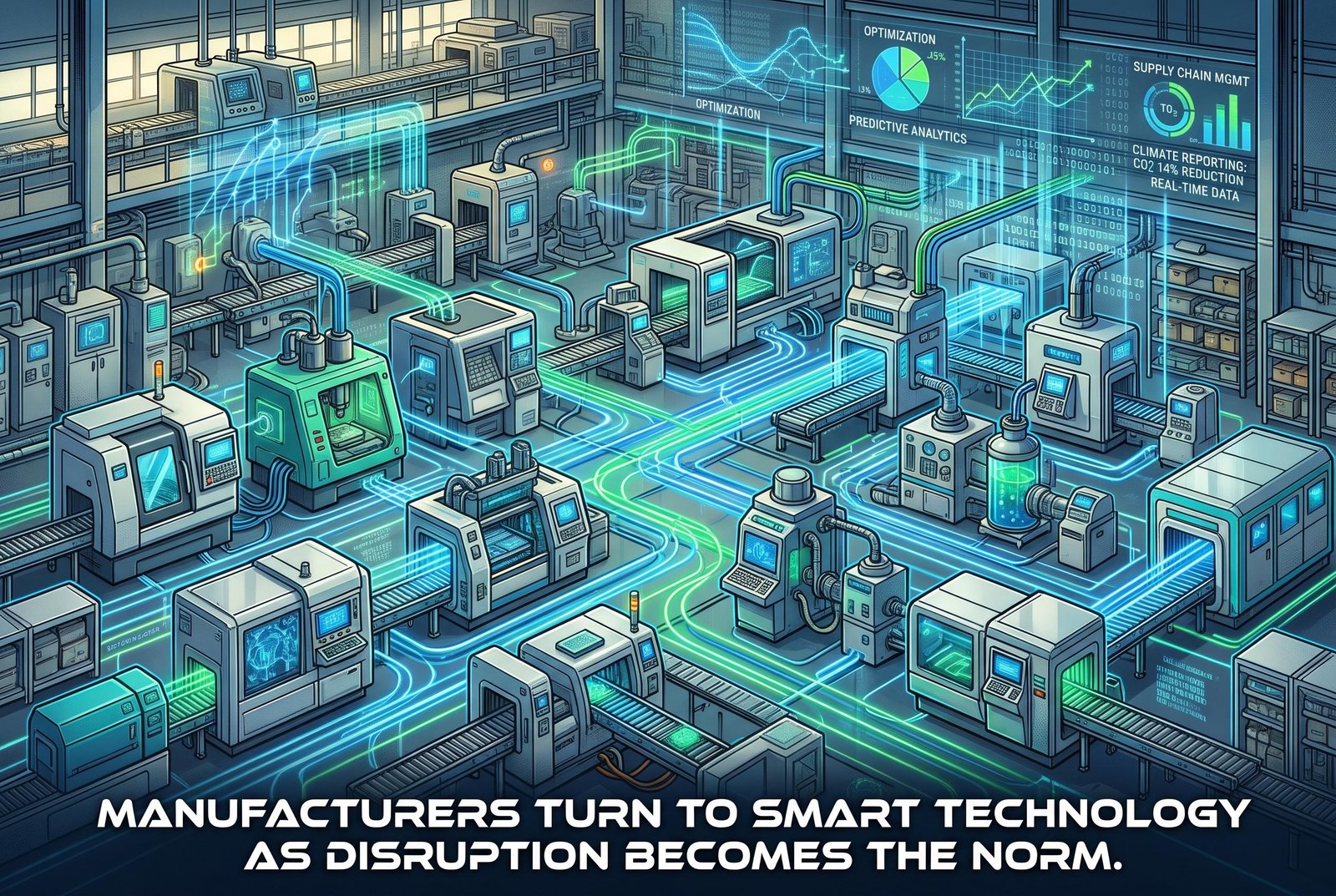
Manufacturing’s digital shift is being propelled by a convergence of familiar pressures and newer technologies that are changing what operational resilience looks like. Rockwell Automation’s 11th Annual State of Smart Manufacturing Report found that 90% of manufacturing leaders now view digital transformation as essential to remaining competitive, and the reasons go well beyond modernisation for its own sake.
One of the clearest drivers is the instability of global supply c...
Continue Reading This Article
Enjoy this article as well as all of our content, including reports, news, tips and more.
By registering or signing into your SRM Today account, you agree to SRM Today's Terms of Use and consent to the processing of your personal information as described in our Privacy Policy.
hains. Disruption has become a baseline condition rather than an occasional shock. RapidRatings’ 2026 Annual Risk Report found that 82% of enterprises experienced a material supplier disruption in the previous 12 months, underscoring how exposed manufacturers remain to tariffs, cost inflation and lingering volatility. Research published in ScienceDirect adds another layer to that picture: as customers become more digital, suppliers can face higher cash-flow volatility because of digital spillovers and a mismatch between supply and demand, with smaller and less stable suppliers often feeling the strain most sharply. At the same time, other academic evidence suggests that technologies such as artificial intelligence, cloud computing, blockchain, the internet of things and augmented reality can reduce supply chain volatility by improving transparency, responsiveness and coordination.
That tension helps explain why manufacturers are increasingly turning to end-to-end visibility tools, predictive analytics and scenario planning. These systems do not eliminate disruption, but they can give firms earlier warning and a faster way to reconfigure sourcing and production when conditions change.
The labour market is another major pressure point. The Manufacturing Institute and Deloitte have projected that more than 1.9 million of the 3.8 million manufacturing roles needed by 2033 could go unfilled, a shortfall that reflects both an ageing workforce and persistent difficulty attracting new talent. CBRE reported that manufacturers were contending with roughly 49,000 vacancies in April 2025, while nearly all manufacturers it surveyed said they were struggling to find and keep skilled workers. The gap is no longer limited to traditional shop-floor expertise; demand is growing for digital fluency as factories adopt more connected systems.
That is why automation, digital training and augmented-reality guidance are becoming central to workforce strategy. They can reduce the burden of repetitive tasks, accelerate onboarding and preserve specialist know-how as experienced employees retire. Research on manufacturing skills has also pointed to substantial shortages in data science capability and domain knowledge, strengthening the case for targeted upskilling and reskilling rather than relying solely on external recruitment.
Downtime remains an equally costly problem. Siemens has estimated that unplanned stoppages cost the world’s 500 largest companies about $1.4 trillion a year, or 11% of revenue. In practical terms, that makes predictive maintenance and real-time production monitoring more than efficiency projects: they are margin-protection tools. Sensors connected to industrial equipment can flag anomalies before they become failures, while live production data can help plant managers identify bottlenecks and rebalance workflows before output is lost.
Sustainability and compliance are also reshaping the digital agenda. The National Association of Manufacturers said in its fourth-quarter 2025 outlook survey that 38.2% of manufacturers were already subject to new laws requiring disclosure of emissions and climate risks. Meeting those obligations requires more granular data on energy use, waste and material flows, but the same information can reveal opportunities to cut costs and improve efficiency.
The opportunity side of the equation is drawing as much attention as the risk side. Deloitte’s 2026 Manufacturing Industry Outlook said 80% of manufacturing executives plan to devote at least 20% of their improvement budgets to smart manufacturing. That points to a sector moving beyond isolated automation projects towards broader digital reinvention.
The next phase is likely to be shaped by agentic artificial intelligence, which Deloitte expects to gain traction over the coming years. In manufacturing settings, AI agents could help identify alternative suppliers during disruptions, capture operational knowledge from retiring workers and automate shift handover reports. For an industry under pressure from shortages, volatility and stricter reporting demands, the appeal is obvious: digital transformation is becoming less a strategic option than a requirement for continuity.
Source: Noah Wire Services