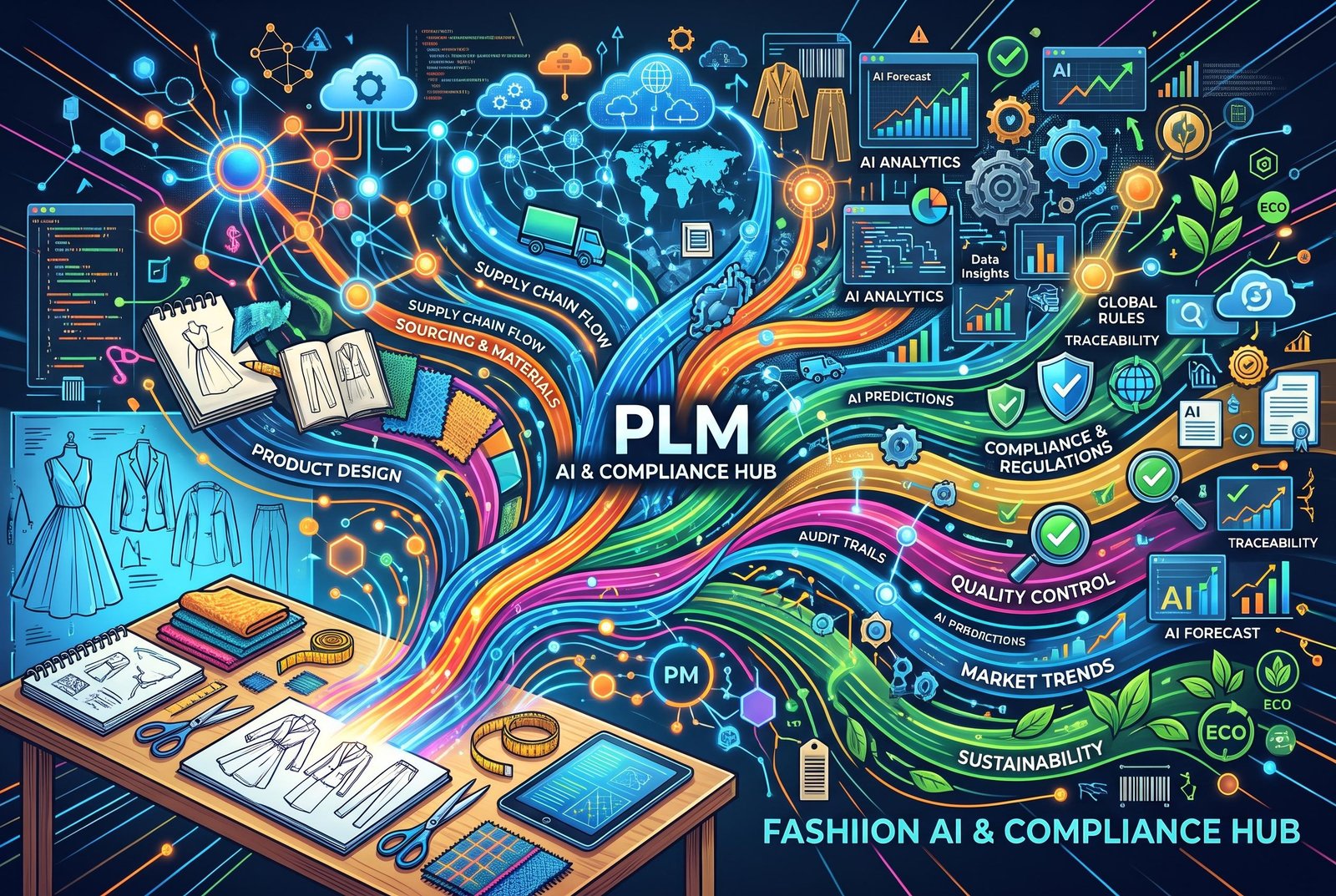
Product lifecycle management has long been one of fashion’s most established digital systems, but the category is far from finished. In fact, according to The Interline’s latest Solution Spotlight, PLM is enjoying renewed relevance as brands confront margin pressure, regulatory change and the rapid spread of AI across the product journey.
That may sound counter-intuitive for software that, in many companies, has been in place for years. Yet PLM remains the central record of...
Continue Reading This Article
Enjoy this article as well as all of our content, including reports, news, tips and more.
By registering or signing into your SRM Today account, you agree to SRM Today's Terms of Use and consent to the processing of your personal information as described in our Privacy Policy.
how a product is conceived, specified, developed and moved towards market. It is where style data, bills of materials, technical details, materials, sizes, supplier information, quality records and sampling workflows are supposed to come together in one governed environment. In practice, the system has become so embedded in the operating model of major fashion businesses that it is often treated less as a technology choice than as a prerequisite for how the business functions.
The Interline argues that this maturity is precisely what makes the category so important now. Fashion is operating in a period marked by geopolitical disruption, unstable commodity costs and shifting consumer demand. In that environment, the ability to work from a single, reliable product record is no longer just an efficiency measure; it is a commercial necessity. The publication’s research with Fashion By Informa found that profitability, risk reduction and the ability to seize margin opportunities were among the top priorities for industry professionals, all of which depend on accurate and connected product data.
Vendors are responding by pushing PLM far beyond its traditional remit. Bamboo Rose positions its platform as a multi-enterprise foundation that supports planning, merchandising, design and development, and says more than $1tn of retail goods is managed annually through its system. The company frames PLM as a collaborative backbone for brands and retailers working across several categories. Centric Software, meanwhile, says more than 13,000 brands use its platform as the starting point for wider enterprise ambitions, presenting its offering as a route from concept to commerce. DeSL uses similar language, describing PLM as a way to move from concept to shelf while replacing spreadsheets, emails and disconnected tools with one shared working environment.
This broader footprint matters because product decisions no longer sit neatly inside the design or development function. Live product data now influences assortment building, pricing, channel allocation, compliance checks and even downstream content creation. As a result, PLM is increasingly being treated as the connective layer between creative work and commercial execution. Some vendors have built outwards from that core, extending into visual collaboration tools, product information management, supplier management and, increasingly, AI-driven workflows.
The arrival of artificial intelligence has sharpened interest in that evolution. While there is still debate over where AI adds the greatest value in fashion software, The Interline suggests PLM is one of the clearest candidates for augmentation. The reason is simple: the system already contains the information most businesses need to interrogate, compare and act upon. Natural-language tools, APIs and agentic systems can, in principle, make that data easier to use and more widely accessible across the enterprise. The publication argues that if there is one place for a copilot to sit, it is alongside the mission-critical record of product data itself.
DeSL has moved quickly in that direction. The company recently launched a Digital Product Passport capability built on top of its PLM platform, allowing brands to generate and publish passports directly from product, supplier, quality and certification data already held in the system. According to DeSL, the solution draws together specifications, materials, supplier details, declarations, inspections and certifications, then makes the resulting passport available through QR codes, portals, retail systems and open APIs. The company also says it can present different views of the same governed record depending on the audience, while keeping the underlying data consistent.
That development reflects a wider shift in the market. Digital Product Passport rules, along with mounting pressure to document provenance, materials and compliance status more clearly, are giving new weight to systems that can serve as a trustworthy source of product information. In that context, PLM is being recast not merely as an internal workflow tool, but as the operational base from which transparency obligations can be met and communicated.
The Interline’s 2026 AI survey offers another clue to where the category may be heading. Early findings suggest fashion professionals see the strongest current AI applications at the start and end of the product journey, particularly in creative inspiration, design, content creation and marketing. The middle of the process, however, remains deeply dependent on structured data about suppliers, costs, calendars, certificates and risks. That is the space PLM occupies. A well-connected assistant that can identify, for example, styles using tariff-exposed materials and propose certified alternatives could have immediate commercial value, not as a futuristic novelty but as a practical extension of existing workflows.
Advisory firms are also positioning themselves around this shift. Kalypso, for instance, continues to frame PLM as the backbone of broader digital transformation, stretching from product creation into production and beyond. That perspective underlines a broader truth in the market: the most interesting opportunity in PLM is no longer whether the category exists, but how much more it can do when connected to adjacent systems and intelligent tools.
For brands and retailers, then, the real question is less whether PLM belongs in the stack and more which platform can support the next stage of transformation. The answer will depend on how well vendors can combine deep product records, cross-functional collaboration and the flexibility to support new regulatory and AI-driven demands. What is clear is that PLM, despite its long history, still has room to evolve.
Source: Noah Wire Services