Pharma research and development rarely becomes fragmented by design. More often, it happens gradually, as teams buy specialist tools to solve immediate problems and those tools begin to accumulate into a patchwork of separate systems.
A study may start with electronic data capture for case report forms, then add an electronic trial master file for regulatory records and randomisation and trial supply management for treatment assignment. As protocols become more complex, eConsen...
Continue Reading This Article
Enjoy this article as well as all of our content, including reports, news, tips and more.

By registering or signing into your SRM Today account, you agree to SRM Today's Terms of Use and consent to the processing of your personal information as described in our Privacy Policy.
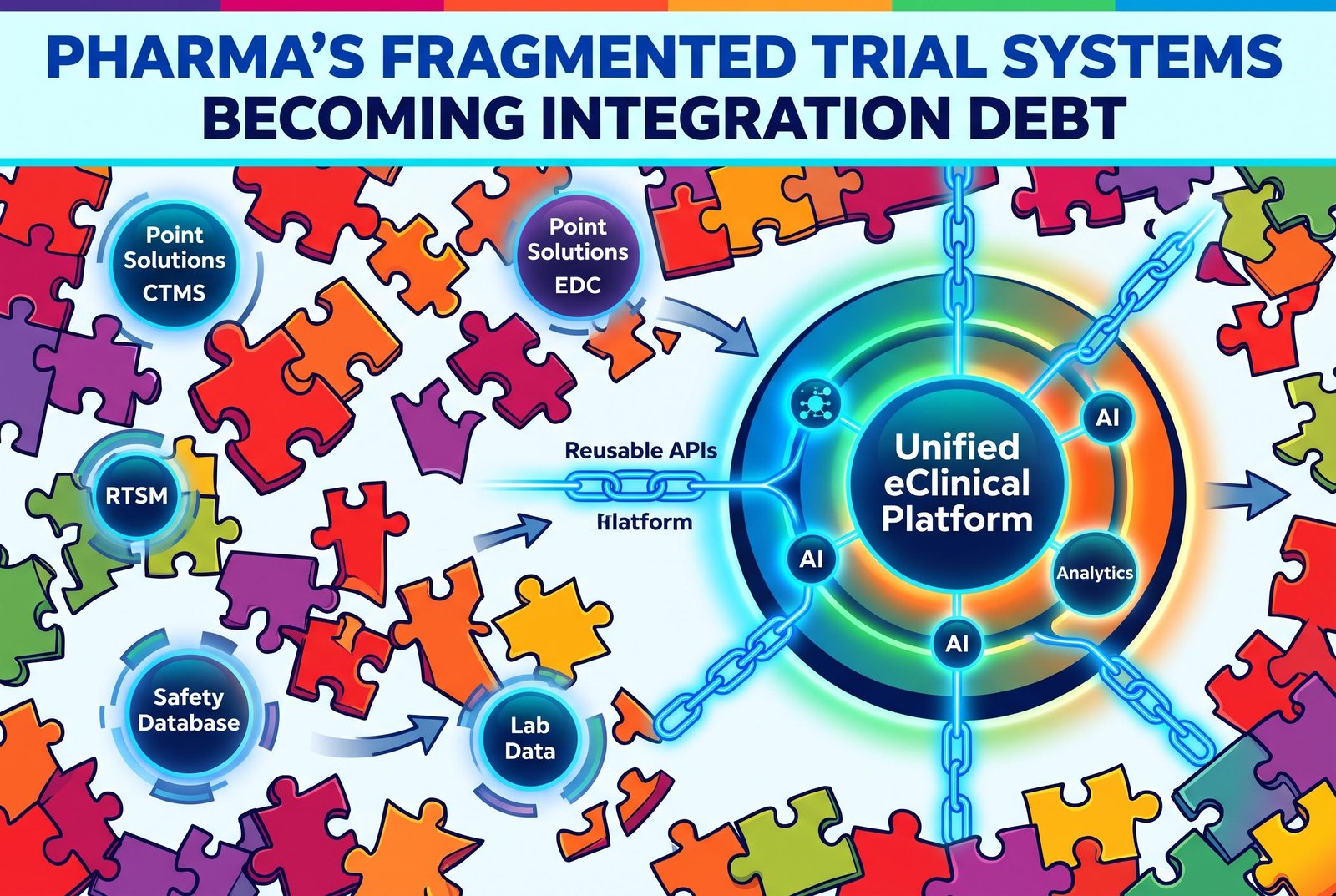
That slow accumulation is increasingly being described as integration debt. The phrase has been used in recent coverage of biopharma lab digitisation to describe the hidden cost of layering new tools on top of an incomplete data architecture. The result is not simply more software, but more interfaces, more mapping work, more validation and more opportunities for disruption whenever one component changes.
In clinical development, that burden can spread quickly. Enrollment records may need to stay aligned with randomisation systems. Consent data may have to flow into downstream processes. Laboratory, imaging and EHR data often require transformation before they can be used in study workflows. None of these links is unusual on its own. The problem is the chain of dependencies they create across the full trial environment.
Every new connection introduces another point that must be monitored, tested and maintained. A protocol amendment may affect several applications at once. A new imaging vendor can trigger additional integration work. A software release in one module may force checks across others. Clinical data teams may then have to reconcile discrepancies, preserve traceability and keep audit trails intact across different platforms, vendors and ownership models.
That is why the industry is increasingly talking about unified eClinical platforms rather than a string of point solutions. According to OpenClinica, a genuinely unified platform is not just a set of tools behind a single login. It is a system in which modules such as EDC, eConsent, eCOA, recruitment and reporting share a common workflow and data flow, reducing the need for manual transfer and repeated reconciliation. In other words, the value lies not in the appearance of integration, but in the way the underlying environment actually operates.
The distinction matters. A portal can make separate applications look connected while leaving their data structures, workflow logic and integration rules untouched. By contrast, a truly unified environment places EDC, eConsent, RTSM, eTMF, medical coding, imaging, wearables, EHR-to-EDC links and televisits within a shared architecture. The practical effect is that clinical context, permissions, metadata and audit information travel with the data rather than being reconstructed at every boundary.
That also changes how individual tools should be assessed. EDC is no longer just about data entry. It must work in concert with consent status, regulatory documentation, site readiness and downstream review processes. RTSM cannot be considered in isolation from protocol logic or blinding requirements. eCOA and ePRO responses need to be reconciled with case report data without creating fresh layers of operational friction. In a connected environment, each module depends on the others more directly, but it also benefits from that shared foundation.
A shared clinical data model is central to that approach. Two systems can exchange data perfectly well and still disagree on what that information means unless the structure underneath is consistent. If subject status is defined one way in EDC and another in RTSM, teams spend time translating between systems rather than working from a common understanding. A unified model reduces that drift and strengthens lineage, traceability and data harmonisation across the study lifecycle.
That matters particularly for clinical data management. Collection, cleaning, validation, review, analysis and downstream use all become easier to govern when they rest on the same underlying data structure. It also supports the standards already embedded in clinical research, including CDISC’s Operational Data Model, CDASH, SDTM and Define-XML, while providing a more direct route into ADaM datasets used for statistical analysis.
The appeal of unity is not only operational but also strategic. As The Medicine Maker has argued in its reporting on integration debt, fragmented digital estates can undermine productivity and weaken the effectiveness of AI because they force teams to spend more time managing gaps than generating insight. That warning applies strongly in R&D, where the value of advanced analytics depends on clean data, clear context and reliable workflows.
This is one reason native AI is drawing attention inside eClinical environments. The opportunity is not to bolt on a separate AI layer, but to embed intelligence within the clinical data and workflow context already available to users. In a unified system, authorised teams can query study information using natural language while remaining within role-based permissions and blinding controls. They can also use AI-generated synthetic data to support study build and testing, creating realistic records for eCRF scenarios, edit checks and conditional logic before formal validation begins.
AI-assisted CRF validation is another likely use case. During build, it can help identify configuration issues or omissions earlier, reducing the amount of repetitive checking needed before user acceptance testing. The point is not to replace clinical judgement or formal oversight. It is to move useful intelligence closer to the work itself, while keeping governance and validation intact.
The benefits of unification extend beyond the internal platform. Clinical research still depends on outside systems, from hospital EHRs and laboratories to imaging providers, payment systems and CRO environments. The challenge is to connect them without creating a bespoke integration project for every study or site. That is where API-led integration becomes important.
Reusable APIs can create repeatable pathways between the eClinical platform and external systems, reducing manual transfers, duplicate entry and one-off development work. If a lab connection or payment workflow has already been built and validated, future studies can often reuse the same pattern with only risk-based verification of the study-specific configuration. A new vendor or site then becomes a manageable change-control exercise rather than a fresh development cycle.
At scale, that difference is significant. One custom interface may be tolerable. Dozens of variations built over time by different teams are what turn integration into a hidden drain on budgets and delivery schedules. Reusable connectivity turns that burden into infrastructure instead of recurring project work.
Study setup itself is another area where a unified environment can improve efficiency. Configuration, edit checks, validation rules, test data preparation and user acceptance testing are all repeated across studies. If they are managed manually every time, the effort multiplies quickly. Automation can standardise those tasks, while reusable study components make it easier to launch new studies without rebuilding the same processes from scratch.
Still, technology alone does not solve the problem. Implementation expertise matters just as much as platform choice. A system can be technically sound and still fail in practice if it is configured by people who do not understand the operational realities of clinical research. A trial build that looks correct on paper may still miss protocol-specific requirements. An RTSM setup can be compliant with the specification yet still fail to reflect the intended blinding model. Those problems often appear only once a study is live, when the cost of correction is much higher.
That is why organisations often need implementation support that combines clinical knowledge with digital engineering, data management and validation experience. For smaller and mid-sized pharma and biotech companies in particular, that expertise does not always need to sit permanently in-house. Functional service provision, managed services and project-based support can all provide access to specialised capability without forcing every function to be built internally.
Seen that way, the argument for a unified eClinical ecosystem is not simply about convenience. It is about reducing hidden complexity, preserving data integrity, making change easier to absorb and creating a foundation that can support both current trial operations and future innovation. In a sector where every new study adds pressure to deliver faster and with greater precision, the question is no longer whether another point solution can solve a local problem. It is whether the broader R&D environment can keep absorbing more fragments without becoming unmanageable.
According to SRM Tech, the answer lies in bringing together eClinical tools, clinical data management, integration, native AI and automation within a single modernisation strategy. The company says that approach can help pharma and biotech organisations move beyond fragmented systems and towards a connected environment that is better suited to scaling clinical programmes over time.
Source: Noah Wire Services
Subscribe to Industry Updates
Get the latest news and updates directly to your inbox.