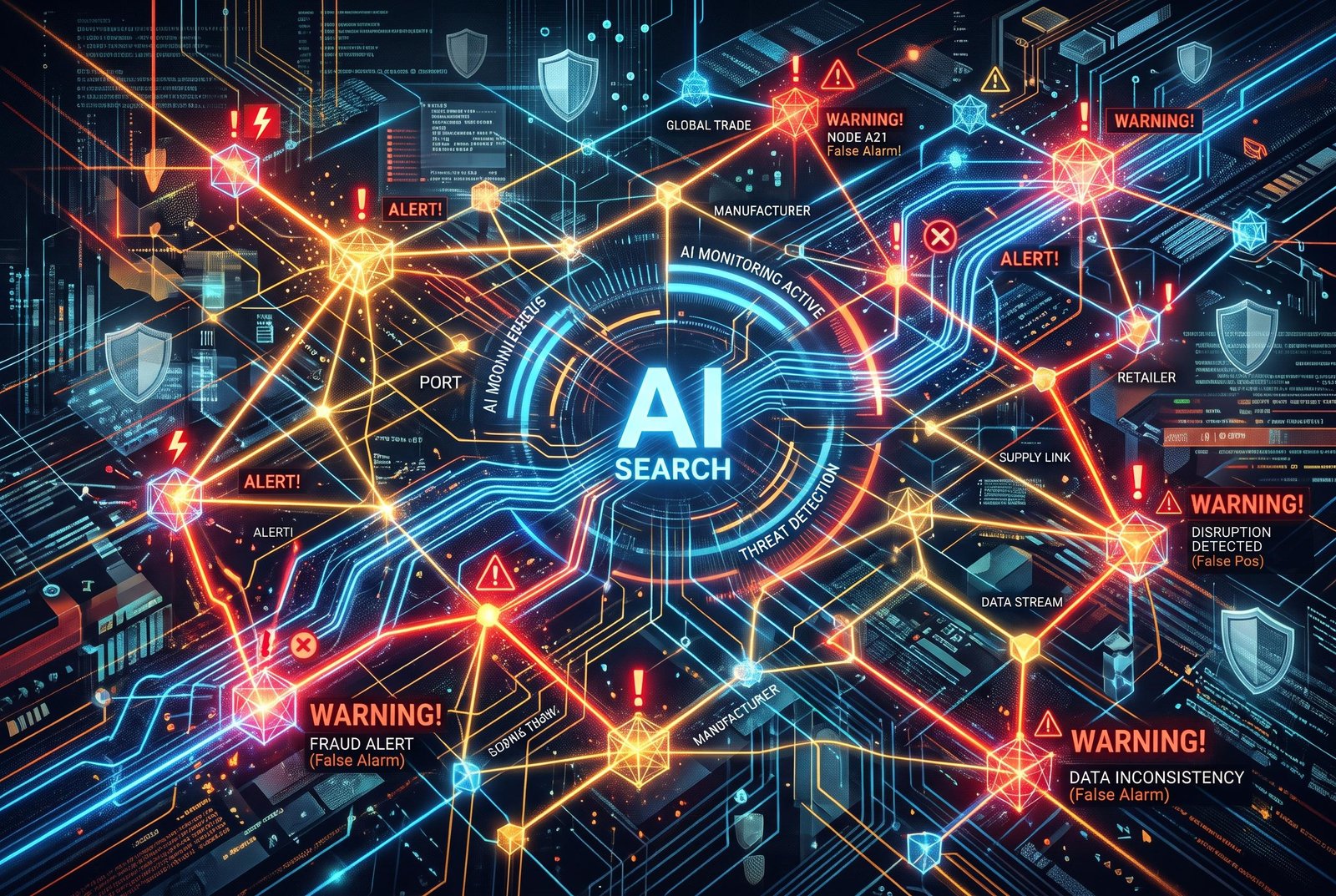
Artificial intelligence is becoming an increasingly prominent tool in supply chain oversight, but industry leaders remain divided over how far it should be trusted to watch for disruption, fraud and data integrity failures.
In the latest InformationWeek podcast, Derek Bush, chief information security officer at Infor, Ryan Davis, CISO at New Charter Technologies, and Art Figueroa, chief operating officer at semiconductor distributor Smith & Associates, examined where AI can...
Continue Reading This Article
Enjoy this article as well as all of our content, including reports, news, tips and more.
By registering or signing into your SRM Today account, you agree to SRM Today's Terms of Use and consent to the processing of your personal information as described in our Privacy Policy.
add value in monitoring supply chains and where it still falls short. Their discussion reflected a broader tension across the industry: the technology can surface problems faster and at greater scale than human teams, yet it can also generate costly noise, false alarms and new attack surfaces.
That debate matters because supply chain failures rarely remain isolated for long. A small error in a supplier’s data, a missed shipment or a fraudulent transaction can quickly ripple across procurement, production and distribution. As companies push for more automation, AI is increasingly being used to spot anomalies, track risk signals and identify emerging threats before they cause wider disruption.
Across logistics and procurement, organisations are already experimenting with systems that can learn from historical patterns and adapt to changing conditions. ComputerWeekly has reported on AI tools that improve supply chain visibility, predict disruption and, in some cases, make operational decisions more autonomously. CH Robinson, for example, has developed systems that continuously learn from network activity in order to manage complex logistics flows. But the same reporting also notes persistent concerns around data governance, accuracy and security, all of which become more important as more decisions are handed to machines.
Those concerns are especially acute in sectors where compliance and patient safety are at stake. In healthcare, AI-driven monitoring is being used to improve forecasting, reduce waste and detect cyber threats or suspicious vendor activity, according to Censinet. The company argues that hybrid monitoring systems can strengthen oversight by combining machine analysis with human review, particularly when organisations must meet regulatory obligations under regimes such as HIPAA and FDA requirements.
The appeal of AI is clear enough. It can process large volumes of operational data, flag outliers and help teams see patterns that would otherwise be buried in spreadsheets, emails and transaction logs. It can also be used to examine unstructured information, such as news reports or supplier communications, which may provide early warning of disruption. A recent academic paper on agentic AI for supply chain resilience describes a framework in which specialised models scan incoming signals, map them to multi-tier supplier networks and recommend mitigation steps. The study says such systems can respond quickly and with high accuracy, underlining the potential for AI to act as an early-warning layer rather than merely a reporting tool.
Yet the same automation that makes AI attractive also complicates its deployment. The new paper on AI software supply chains highlights weaknesses in verifiability, version control, observability and traceability across the systems that power modern AI. Those shortcomings matter because a model is only as reliable as the data, components and dependencies that support it. If those layers are poorly managed, AI can amplify errors as easily as it can detect them.
That is why many executives are reluctant to treat AI as a replacement for human judgement. The technology may be able to reduce blind spots, but it can also introduce overzealous alerts, expensive infrastructure demands and the risk that teams will become over-reliant on automated recommendations. In practice, the most effective use of AI may be as a force multiplier: a means of scanning vast networks for weak signals while humans decide which anomalies truly warrant intervention.
The podcast’s discussion suggests that this balance is still being negotiated. Companies want faster detection, better prediction and stronger defences against both cyber and physical disruption. At the same time, they must decide where AI can be trusted, where it needs supervision and where its costs outweigh its benefits. For now, the best watchdog for the supply chain may be AI working alongside experienced operators rather than standing alone.
Source: Noah Wire Services