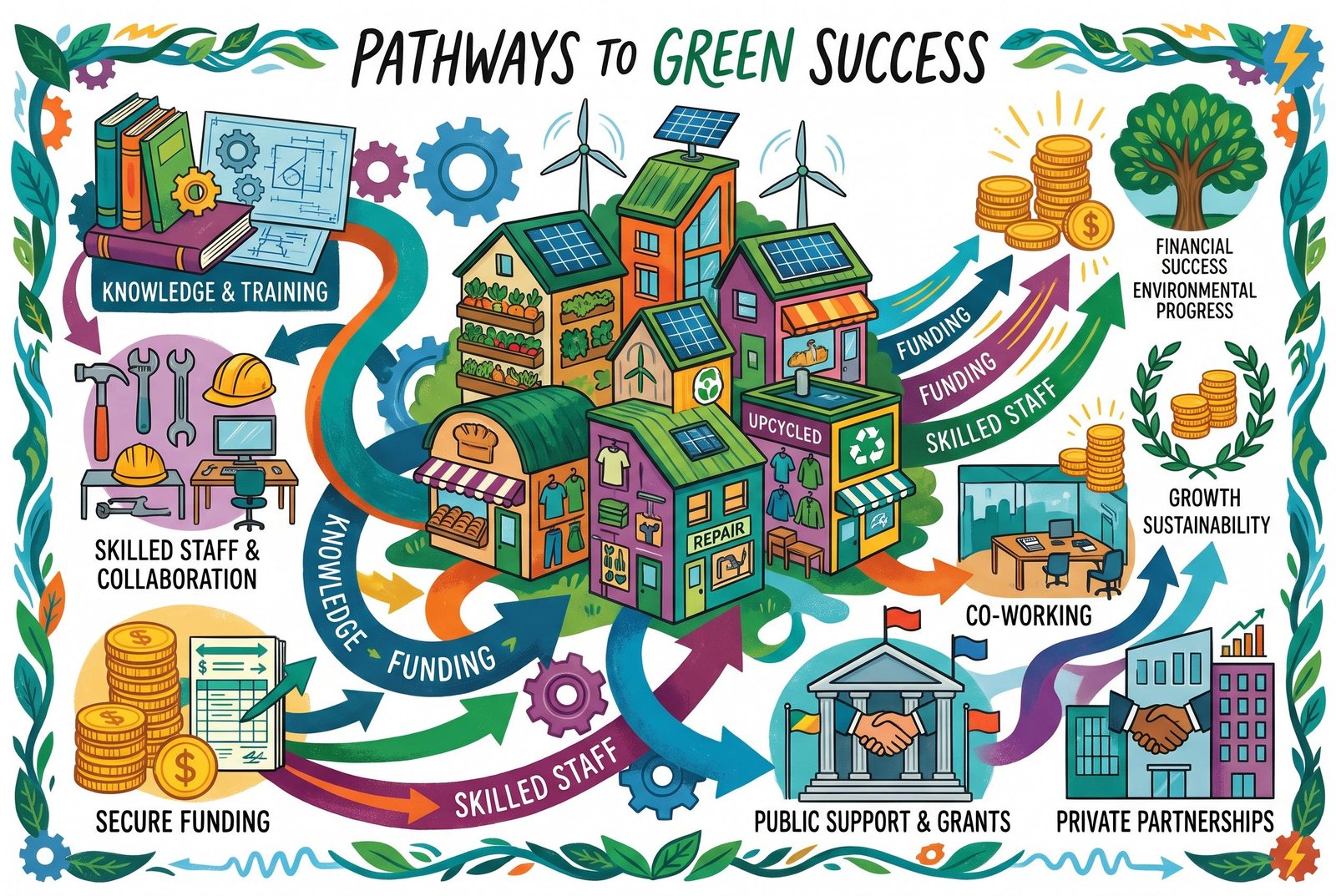
A study published in Business Strategy and the Environment argues that green small and medium-sized enterprises do not follow a single route to success. Instead, the research suggests that different bundles of resources and capabilities can support either stronger financial performance or more active environmental behaviour, depending on how firms assemble what they have at hand.
Using the dynamic capabilities view alongside qualitative comparative analysis, the author...
Continue Reading This Article
Enjoy this article as well as all of our content, including reports, news, tips and more.
By registering or signing into your SRM Today account, you agree to SRM Today's Terms of Use and consent to the processing of your personal information as described in our Privacy Policy.
s examine how green SMEs in sustainability-challenged economies combine internal and external assets to pursue both commercial and environmental goals. Their analysis identifies four configurations associated with high financial performance: technical knowledge paired with private support, technical knowledge paired with public support, green workers combined with financial resources, and a more comprehensive mix of resources across the firm. A separate set of three configurations is linked to stronger environmental action, including pathways in which energy and waste routines are supported by both public and private actors even when internal resources are limited.
The findings add to a growing body of research showing that sustainability in smaller firms is rarely the result of one ingredient alone. Earlier work on green practice in SMEs has similarly found that organisational culture, enabling conditions and expected consequences can combine in different ways to produce green activity, while the specific practices involved vary from one company to another. That perspective fits with wider sustainability research suggesting that firms often progress through multiple pathways rather than a single best-practice model.
The study also sits within a broader debate about how firms organise resources for environmental improvement. Recent scholarship on green resource orchestration has argued that businesses need to structure, bundle and deploy assets in ways that create both economic and environmental value, yet the field has often lacked consistency in how those ideas are applied. By focusing on combinations rather than isolated variables, the new research helps translate that conceptual work into a more practical framework for SME strategy.
Its emphasis on support from both public and private sources is particularly relevant. OECD analysis has underlined that smaller businesses often need tailored help with finance, information, skills and networks if they are to take part in the green transition. The study’s results reinforce that point, suggesting that policy can matter not simply by providing subsidy, but by helping firms access the right mix of resources for their specific circumstances. In some cases, public support appears to work best when it complements private assistance; in others, it may matter less than the presence of technical know-how or suitably trained staff.
The research also builds on dynamic capabilities theory, which treats strategic renewal as a matter of learning, reconfiguring and applying resources in changing environments. Foundational work in the field has argued that capabilities are not fixed assets but identifiable processes that allow firms to adapt as markets and competitive conditions shift. In the context of green SMEs, the new study suggests that these processes can support two related but distinct outcomes: financial resilience and environmental action.
That distinction matters for managers. A firm may be able to improve profits without becoming especially environmentally proactive, or it may strengthen its ecological performance without immediately maximising financial returns. The study indicates that the most effective route depends on the firm’s starting point, the resources already embedded in its operations, and the external support available to it.
For policymakers, the message is equally clear. If the aim is to widen SME participation in the sustainability transition, broad-brush interventions are unlikely to be enough. The evidence points instead towards more targeted combinations of assistance: finance where capital is missing, skills where knowledge is thin, and institutional backing where firms need help to turn intent into action. In that sense, the article adds a useful empirical layer to the argument that greening smaller businesses is less about one universal formula than about matching the right support to the right firm at the right time.
Source: Noah Wire Services