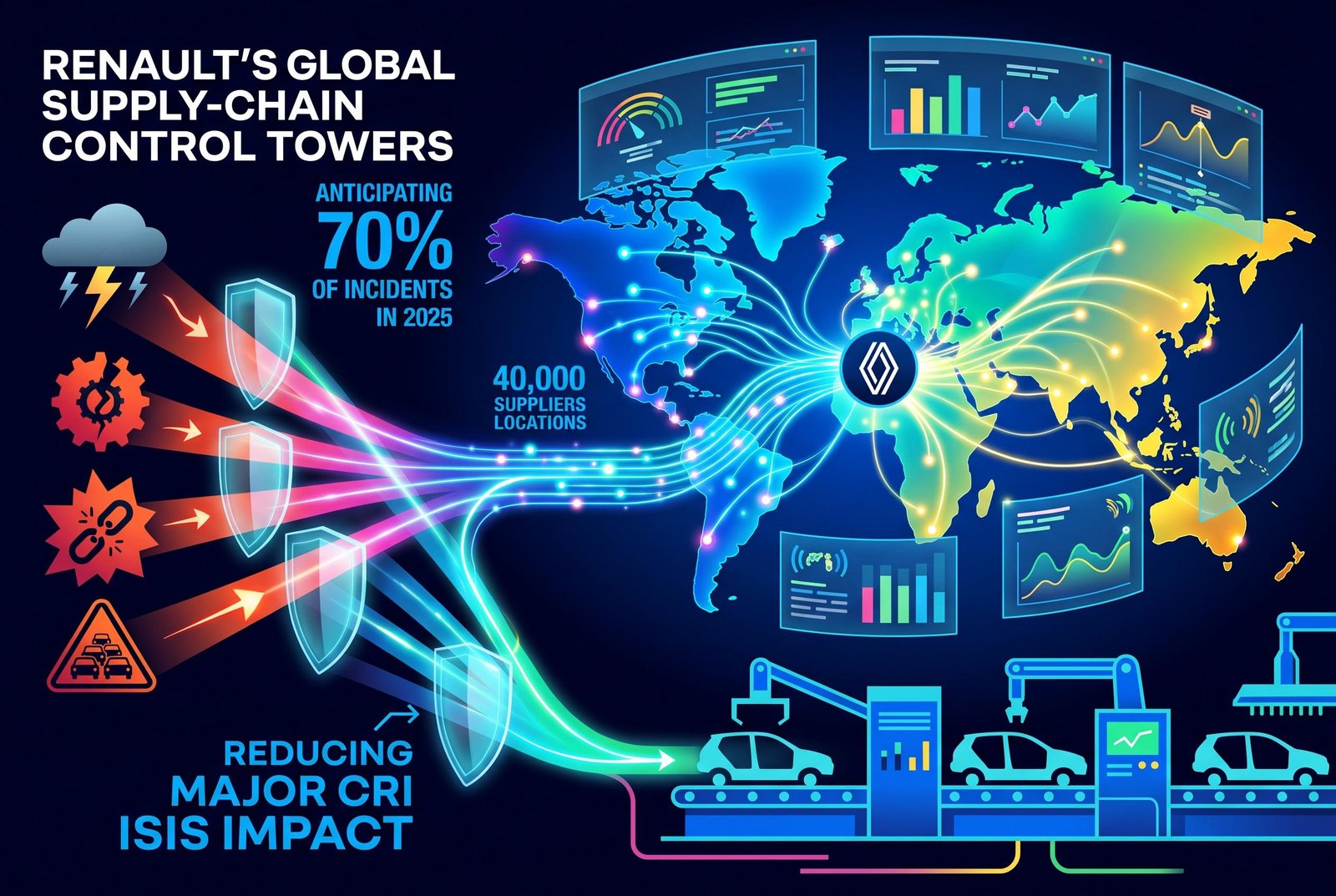
Renault Group has turned supply-chain resilience into a structured operating discipline, using digital control towers to spot risks early, keep goods moving and protect delivery commitments in an industry where disruption can quickly ripple from suppliers to showrooms.
According to Logistics Insider, the carmaker’s approach rests on three linked systems: a business continuity control tower, an inbound logistics tower and an outbound logistics tower. Together they are designed...
Continue Reading This Article
Enjoy this article as well as all of our content, including reports, news, tips and more.
By registering or signing into your SRM Today account, you agree to SRM Today's Terms of Use and consent to the processing of your personal information as described in our Privacy Policy.
to give the company a live view of supplier exposure, component movements and finished-vehicle distribution, allowing teams to act before problems become production stoppages or missed customer handovers.
The business continuity tower sits at the front line of that effort. It monitors a reported network of 40,000 suppliers across 87 countries, with a dedicated team reviewing around 50 alerts a day. Renault’s target is to assess each alert within 48 hours, determine the likely impact and decide on an initial response. The company says that in 2025 the system helped manage 51 major crises, anticipated or avoided 70% of incidents and cut the operational impact of each crisis by 30% to 40%.
That monitoring layer is matched by real-time logistics visibility. The inbound control tower follows components from suppliers to factories, while the outbound tower tracks completed vehicles heading to dealers. Both draw on regularly refreshed GPS data from trucks and ships, giving planners the information needed to adjust arrival forecasts, rework transport plans or alert plants when inventory or delivery schedules are at risk.
Logistics Insider said the inbound system watches 4,000 supplier sites, 300,000 part numbers and 20 logistics platforms, handling roughly 3,500 shipments to plants every day. The outbound tower, meanwhile, follows about 1,200 road shipments and 1,000 sea transfers daily, helping Renault hold to the delivery dates it has already promised customers.
The company’s visibility programme has been developed over time as the automotive sector has wrestled with the limitations of just-in-time manufacturing and the growing cost of disruption. Automotive Logistics has reported that Renault’s digital supply-chain work has been as much about organisational change as software: teams must trust the data, use it consistently and translate it into decisions quickly enough to matter. Earlier efforts focused on tracking inbound freight more accurately, while later phases extended that oversight to maritime shipments and outbound vehicle transport.
That evolution appears to have been driven by the practical weaknesses of older methods. Supply Chain Brain reported that Renault’s control-tower development was meant to replace manual processes and patchy shipment information that made delays harder to detect and more expensive to fix. By linking transport data with production needs, the company has been able to calculate estimated arrival times more accurately and decide whether to reroute trucks, speed up deliveries or move critical parts before a line stoppage occurs.
Renault has also tried to reduce its exposure to shocks before they happen. Logistics Insider reported that the company is working on alternative sourcing, critical-part stockpiles and dual-sourcing arrangements so that it is not overly reliant on a single supplier or route. Najime Oucouc, Renault Group’s supply chain resilience director, told the publication: “Today, crises have become a kind of ‘new normal.’ What makes the difference is the ability to react quickly, coordinate rapidly and leverage data. But prevention is just as important: identifying alternatives, securing critical supplies and developing dual sourcing, meaning having two source supplies for the same part or component.”
French-language remarks reported by Republik Group echoed that view, describing crisis management at Renault as a more disciplined process rather than an improvised response to disruption. The same report said the company’s framework brings together supplier oversight, local contacts and operational decision-making, with the aim of cutting the cost and duration of shocks. Renault has said that more structured crisis handling has lowered the financial hit from disruptions by an estimated 30% to 40%.
The company’s maritime visibility work has been another important piece of the puzzle. Kpler said Renault uses vessel data within its control-tower set-up to follow containerised parts more closely, reducing dependence on manual follow-up and improving the company’s ability to spot delays before they affect production. That kind of tracking is particularly valuable in an industry where a missed shipment can trigger expensive emergency freight, inventory problems or even line stoppages.
Renault is also applying more advanced analytics to the process. Automotive Logistics reported in a separate interview that the company is using artificial intelligence in its inbound and outbound towers to help teams identify patterns, suggest responses and reduce the time spent on repetitive problem-solving. The same report said Renault is extending its planning horizon beyond six months and bringing supply-chain teams into procurement discussions earlier, in an effort to make the organisation more agile when conditions change.
Taken together, the system reflects a wider shift in automotive logistics. Resilience is no longer being treated simply as a back-up plan for crises already under way. Instead, Renault’s model shows how continuous monitoring, early warning systems and coordinated decision-making can be used to prevent disruption from reaching the factory floor or the customer’s driveway in the first place.
Source: Noah Wire Services