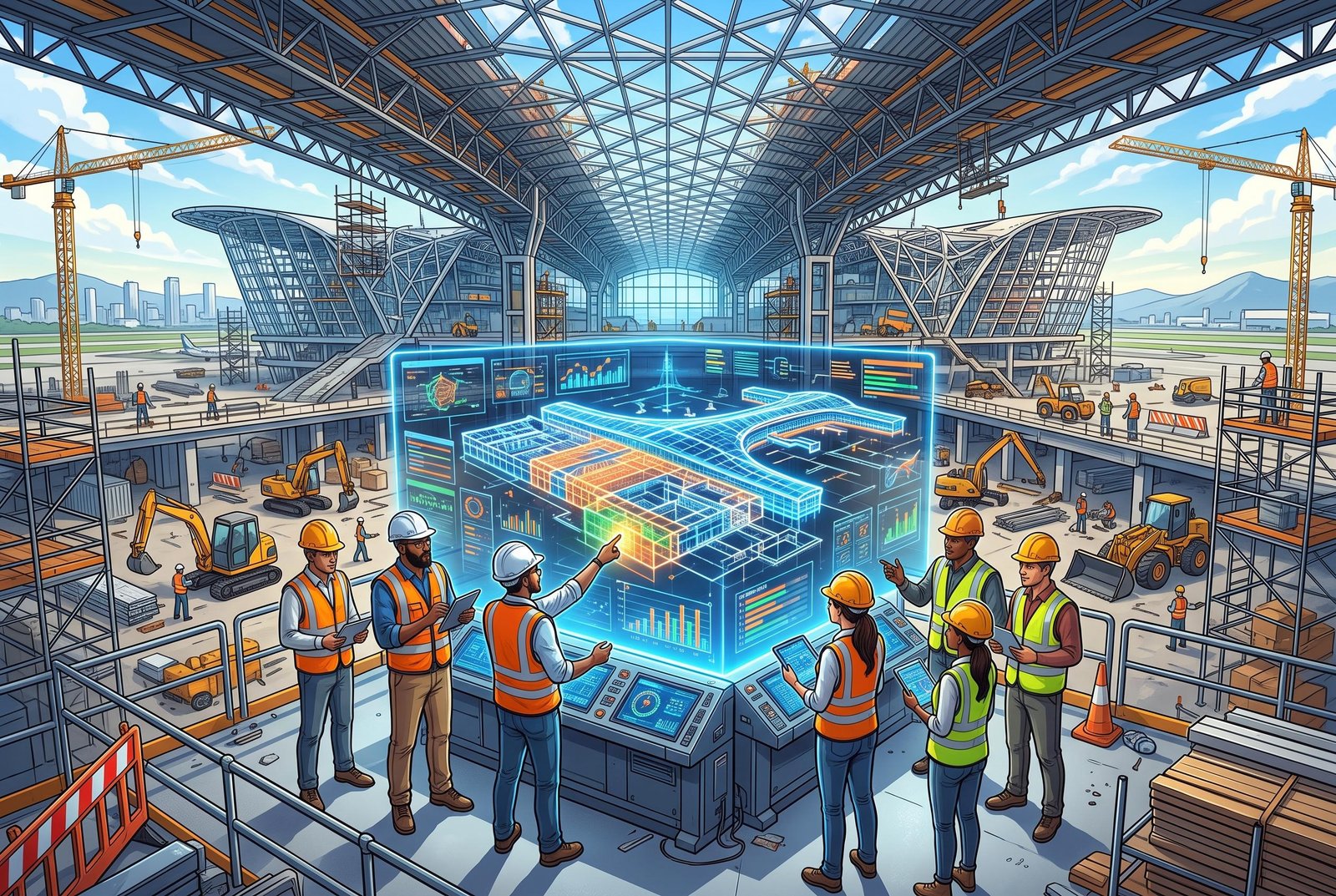
Airport terminal projects are among the most demanding undertakings in the built environment, combining dense engineering, strict safety rules and the operational pressures of live aviation sites. As the industry pushes to deliver more capacity in less time, digital construction workflows are becoming central to how airports are planned, built and handed over.
At the heart of that shift is a move away from fragmented communication and towards shared, cloud-based project environ...
Continue Reading This Article
Enjoy this article as well as all of our content, including reports, news, tips and more.
By registering or signing into your SRM Today account, you agree to SRM Today's Terms of Use and consent to the processing of your personal information as described in our Privacy Policy.
ments. According to the material from World Construction Today, these systems give designers, engineers, contractors and specialist trades a single source of truth, reducing the risk that teams will be working from outdated drawings or disconnected spreadsheets. In a setting where one missed revision can trigger expensive rework, that consistency matters. The same approach also improves auditability, with requests for information, submittals, approvals and change orders managed in one place rather than across scattered email chains.
The wider infrastructure sector is moving in the same direction. Burgess & Niple has described digital delivery as a way of linking planning, design, construction and operations through shared data environments, while the Federal Highway Administration has promoted integrated digital project delivery as a method that improves accuracy, reduces mistakes and keeps stakeholders aligned. In practice, that means terminals are increasingly being developed with model-based deliverables that support not just design, but procurement, sequencing and eventual operations.
For airport projects, the operational value of digital tools is especially clear. Lean construction methods, including the Last Planner System, can be supported with live dashboards that show short-term progress and emerging constraints. The addition of 4D and 5D modelling allows teams to test how time and cost interact with the build sequence, helping project managers spot clashes before they become field problems. On an active airfield, where access routes, security zones and passenger movement all have to be protected, this predictive capability can make the difference between a controlled programme and a disruptive one.
Field execution is also becoming more data-driven. Mobile applications allow crews to consult the latest specifications on site, while digital checklists and automated inspection records speed up quality assurance. The result is a faster feedback loop between the office and the field, with fewer punch-list items left for the final stages of the job. This is particularly useful on terminal schemes, where the number of trades involved can run into the hundreds and coordination failures can quickly cascade across the programme.
Digital workflows are equally influential in procurement and supply chain management. By tying material tracking to the project schedule, teams can see where high-value equipment is in the manufacturing and shipping process and prepare for delays before they hit the site. That visibility is especially important for airport terminals, where complex mechanical, electrical and baggage-handling systems often arrive from different parts of the world. Better oversight can reduce storage pressure, improve cost control and limit idle time caused by late deliveries.
The same logic extends into commissioning and handover. Rather than treating the close-out phase as a separate administrative exercise, digital project delivery captures technical data throughout the build, creating a structured record that can be passed to the airport operator. Trimble has argued that digital as-builts can form the basis of a digital twin, capable of supporting diagnosis, simulation and long-term asset management once the building is in use. Aviation specialists are taking that further: AviationPros recently reported on digital twins moving from static planning tools to live operational platforms, with potential applications ranging from asset tracking to safety alerts. In a terminal, that kind of continuity from construction to operations can reduce handover friction and help the facility team start work with more confidence.
Technology is also changing how airports capture reality in the first place. Digital Building Services, which works on aviation scanning and BIM projects, says it has delivered work at more than 50 airports across North America since 2005, using 3D laser scanning and virtual design and construction to improve accuracy in complex mechanical and electrical environments. Those methods help ensure that digital models reflect actual site conditions, which is vital when new systems are being inserted into crowded existing facilities.
The broader industry trend is clear: digital workflows are no longer just an efficiency tool, but a structural change in how infrastructure is delivered. Autodesk’s connected construction workflow model reflects that direction, bringing together collaboration, bidding, document management and project administration across the full lifecycle. For airport owners, that integrated approach offers something particularly valuable: more certainty. With better information flow, tighter coordination and more complete handover data, terminal projects can move faster without sacrificing control.
As aviation demand continues to rise, the pressure on terminals will only intensify. The case for digital delivery is therefore not simply about convenience or modernisation. It is about building infrastructure that can be delivered at speed, operated efficiently and adapted over time. In that sense, the digital terminal is becoming less of a future concept than a practical requirement for the next generation of airport development.
Source: Noah Wire Services