Food supply networks are being reshaped by climate pressures, geopolitical disruption and the growing dependence of retailers on tightly connected logistics and digital systems. At a FoodChain Forward conference in the Netherlands, Roel Gevaers, a supply-chain management professor at the University of Antwerp, argued that bringing production and purchasing relationships closer together can help companies manage some of those risks.
The same food can travel through markedly diff...
Continue Reading This Article
Enjoy this article as well as all of our content, including reports, news, tips and more.
By registering or signing into your SRM Today account, you agree to SRM Today's Terms of Use and consent to the processing of your personal information as described in our Privacy Policy.
erent routes. Gevaers contrasted whole mangoes shipped from South America to Europe in refrigerated containers with prepared mango pieces processed in Ghana and flown to European shops. The choice of route affects not only transport time but also where processing takes place and how value is distributed.
Research by Wageningen Food & Biobased Research, commissioned by the World Bank Group, examines mango logistics in Ghana and identifies opportunities to improve handling and processing closer to farms. It considers fresh-fruit hubs and small-scale processing facilities as ways to reduce post-harvest losses and connect growers more effectively with markets, while stressing that infrastructure, finance, technical skills and organisation all matter. The study does not assess the specific Ghana-to-Europe route described by Gevaers, but it illustrates the broader challenges involved in designing supply chains around local production and processing.
Gevaers also pointed to the vulnerability of networks built around low cost and maximum efficiency. Rising energy prices, he said, have curtailed fertiliser production in Antwerp, with potential consequences for food costs. The international trade in frozen chips offers another example of exposure: after a supply shortfall several years ago, McDonald’s reportedly flew four jumbo jets of chips to meet demand. Efforts by countries including India and China to expand their own potato production could, in turn, put pressure on growers in the Benelux.
Digital disruption can have similarly immediate effects. Rotterdam School of Management’s analysis of a cyber incident at Albert Heijn describes how the retailer took parts of its IT systems offline, disrupting distribution and contributing to shortages in shops, particularly of fresh goods. The episode shows how problems in digital infrastructure can quickly affect the physical movement of food. It also underlines that resilience depends on preparing for interruptions, not simply making routine operations more efficient.
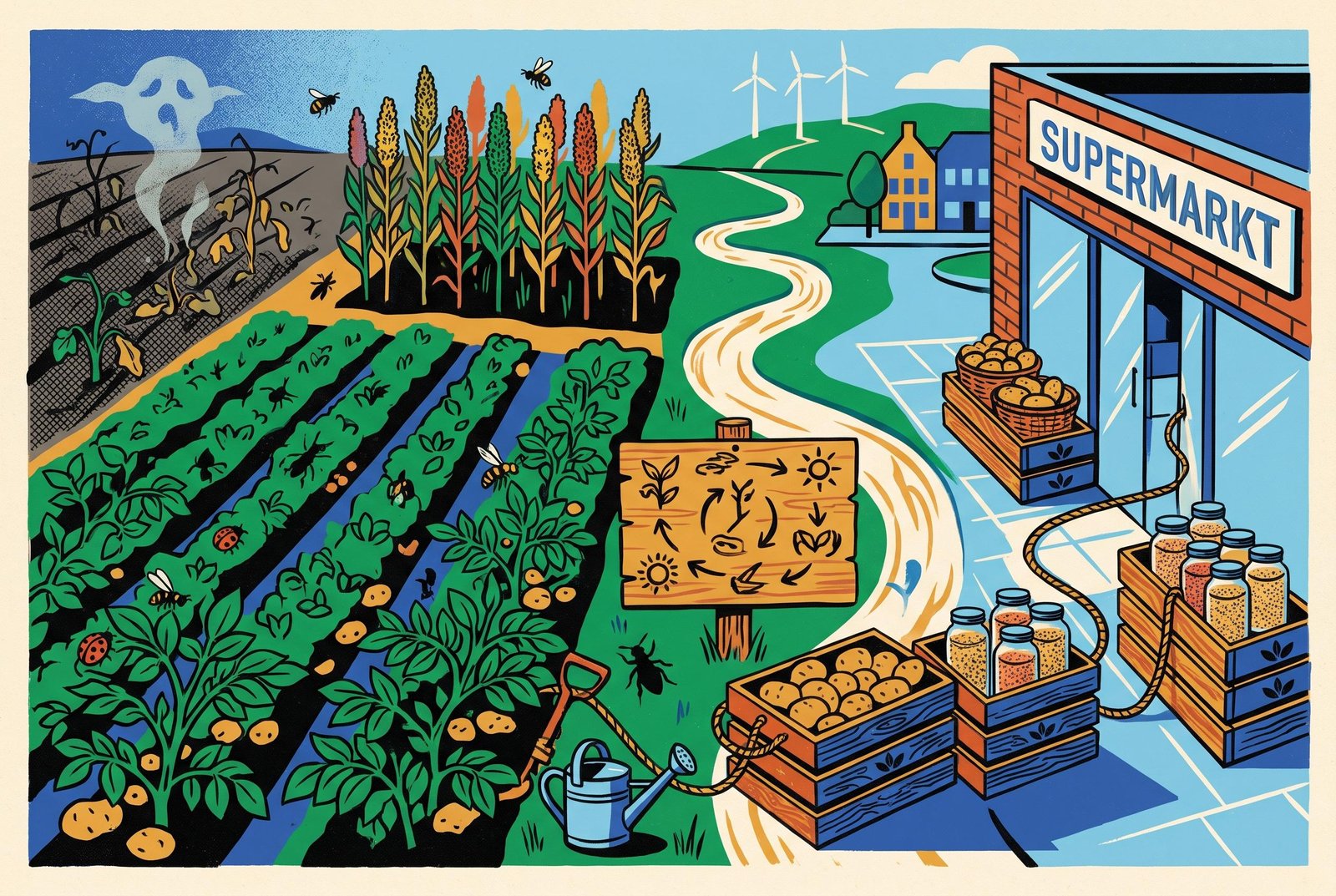
For Dutch supermarket chain Jumbo, shortening supply routes has included sourcing quinoa from domestic growers. The retailer is introducing a Dutch-grown alternative in place of imports from South America and India. Foodvalley’s Plant Protein Forward programme helped link farmers with processors and buyers, with support from partners including Rabobank and regional organisations. The initiative is intended to turn promising crops into workable commercial supply chains, rather than leaving farmers to grow them without a secure market.
Foodvalley says the programme has also helped develop domestic chains for crops such as edamame, lupin and faba beans. In one example, a multi-year arrangement between Dutch edamame growers and Jumbo created demand equivalent to around 30–40 hectares of cultivation each year, with successful production allowing scope for growth. The wider aim is to give farmers sufficient certainty to invest, while allowing buyers to adjust volumes as demand develops.
Jumbo’s quinoa project reflects that balance. The company says it is phasing out imported quinoa as the Dutch crop becomes available, and that the domestic product is organic and wholegrain at the same price. Foodvalley reports that the programme has enabled 90 farmers to grow Dutch protein and fibre crops. The initiative’s organisers say long-term purchasing commitments and fairer sharing of value are important if growers are to take on new crops and the risks of establishing unfamiliar markets.
Lidl Netherlands is pursuing a different kind of change through work with potato growers to reduce chemical crop-protection products. Its wider two-year pilot, launched in 2025 with growers, suppliers, Natuur & Milieu and CLM Research and Advice, covers arable crops, fruit and greenhouse horticulture. Lidl says the programme aims to halve chemical crop-protection use and avoid the most harmful products, using measures such as resilient varieties, improved soil health and mechanical weed control.
The potato trials show why reductions require more than simply stopping treatments. Nieuwe Oogst reports that growers Jan and Ben Ham, Lidl and agricultural advisers are testing techniques including harrowing, hoeing and earthing up. Choices depend on crop health, disease pressure, the resilience of individual varieties and the alternatives available; some preventive spraying may continue, though its timing or frequency can change.
In the account presented at the conference, Lidl’s sustainability chief, Esmée van Veen, said early discussions between the retailer and growers were difficult because farmers were unsure whether they could speak freely in front of a major supermarket and its supplier. She said the project gained momentum after staff responsible for commercial negotiations were excluded from those conversations. The participants also agreed to share the financial risk of a failed harvest equally.
Grower Jan van der Ham said Lidl’s willingness to cover half the cost in that eventuality gave him the confidence to change his methods. The reported reduction in chemical pesticide use after one year was 90 per cent. The next challenge is to make the approach part of routine purchasing, rather than a standalone trial. That would require retailers to build sustainability goals and risk-sharing into the way they buy produce, giving farmers a stronger basis for investing in change.
Source: Noah Wire Services