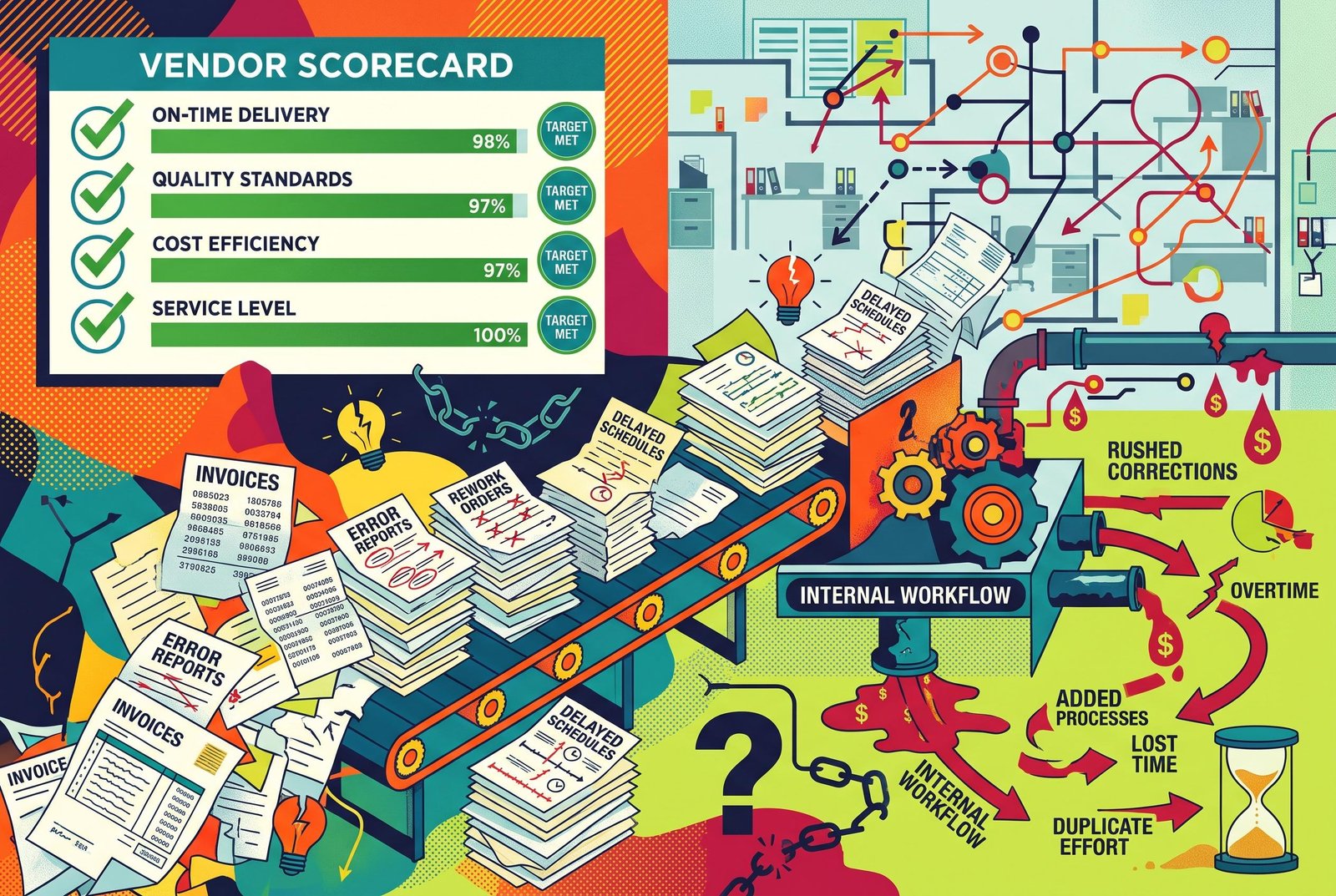
Business leaders often assume that if a supplier is meeting its service-level targets, the relationship is working as intended. In practice, that can be a misleading comfort. A vendor may deliver exactly what the contract asks for and still leave the organisation with avoidable rework, extra cost and slower operations.
That gap matters because many performance reports are built to measure the vendor’s obligations, not the business outcome those obligations are meant to suppor...
Continue Reading This Article
Enjoy this article as well as all of our content, including reports, news, tips and more.
By registering or signing into your SRM Today account, you agree to SRM Today's Terms of Use and consent to the processing of your personal information as described in our Privacy Policy.
t. According to the LogicManager article, the result can be a narrow scorecard that shows invoices were issued on time, response times were met or availability stayed within threshold, while internal teams quietly absorb the consequences of errors, missing data or poor handovers.
The distinction is easiest to see in a billing process. A provider may send invoices within the agreed timeframe and still produce documents that contain omissions or inaccuracies. Those mistakes can trigger customer disputes, force finance teams to investigate and correct records, delay collections and consume staff time that is rarely visible in the vendor’s own report. On paper, the supplier has performed well. In the day-to-day reality of the business, the process is still under strain.
That is why performance monitoring needs to extend beyond punctual delivery. APQC, which publishes benchmarking guidance on supplier management, says organisations should assess vendors using a balanced set of measures tied to wider objectives rather than relying on a single indicator. Its recommended metrics range across delivery, quality, cost, efficiency and risk, with different audiences needing different levels of detail. Senior leaders need to understand outcomes for the organisation, managers need information on productivity and efficiency, and frontline teams need visibility into specific tasks and deliverables.
In the context of billing and order-to-cash processes, that broader approach is especially important. APQC advises measuring the full end-to-end journey, including invoice accuracy, disputes, adjustments, rework, collection time and customer outcomes, rather than treating each department in isolation. The aim is not merely to establish whether a document arrived on time, but whether the process produced a usable invoice that moved the business towards payment without creating extra work.
The Federal Deposit Insurance Corporation makes a similar point in its guidance on managing technology providers. Its sample service-level agreement provisions focus on precisely defined obligations such as availability, measurement periods, thresholds, reporting and remedies for missed targets. That framework is useful, but it also shows the limits of contract-based oversight: a report can accurately reflect whether a provider met the terms written into the agreement without answering the broader question of whether the arrangement is helping or hindering operations.
The same logic appears in guidance from the Office of the Comptroller of the Currency, which says ongoing monitoring of third-party relationships should go beyond checking contractual compliance. Its third-party risk management guide highlights the need to watch the effect on customers, complaints, access to information, management oversight and the potential disruption if a relationship ends. In other words, the quality of a vendor relationship cannot be judged solely by whether technical boxes are ticked.
That is the underlying challenge for business and finance leaders. If a provider’s work creates corrections, exceptions and manual intervention downstream, then the organisation is paying for more than the vendor invoice alone reveals. Staff time, delayed cash flow and the operational drag of repeated fixes all represent real costs, even if they never appear on the supplier’s monthly report.
The LogicManager article argues that the first task is to establish where the problem actually begins. The source may lie in inaccurate information supplied internally, a processing failure by the vendor or a weak handoff between the two. Without that diagnosis, leaders can easily misread the evidence and make the wrong decision about renewal, escalation or replacement.
The more effective approach is to trace work across the full process, measure the rework that follows, verify whether corrective actions actually solve the problem and connect vendor metrics to business results. A vendor can still be doing exactly what was promised, but that does not necessarily mean the enterprise is getting what it needs.
Source: Noah Wire Services