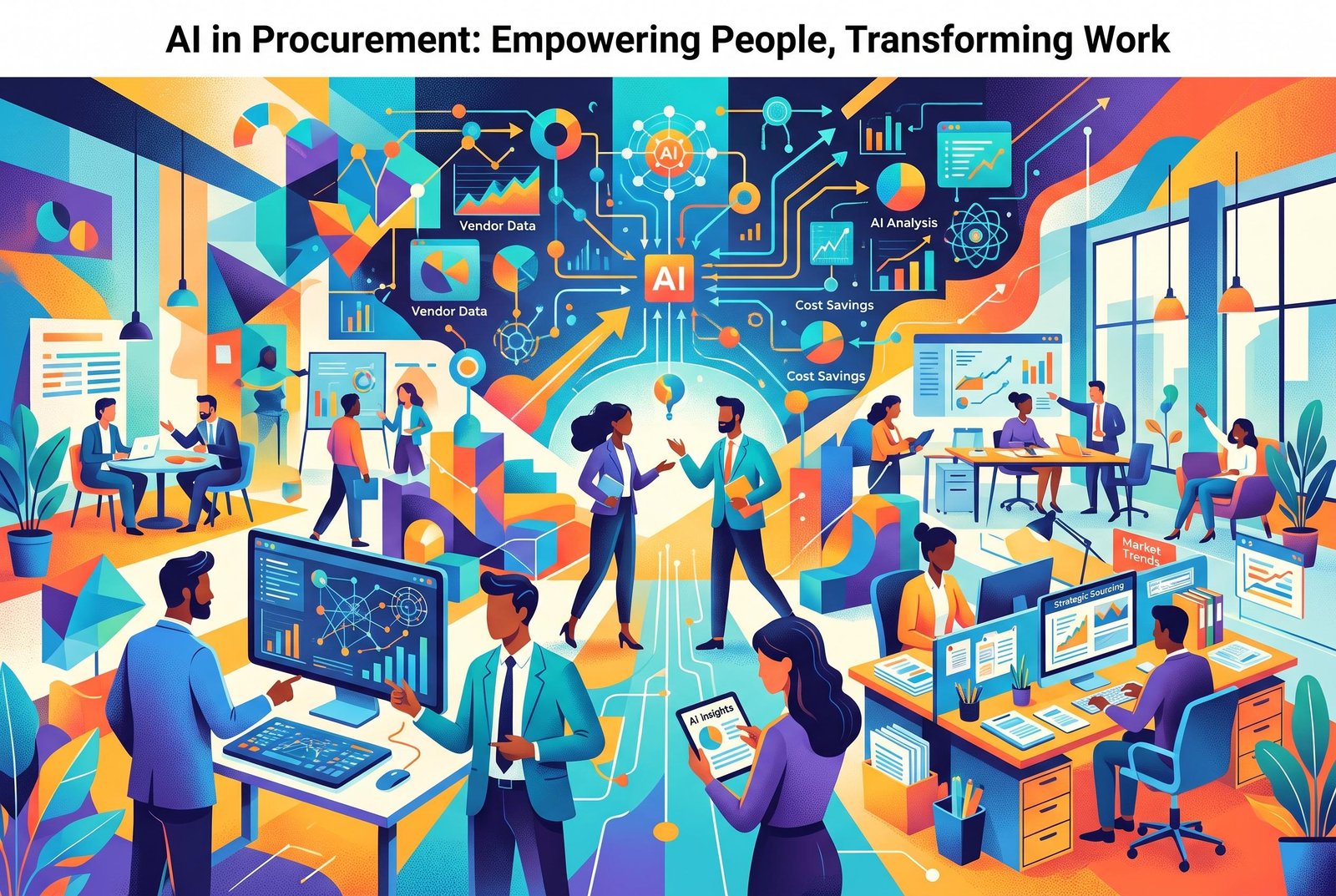
Procurement’s march towards AI-first operations is proving to be less about replacing people than about reworking the shape of their work. New research from Ardent Partners suggests that the real constraint is not enthusiasm for artificial intelligence, but the sheer weight of manual activity, fractured processes, legacy technology and weak data foundations that still absorb so much of procurement’s capacity. In that context, the route to AI-first procurement starts with easing th...
Continue Reading This Article
Enjoy this article as well as all of our content, including reports, news, tips and more.
By registering or signing into your SRM Today account, you agree to SRM Today's Terms of Use and consent to the processing of your personal information as described in our Privacy Policy.
e operational load, so teams can devote more time to higher-value work and use technology to move faster, think more clearly and contribute more strategically.
The latest stage of that journey is a distinctly human-agent model, in which AI is expected to support judgement rather than supplant it. Ardent Partners says nearly half of procurement leaders, 47%, see cognitive augmentation as the leading objective for a hybrid operating model, while 36% prioritise relationship enablement. By contrast, only 4% are focused on full autonomy. That balance matters because it shows where the profession believes AI can add the most value: in sharper analysis, better decisions and more scalable execution, not in the wholesale removal of human oversight.
The implications for operating design are significant. If procurement leaders are mainly looking for systems that can take over repetitive work, they will miss the point. What they appear to want instead is technology that improves the quality of decisions, strengthens coordination and frees teams from the most time-consuming administrative burdens. That aligns with Ardent’s wider report, which frames AI-first procurement as a progression built on connected data, embedded governance and a practical balance between machine execution and human judgement.
The skills profile that emerges from the research is equally revealing. Data literacy and analytical thinking top the list at 71%, closely followed by business acumen and critical thinking at 70%. That near tie underlines the dual requirement facing procurement professionals: they must understand what the data says and what it means for the business. Relationship management, supplier collaboration and technology fluency follow, alongside risk, governance and compliance expertise. As agentic AI becomes more widely deployed, those governance capabilities are likely to become even more important.
This shift is already visible in how organisations say AI is affecting their teams. Ardent reports that 68% of organisations say AI is reducing manual workload without cutting headcount. More than half, 51%, are placing greater emphasis on upskilling and reskilling existing staff, while 39% say roles are being redefined or expanded. Changes to hiring profiles are affecting 32% of organisations. Actual headcount reduction, often raised in public debate about AI and jobs, is reported by only 19%. In other words, the dominant effect so far is not displacement but redistribution of effort.
That does not mean the transition is frictionless. Procurement teams are still adapting to new expectations, new tools and new forms of accountability. But the direction of travel is clear. As AI takes on more analysis, monitoring and process coordination, people are moving further towards interpretation, governance, collaboration and orchestration. PwC has argued that agentic AI can transform procurement workflows by converting unstructured information into useful analysis and automating repeatable knowledge work, but Ardent’s findings suggest that most leaders are approaching that future cautiously, with an emphasis on augmentation rather than autonomy.
This is also why the debate around procurement AI cannot stop at isolated use cases. Ardent’s broader research programme says the profession is moving from experimentation towards execution, but that progress depends on whether organisations can connect data, embed governance and redesign workflows at scale. The challenge is not simply to deploy AI tools, but to build an operating environment in which they can be trusted, used consistently and tied to measurable business outcomes.
For now, procurement leaders seem to be making a pragmatic bet. They are not designing around the idea that machines will take over the function. They are building towards a model in which AI handles the analytical and transactional burden, while humans focus on judgement, relationships and strategic influence. That is a very different proposition from simple automation. It suggests a function that is not shrinking its human role, but redefining it for a more data-intensive and intelligence-driven era.
Source: Noah Wire Services