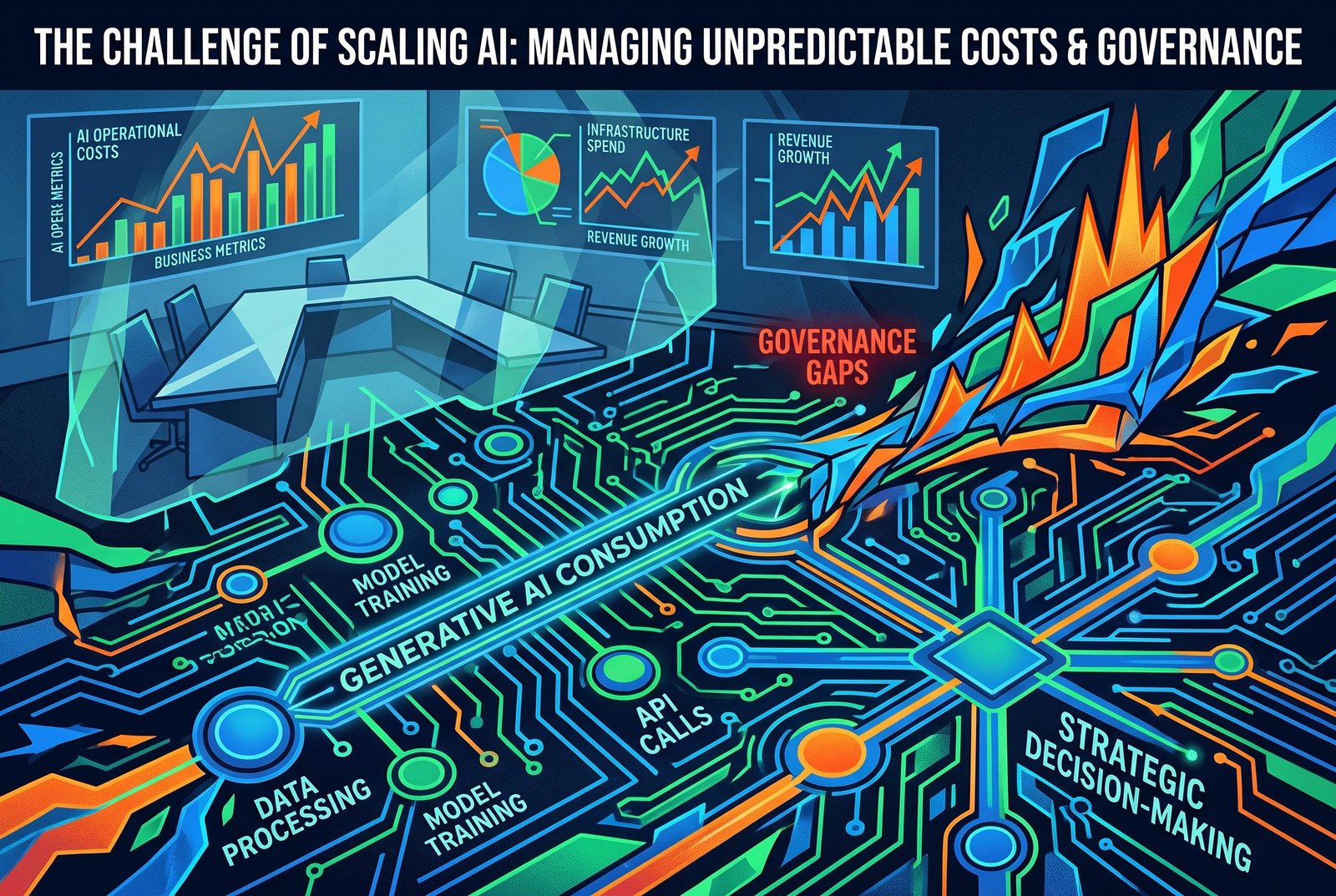
The rapid spread of generative AI through large organisations is forcing a more uncomfortable conversation in boardrooms: intelligence may be becoming cheaper to access, but it is not becoming easier to govern. As the technology moves from pilots into daily operations, the real risk for many firms is not that they will fail to adopt AI quickly enough, but that they will adopt it faster than they can control the economics behind it.
That concern is increasingly visible in enterp...
Continue Reading This Article
Enjoy this article as well as all of our content, including reports, news, tips and more.
By registering or signing into your SRM Today account, you agree to SRM Today's Terms of Use and consent to the processing of your personal information as described in our Privacy Policy.
rise spending patterns. McKinsey research cited by the article suggests that 93% of respondents had gone over their AI budgets, while overall enterprise AI spending had risen almost fourfold as organisations moved from isolated experiments to broader deployment. The same research estimates that as much as a fifth to nearly a third of AI spending can go untracked because costs are spread across suppliers, tools and business units. In practice, that means many organisations are discovering too late that generative AI behaves less like conventional software and more like a variable utility: useful, scalable and potentially expensive in ways finance teams do not always see immediately.
The problem is not simply that AI is costly. It is that the cost can be highly unstable. A single request may generate very different levels of token use depending on the model selected, the prompt structure, the workflow design and the behaviour of autonomous agents. That makes forecasting difficult and weakens older procurement assumptions built around fixed licences and predictable consumption. The result, according to the materials behind the article, is a pattern of duplicated subscriptions, repeated requests, overlong prompts and agent loops that quietly inflate spend while remaining disconnected from any measurable business result.
This is where many organisations fall into a governance gap. Traditional FinOps practices can help allocate costs after the fact, but they are often too retrospective to stop inefficient AI workloads while they are still running. At the same time, clamping down too hard on experimentation risks slowing adoption and suppressing the returns that AI is meant to deliver. The challenge, therefore, is not merely to track expenditure, but to build controls into the operating model itself.
The argument advanced in the article is that AI governance has to move closer to the architecture layer. Rather than letting each application team bolt on its own model connections, security settings and monitoring tools, organisations need a shared operational control plane that sits between the user request and the model response. That approach would allow leaders to standardise routing, privacy checks and cost telemetry across every transaction, while still retaining the flexibility to switch between different foundation models as business needs change.
The same logic applies to management reporting. A finance dashboard that only shows total token spend tells executives very little about whether the technology is creating value. A more useful view would capture request metadata, user identity, business ownership and service-level expectations before the prompt is processed, then feed real-time data back to chief financial and technology officers on token yield, unit cost per business outcome, quality and drift. In other words, the question should not be how much intelligence was consumed, but what was produced in return.
That shift in emphasis also reflects a broader change in how boards are beginning to assess AI. IBM has argued that enterprise AI cost management is now centred on cost attribution, outcome-based benchmarking, cross-functional governance and continuous portfolio optimisation. SAS, in a recent post on consumption-based AI, made a similar point: easy experimentation is attractive, but the metered unit is rarely the same as the unit of business value. In that sense, the challenge is structural as much as financial. Organisations must connect the economics of AI to the outcomes that matter in the business, whether that means a claim processed, a customer issue resolved or a line of code reviewed.
The article also draws on Lean Six Sigma thinking to suggest that AI operations should be treated as a process-improvement exercise, not just a technology deployment. That means identifying waste, reducing variation and tightening the relationship between input and output. Three priorities stand out. First, companies should measure the cost of a verified business result, not raw token usage. Second, they should enforce prompt standards, response limits and caching so that teams do not pay for unnecessary output. Third, they should preserve the ability to move between proprietary and open-weight models, both to maintain pricing leverage and to avoid becoming dependent on a single supplier.
There is also a wider trust issue. EY’s global CIO has argued that organisations must move quickly on AI while ensuring that trust is built into the process through reliable data, secure systems, governed workflows and workforce training. That point matters because the financial case for AI can collapse if governance is weak. As TechRadar has noted, AI is scaling faster than many organisations can control, while other commentary has warned that the technology is exposing long-standing gaps in ownership and accountability at speed. The more deeply AI is embedded into operations, the more damaging those gaps become.
The implication for executives is clear. AI can no longer be treated as a bottomless source of digital productivity, nor as a series of disconnected use cases that each manage their own economics. It has to be run as a controlled strategic asset, with clear accountability, real-time visibility and architectural discipline. Without that, the gains from generative AI may be swallowed by the very consumption that was supposed to create them.
Source: Noah Wire Services