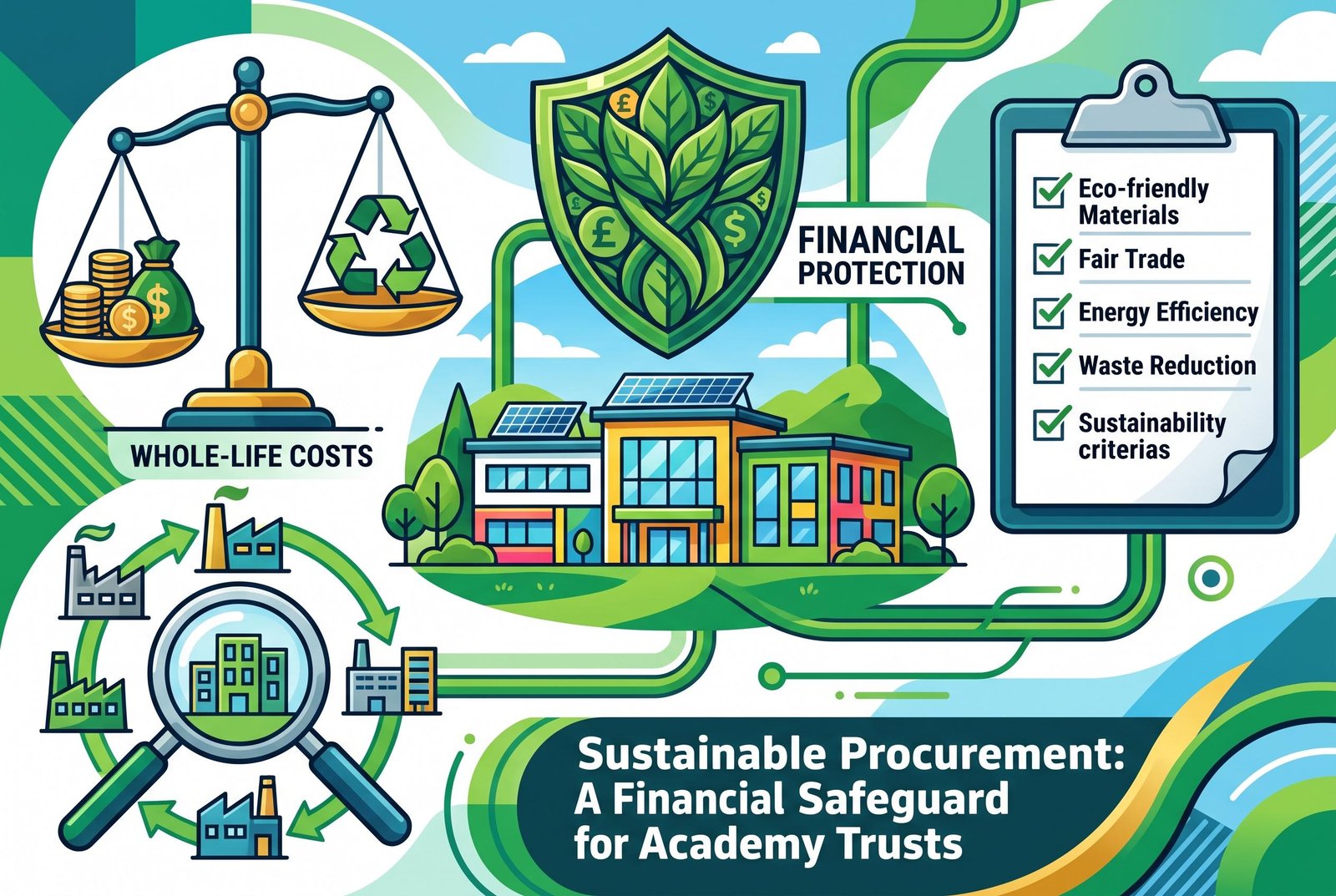
For schools and academy trusts facing tight budgets, procurement can look like a purely financial exercise: find the lowest price, protect cashflow and keep services running. Yet sustainable procurement is better understood as a form of prudent stewardship, because the cheapest option is not always the one that delivers the best long-term value. As Helen Burge argues, the real question is not simply what is being bought, but why it is being bought, how it will be used and what consequ...
Continue Reading This Article
Enjoy this article as well as all of our content, including reports, news, tips and more.
By registering or signing into your SRM Today account, you agree to SRM Today's Terms of Use and consent to the processing of your personal information as described in our Privacy Policy.
ences it will have over its full life.
That broader lens matters in a sector where staffing costs absorb most revenue spending, leaving leaders to squeeze savings from the rest of the budget. Sustainability can appear, at first glance, to be an additional burden competing for scarce time and money. But procurement that takes account of durability, maintenance, transport, reuse and disposal can reduce waste, cut hidden costs and strengthen governance. In that sense, it is not a separate environmental add-on; it is part of sound financial management.
The traditional idea of value for money has long rested on the three Es: economy, efficiency and effectiveness. Sustainable procurement adds a further dimension: ethics. That means asking whether a purchasing decision supports human rights, avoids unnecessary environmental harm, contributes to local economies and aligns with an organisation’s stated values. A lower upfront price may prove expensive if a product wears out quickly, requires frequent maintenance, arrives in excessive packaging or comes from a supply chain with poor labour standards.
This is where the concept of whole-life value becomes important. Leaders should think beyond the initial purchase and consider the total cost of ownership. Before replacing equipment, for example, it may be worth asking whether it can be repaired, refurbished, redeployed elsewhere in the trust or shared between sites. Contracts can also be designed to include maintenance, recycling or take-back arrangements. Even practical steps such as consolidating deliveries can reduce administrative effort as well as transport emissions.
The first step, however, is knowing what is already being bought. Burge’s research into procurement across multi-academy trusts found that many organisations lacked a clear picture of their own spending. Just over a third of respondents knew their annual non-staff operational expenditure, and fewer still could say how many suppliers they used. That lack of visibility makes it difficult to improve value, control risk or introduce meaningful sustainability objectives. A proper commercial discovery exercise can reveal what is being purchased, how often, from whom and under what contract terms, as well as where spending is fragmented or duplicated.
This kind of analysis can also highlight automatic renewals, overlapping contracts and categories where procurement risk is concentrated. Not every supplier needs the same level of oversight. A stationery provider will not usually require the same scrutiny as a catering, cleaning or energy contractor. The point is to segment suppliers according to spend, operational importance, supply-chain risk and sustainability impact, so that attention is focused where it matters most.
Once suppliers are grouped in this way, trust leaders can begin to ask sharper questions of strategic partners. They can request information on carbon emissions, packaging reduction, delivery frequency, labour standards and end-of-life arrangements. They can also ask whether suppliers can support repair, reuse or take-back schemes, rather than simply replacing products when they fail. Burge’s research suggests schools may have more leverage than they assume: most trusts carried out some form of due diligence, yet fewer than half knew whether corporate social responsibility was part of that process, while the suppliers involved said they were able to answer sustainability questions if asked.
That finding underlines an important point. Good intentions achieve little unless they are built into the procurement process itself. A sustainability statement in a strategy document will not change outcomes unless it is translated into specifications, tender questions and evaluation criteria that actually influence decision-making. Asking whether a supplier is “sustainable” is too vague. It is more effective to seek evidence of waste reduction, emissions reporting, ethical sourcing, environmental certification or wider community benefit.
Weighting is crucial. If price accounts for almost all the available marks, sustainability will remain a nice-to-have rather than a deciding factor. To change behaviour, environmental and social criteria must be given enough weight to shape the outcome, and performance should then be monitored against the commitments made at tender stage. In that respect, procurement does not end when the contract is signed; it continues through the life of the agreement.
That approach also fits with wider government thinking. UK guidance for academy trusts stresses the need for well-governed and transparent procurement processes that deliver value for money and reduce risk. Westminster City Council, meanwhile, has promoted purchasing decisions that take account of environmental, social and economic value, including the use of reused or recycled materials and support for local and small suppliers. Other sector initiatives have shown that shared purchasing models can also deliver better prices and simpler processes while supporting sustainability goals.
The practical message for schools is straightforward. Sustainable procurement should not be treated as a separate campaign to be bolted on when time allows. It should be woven into ordinary commercial discipline: understand the spend, segment suppliers, set meaningful criteria and monitor what is delivered. Done well, it can help schools spend more wisely, reduce avoidable waste and turn procurement into a tool for both financial resilience and social responsibility.
Source: Noah Wire Services