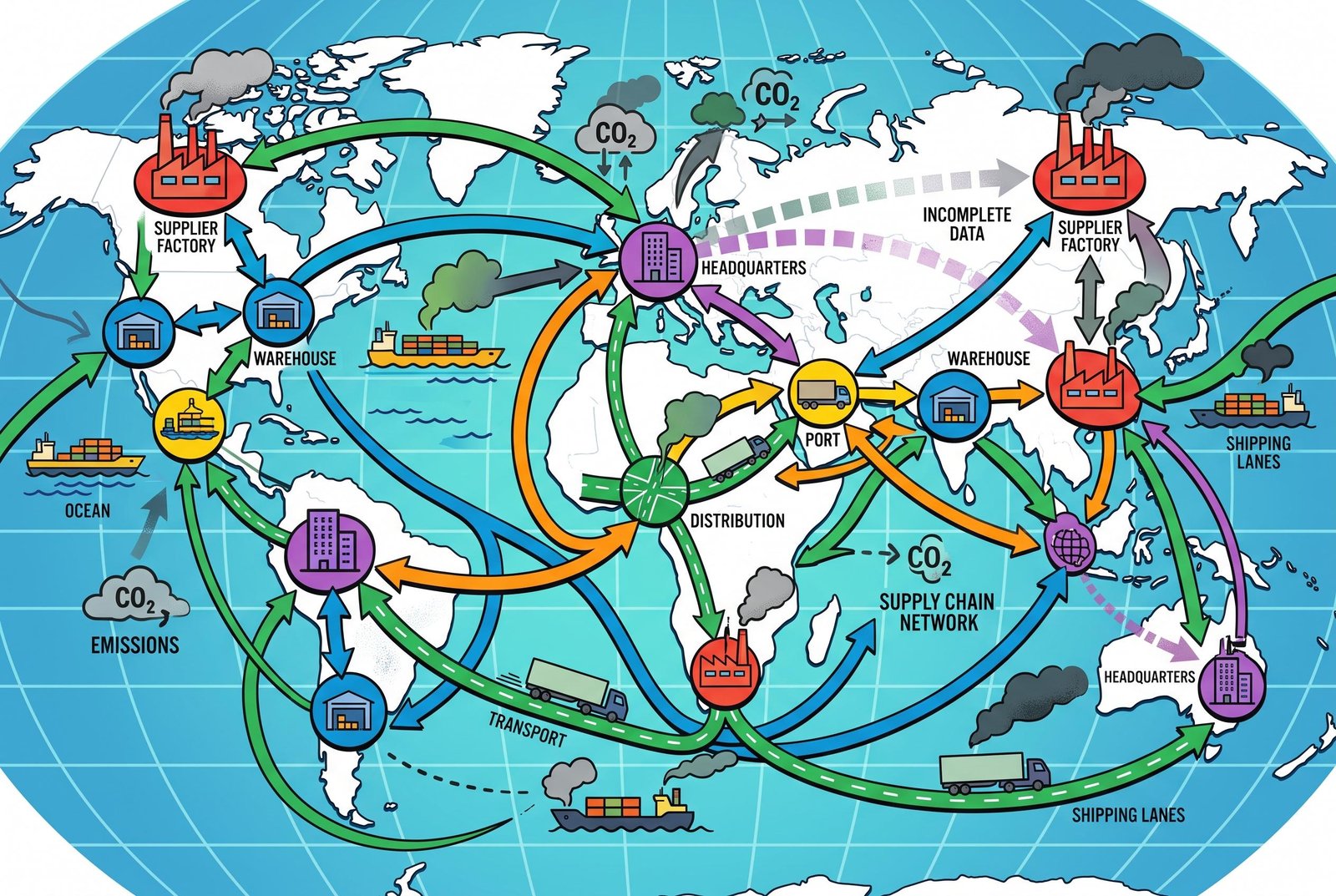
Scope 3 emissions have become one of the most visible fault lines in corporate climate disclosure, but the real problem is often misunderstood. The issue is not simply how companies present the figures. It is whether they have trustworthy supply-chain data to calculate them in the first place.
That is the central argument made by Logistics Viewpoints, which frames Scope 3 as a data architecture challenge rather than a reporting one. In practice, the quality of an inventory depe...
Continue Reading This Article
Enjoy this article as well as all of our content, including reports, news, tips and more.
By registering or signing into your SRM Today account, you agree to SRM Today's Terms of Use and consent to the processing of your personal information as described in our Privacy Policy.
nds on the quality of the underlying evidence: where the boundaries are drawn, what activity data exists, how emission factors are governed, how emissions are allocated, and whether the assumptions and uncertainties are made visible.
This matters because Scope 3 covers a company’s wider value chain, where information is often incomplete, inconsistent or altogether missing. As Neo.eco notes, suppliers frequently lack the tools, expertise or internal systems needed to measure and share emissions data reliably. In many cases, organisations are forced back on estimates, intensity factors or spend-based proxies, which can provide coverage but rarely deliver the operational precision needed for meaningful decision-making.
The challenge is compounded by the structure of global supply chains. GEP describes Scope 3 data collection as labour-intensive and slow, particularly for companies with sprawling supplier networks that extend across multiple tiers. The task is not a matter of pulling together a single dataset. It can require months or even years of mapping relationships, validating inputs and reconciling inconsistent methodologies across suppliers, logistics partners and business units.
Boundary-setting is one of the most consequential choices. Small differences in which activities, entities, shipments or reporting periods are included can produce large apparent changes in emissions that are methodological rather than real. That is why governance is so important: without a clear record of the rules used to define the inventory, comparisons over time become unreliable and reduction efforts harder to interpret.
Research published in Nature adds another layer to the problem by showing that even when suppliers have relevant information, they may not be willing or able to share it at product level. The paper points to concerns over data privacy, competitive sensitivity and the substantial effort required to prepare information for disclosure. In some cases, revealing detailed emissions data could expose aspects of production processes that suppliers would prefer to keep confidential.
The result is that many companies end up with more disclosure but not necessarily more clarity. ISS STOXX has found that a substantial share of reported Scope 3 figures fail quality reviews and must be replaced with modelled estimates. Incomplete coverage and inconsistent boundaries are among the main reasons, particularly in emissions-heavy sectors such as financials, energy and industrials. The omission of financed emissions by some financial institutions can also leave a distorted picture of climate exposure.
Another persistent misconception is that supplier engagement alone is enough to solve the problem. Emission3 argues that even when suppliers are engaged on climate topics, only a minority provide usable primary data, with the conversion rate varying sharply by sector and supplier maturity. The gap arises because suppliers may send aggregated intensity metrics without the underlying activity data, or without identifying the emission factors and methods used to build them. Without verification, even apparently detailed numbers can be difficult to trust.
This is why the most useful Scope 3 programmes treat uncertainty as a feature to be managed, not hidden. Mature organisations do not merely publish a number; they disclose the quality of the source data, the factor versions used, the allocation logic applied and the level of confidence attached to each category. That allows decision-makers to distinguish between areas where the inventory is already decision-grade and those where primary-data collection still needs to improve.
The practical value of better data lies in what it enables next. If Scope 3 is measured well, it can become a management tool rather than an accounting exercise. Better visibility can help companies identify where emissions can be reduced through mode shifts, more efficient routing, carrier selection, supplier changes, packaging redesign, product reformulation or network reconfiguration. The point is not only to refine the inventory, but to connect measurement to the operating levers that actually lower emissions.
In that sense, the strategic imperative is straightforward: improve the evidence, keep the uncertainty visible, and use the resulting data to prioritise the parts of the supply chain where reductions are most achievable. The reporting layer matters, but it cannot compensate for weak foundations.
Source: Noah Wire Services