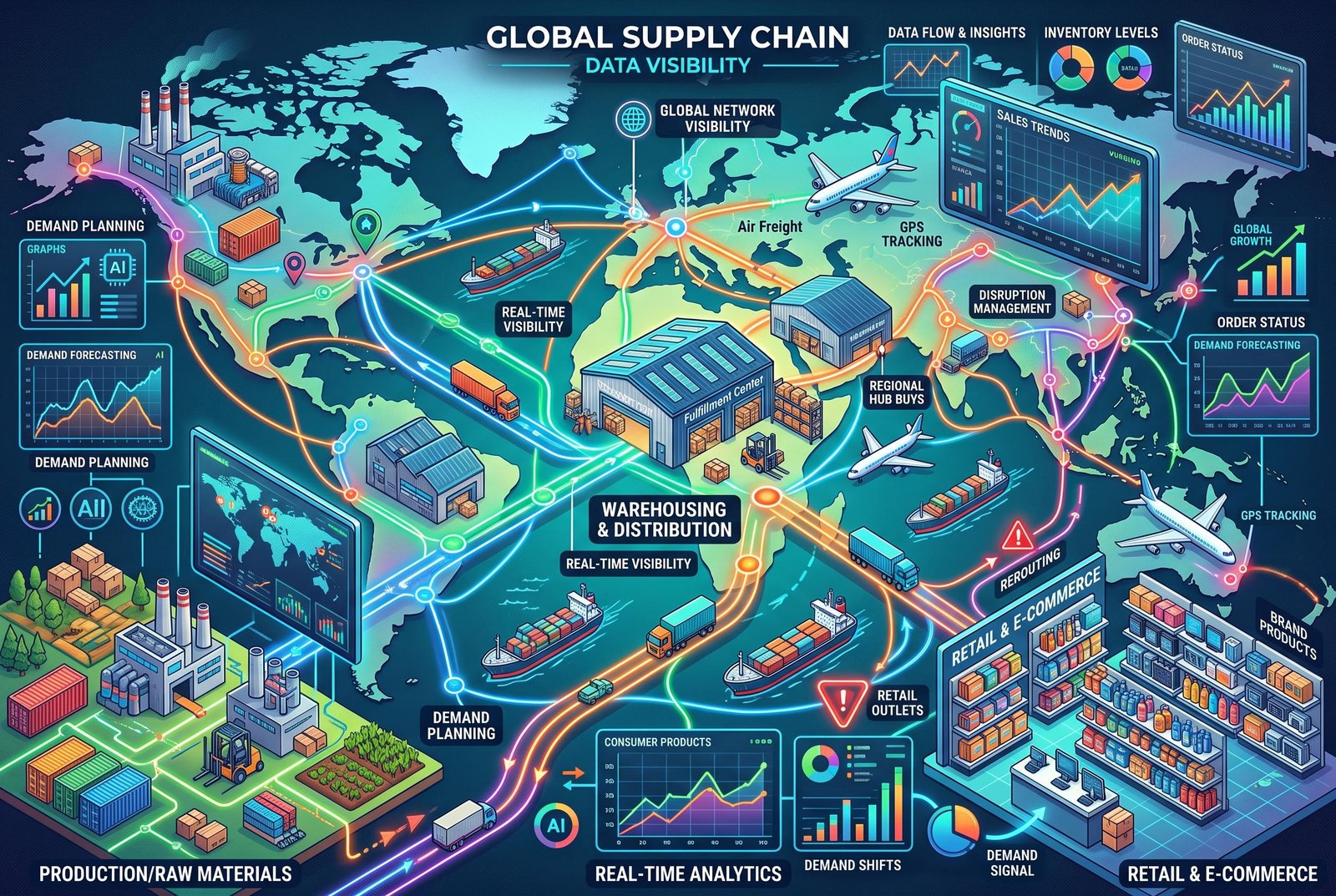
For consumer products companies, supply chain inefficiency can remain tolerable when demand is steady and forecastable. The trouble begins when demand moves quickly or a disruption hits unexpectedly. At that point, gaps in planning, inventory allocation and production coordination can turn from background friction into a direct threat to sales, service levels and margins.
That is why end-to-end visibility is increasingly being treated not as a reporting nicety but as a growth l...
Continue Reading This Article
Enjoy this article as well as all of our content, including reports, news, tips and more.
By registering or signing into your SRM Today account, you agree to SRM Today's Terms of Use and consent to the processing of your personal information as described in our Privacy Policy.
ever. As supply networks become more complex and shoppers shift preferences faster, companies need more than a snapshot of what is happening. They need a connected view of demand, inventory, supply and production that shows how one change ripples through the rest of the business. According to Kinaxis, that distinction between visibility and transparency matters: visibility shows the issue, while transparency helps explain the cause, the knock-on effects and the available responses.
The challenge is particularly acute when demand rises suddenly. A promotion may land better than expected, a product may gain traction in one market, or a broader consumer trend may move faster than planners anticipated. In those moments, companies must decide whether they can ramp production, reallocate inventory, or protect service to the customers and channels that matter most. When the relevant information sits in separate systems or across disconnected teams, those decisions can take too long to make, by which point the opportunity may already have passed.
A similar problem emerges when stock exists, but not in the right place. Having sufficient inventory overall does not guarantee availability where consumers are actually buying. A business may be sitting on excess stock in one market while losing sales in another, with the longer-term risk that surplus inventory eventually turns into markdowns. Without a shared picture of demand shifts, replenishment timing and production flexibility, teams may struggle to distinguish between a supply problem, a positioning problem and a pricing problem.
Project44 says end-to-end supply chain visibility should cover the movement of goods, information and processes from raw materials through manufacturing, distribution, transport and final delivery. In practice, that means connecting data across functions so planners can understand how a sourcing delay, a production constraint or a transport issue affects the rest of the chain. Shapiro and other visibility providers describe a similar model, one that unifies suppliers, carriers, customs and internal data into a single operational view.
The value of that approach is not simply that it exposes problems earlier. It also improves the quality of the response. If a supplier signals delay just as demand is strengthening, the business may have several options: move available stock, reprioritise production, look for substitute supply or adjust customer commitments. None of those actions can be made in isolation without risking an unintended consequence elsewhere. Scenario simulation can help leaders weigh the effect of each choice on inventory, capacity, customer service and revenue before committing to a course of action.
That need for joined-up decision-making becomes even more important as companies scale. More products, more markets, more channels and more suppliers create a denser web of dependencies. Reassigning stock to meet a spike in one channel can drain availability from another. Increasing output on one item can consume constrained materials or factory capacity needed somewhere else. Balanced scorecards and simulation tools can help teams see those trade-offs in advance, rather than learning about them only after the damage has been done.
Some providers say the operational benefits can be substantial. Phronex, for example, cites a consumer goods case study in which a control tower integrated supplier portals, carrier tracking APIs and ERP data to provide real-time shipment status and delay-risk alerts. The company says the system cut disruption response time from four days to six hours, reduced stock-outs by 71%, and helped avoid $1.8 million in expedited freight costs in the first year.
Other supply chain technology firms make similar claims about the role of real-time monitoring and proactive exception management. Overhaul says its platform tracks containers, assets and SKUs across transport modes, while Zetes describes a harmonised, real-time single version of truth designed to improve collaboration and response. Schneider has also argued that greater visibility helps companies mitigate disruption, improve operating efficiency and protect revenue in increasingly complex supply chains.
For consumer products firms, though, the strategic point is broader than technology selection. The real value of visibility lies in knowing which opportunities the business can support, what it will take to capture them and what trade-offs will follow. That might mean keeping a fast-selling item on shelf during a spike in demand, or it might mean resisting an inventory decision that would create markdown pressure later.
As Fred Baumann, senior industry principal at Kinaxis, notes, the companies best placed to grow are those that can bring commercial and supply chain teams to the same view of demand, inventory, supply and production. In an environment where demand can move quickly and disruptions can arrive without warning, that shared picture is becoming less a luxury than a practical requirement for profitable growth.
Source: Noah Wire Services