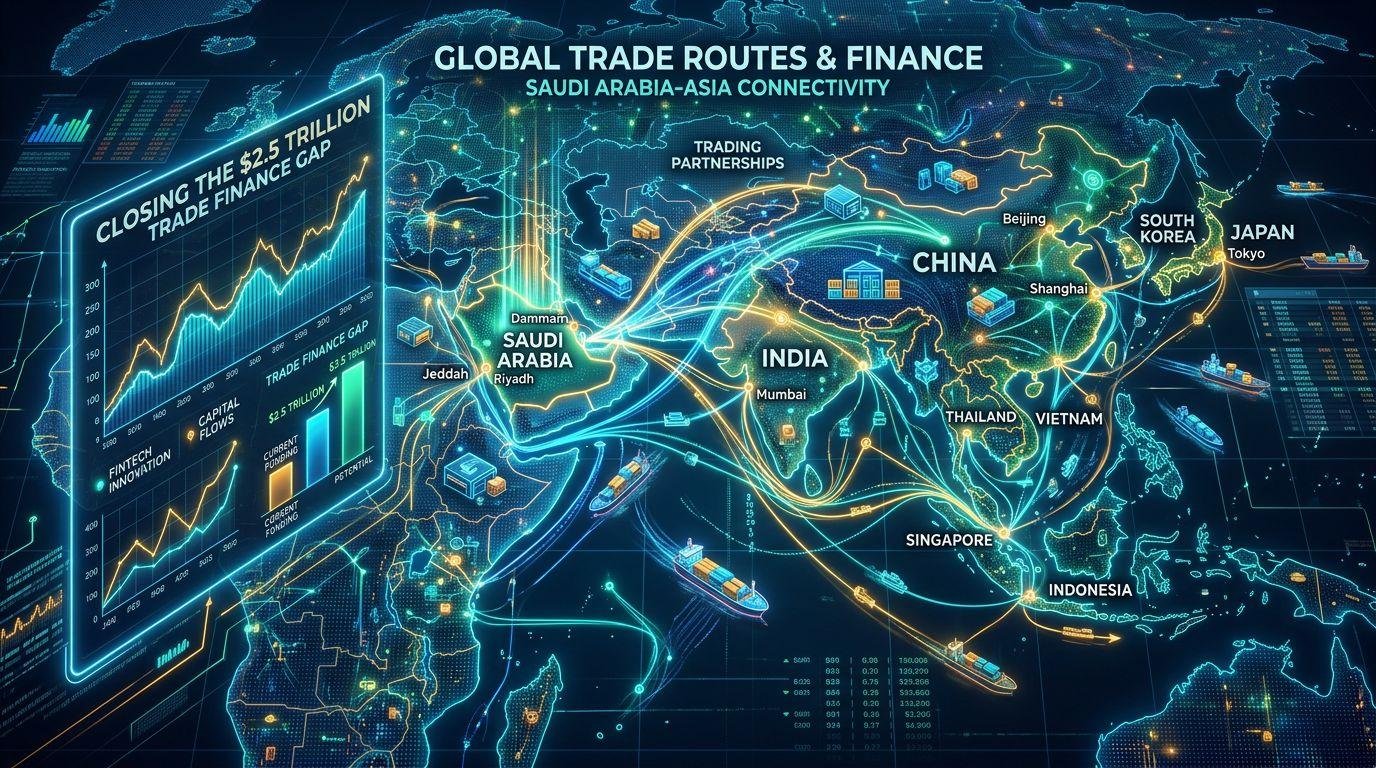
The global shortfall in trade finance remains vast at $2.5 trillion, according to the Asian Development Bank’s latest 2025 survey, a sum equivalent to roughly 8% to 10% of world trade depending on the measure used. The bank says the gap has not narrowed since 2023, underscoring how many otherwise viable transactions still struggle to secure funding. It also found that 80% of the lenders surveyed expect demand for trade finance to rise in the near term as companies diversify supplier...
Continue Reading This Article
Enjoy this article as well as all of our content, including reports, news, tips and more.
By registering or signing into your SRM Today account, you agree to SRM Today's Terms of Use and consent to the processing of your personal information as described in our Privacy Policy.
s, shift markets and redraw supply chains in response to a more fragmented trading environment.
That mismatch between commercial activity and available financing sits at the heart of a persistent problem. A sale may be agreed and goods may be delivered, yet cash does not necessarily arrive at the same time. Suppliers often have to wait weeks or even months before payment is made, leaving them exposed to working-capital pressure even when orders are strong. In practice, this means a business can run into trouble not because demand is weak, but because it is expanding faster than its access to liquidity.
Supply chain finance is designed to bridge that gap. When a smaller supplier has an invoice backed by a large, creditworthy buyer, a financier can advance payment early and collect from the buyer when the invoice falls due. In effect, the stronger credit profile of the anchor buyer is used to unlock funding for firms that might otherwise be shut out of traditional lending. The ADB has argued that scaling such structures, along with expanding trade digitalisation and widening access to trade finance registries, could help narrow the market’s structural shortfall.
India offers one of the clearest examples of how that model can work in practice. Under the Reserve Bank of India’s electronic invoicing and discounting framework for small and medium-sized enterprises, approved invoices can be financed competitively by multiple lenders, allowing suppliers to choose the most attractive offer. Rather than approaching banks one by one in search of cash, sellers can effectively place their receivables into a competitive marketplace.
The relevance of such mechanisms has grown sharply since the pandemic, as well as after geopolitical tensions, shipping disruptions and trade frictions forced firms to rethink how they source, produce and distribute goods. Efficiency still matters, but resilience has become just as important. That resilience is not only physical, in the form of ports, warehouses and inventories, but financial too. A supply chain is only as strong as its weakest link, and that weak link is often a smaller supplier with orders in hand but insufficient cash to fund production until payment arrives.
Against that backdrop, the launch by Saudi Arabia’s Public Investment Fund of Tawreed for Financial Solutions can be read as part of a broader push to strengthen liquidity across the economy’s industrial base. Described as a digital platform linking buyers, suppliers and financiers, it includes early payment for invoices that have been approved. The timing is significant. Saudi Arabia’s large-scale projects, efforts to localise industry and supply chains, and the expansion of new sectors have all increased the number of contractors, vendors, and small and medium-sized enterprises operating around major investment programmes.
The logic is straightforward. As investment scales up, the need to finance working capital rises alongside it. Large projects do not build a stronger private sector on their own; the wider effect comes when the value they create circulates more quickly to the firms around them. By shortening the gap between delivering value and receiving payment, supply chain finance can give more companies room to grow, improve the resilience of supply networks, and use capital more efficiently within the domestic economy. In that sense, an unpaid invoice is not merely an administrative claim. It can also be a financial asset, one that helps convert commercial activity into immediate funding and keeps the machinery of trade moving.
Source: Noah Wire Services