


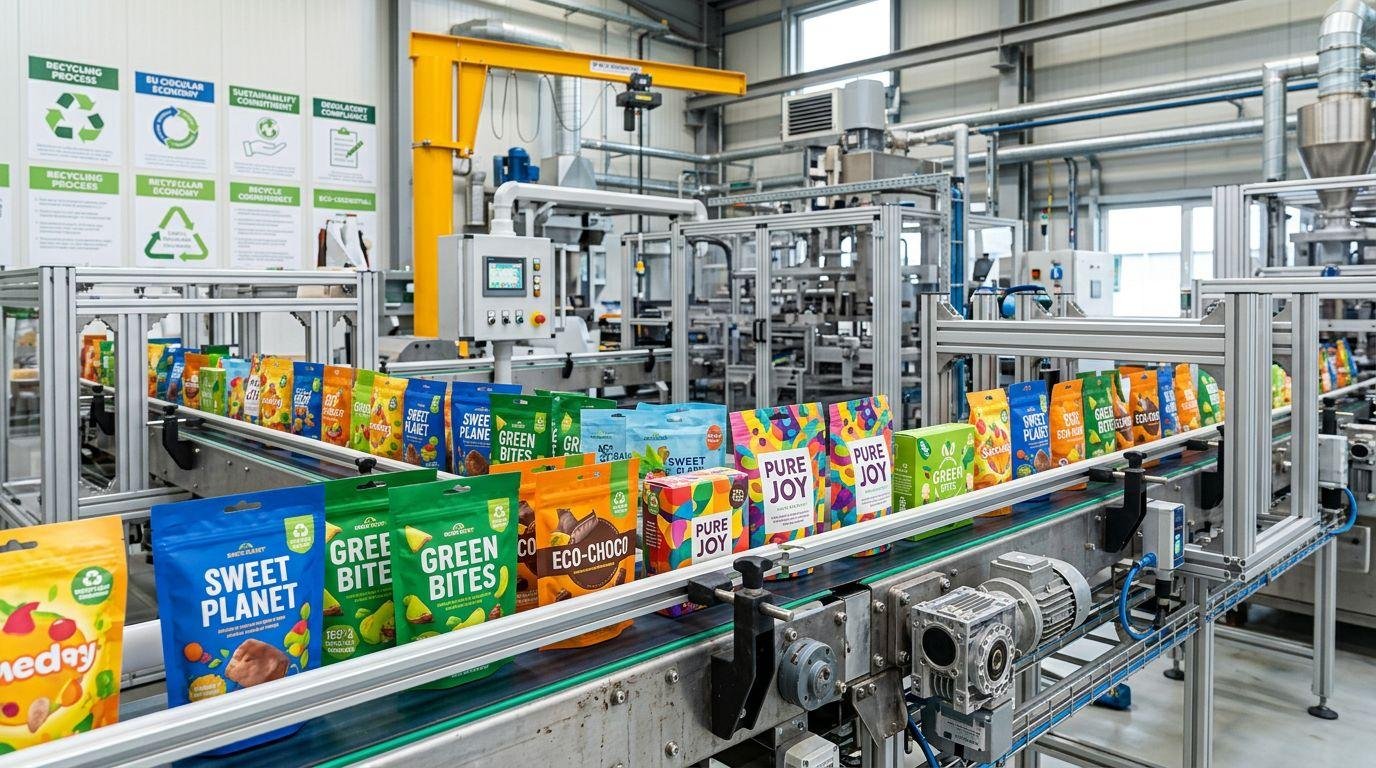
Confectionery packaging has to do two jobs at once: it must attract buyers and keep products intact. In an industry where presentation and protection are both commercially vital, sustainability cannot simply be bolted on afterwards. Any shift to lower-impact packaging has to work with filling lines, distribution networks and shopper expectations, according to PMMI’s 2025 report, The New Material World: Packaging’s Path Toward Sustainability.
That balancing act has ...
Continue Reading This Article
Enjoy this article as well as all of our content, including reports, news, tips and more.

By registering or signing into your SRM Today account, you agree to SRM Today's Terms of Use and consent to the processing of your personal information as described in our Privacy Policy.
The result is a market that is increasingly reactive to the toughest rules in force. Many companies are effectively designing for California first, not because they sell only there, but because building separate packaging systems for different states is too costly and too complex. PMMI’s 2026 Packaging State of the Industry report reinforces that point, showing that sustainability pressures, regulation and the need for operational flexibility are now among the main factors influencing machinery investment.
For confectionery manufacturers, the most immediate policy drivers are restrictions on single-use plastics and the spread of extended producer responsibility, or EPR, schemes. These frameworks move beyond isolated material bans and place more of the financial and administrative burden for packaging recovery, recycling and reporting on producers. That is pushing candy makers to examine how fees, compliance obligations and material choices will affect their long-term costs. But many are holding back on major redesigns until the rules are clearer, particularly where fees are still uncertain.
Cost remains the biggest obstacle to greener packaging. PMMI’s interviews with consumer packaged goods companies found that firms are worried not only about higher material prices, but also about the chance of product damage, reduced shelf life or other performance failures. For confectionery, where packaging must protect delicate formats and preserve quality, those risks carry real weight. Even where companies are persuaded of the environmental case, they are reluctant to move too quickly if the commercial trade-offs are unclear.
That caution helps explain why recyclable materials continue to take priority. PMMI’s study found that more than 80% of respondents expected their companies to increase the use of recyclable materials over the next five years. Recycled paperboard with forestry certification was identified as the material most likely to remain in use, alongside SBS paperboard, kraft paperboard, reusable formats, post-consumer recycled rigid materials, post-consumer recycled flexible materials and aluminium. For many companies, recyclability is seen as the most practical sustainability target because it aligns with retailer expectations and fits more easily into existing supply chains.
By contrast, compostable packaging appears to have lost some momentum. PMMI’s 2023 Packaging Compass report had pointed to growing interest in compostable formats, but by 2025 that enthusiasm had slowed. The latest findings suggest an 8% decline since 2022 in the share of respondents who said they were somewhat likely to adopt compostable packaging within five years. Industry professionals cited weak performance in food applications, higher costs, limited composting infrastructure and modest consumer demand as the main reasons. For now, compostables remain a niche or exploratory option rather than a mainstream answer.
The technical barrier is not just the material itself, but the machinery required to run it. Much of the installed packaging equipment base was designed for conventional substrates and formats, which means sustainable alternatives often cannot be adopted at scale without either modifying the line or replacing equipment entirely. PMMI says nearly two-thirds of original equipment manufacturers are now building or adapting machinery to work with more sustainable materials, while close to half report that as much as a quarter of their equipment has been redesigned or modified for that purpose.
That shift matters because packaging changes do not happen in isolation. According to PMMI, the top sustainability priorities for consumer packaged goods firms are reducing the amount of packaging used, increasing the use of recyclable materials and cutting packaging waste in operations. OEMs, meanwhile, are focusing on the same broad agenda from a different angle: redesigning machinery to use less packaging, making equipment compatible with recyclable materials and reducing waste on the production floor.
The overlap is significant. End users and machinery suppliers also pointed to the same three forces most likely to shape packaging over the next five years: consumer preference, cost and legislation or regulation. That convergence suggests that packaging strategy is becoming less about isolated technical fixes and more about coordinated planning across the supply chain.
PMMI’s broader industry data underline the scale of the challenge. Its 2026 Packaging State of the Industry report estimates that the U.S. packaging machinery market reached $11.7bn in shipment value in 2025, with food accounting for roughly 44% of the total. The report also points to flexibility, automation and compliance as central investment themes, indicating that equipment buyers want systems that can adapt to changing materials, labour constraints and regulatory demands.
For confectionery producers, that means sustainability decisions are increasingly tied to machine capability. A packaging format that looks attractive in theory may prove difficult to run reliably on older lines, especially if it affects throughput, sealing performance or product protection. As a result, many companies are choosing gradual adjustments rather than wholesale redesigns. The emphasis is on making packaging lighter, more recyclable and less wasteful without compromising the functional demands of candy production.
PMMI argues that this is where collaboration between OEMs and end users becomes essential. Manufacturers need more than a machine supplier; they need a partner able to anticipate future material requirements, help interpret regulatory change and develop systems that can handle new substrates without undermining efficiency. In a market shaped by uneven rules and rising expectations, that kind of coordination is becoming a competitive necessity rather than an optional extra.
The message for the confectionery sector is clear. Sustainable packaging is no longer a side project, but it cannot succeed if cost, compliance, consumer appeal and machinery performance are treated separately. The companies most likely to progress are those willing to align packaging design, operations and equipment strategy at the same time, rather than waiting for a single perfect material or a fully settled rulebook.
That practical, collaborative approach is expected to be a focus at PACK EXPO International 2026 in Chicago, where confectionery technology and sustainability-related packaging solutions will be prominent. For an industry under pressure to reduce materials, meet emerging EPR obligations and maintain product quality, the next phase of progress is likely to come from better coordination between brands and the machinery makers that serve them.
Source: Noah Wire Services
Subscribe to Industry Updates
Get the latest news and updates directly to your inbox.

