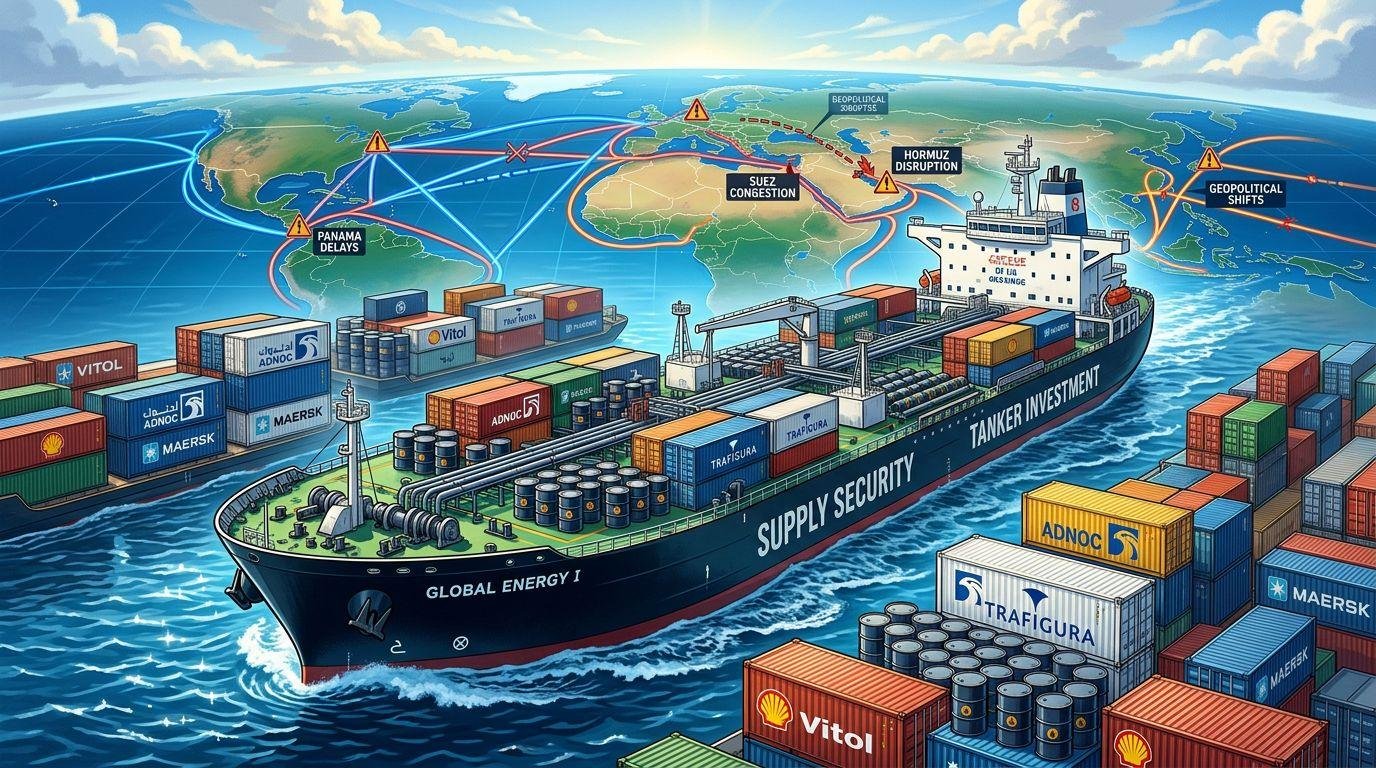
In shipping, control of the vessel has long meant control over the cargo’s fate. That lesson is being rediscovered with particular force as geopolitical friction, sanctions risk and chokepoint uncertainty push commodity groups to secure their own tonnage.
ADNOC Logistics & Services has become one of the clearest examples of that shift. According to the company, it agreed in August to acquire five very large gas carriers and six very large crude carriers for about $1.3 bil...
Continue Reading This Article
Enjoy this article as well as all of our content, including reports, news, tips and more.
By registering or signing into your SRM Today account, you agree to SRM Today's Terms of Use and consent to the processing of your personal information as described in our Privacy Policy.
lion, adding to a broader fleet expansion designed to support ADNOC Group’s integrated value chain and rising production, trading and export volumes. The move follows earlier orders for four LNG carriers and additional options exercised later in the summer, taking ADNOC’s announced vessel commitments in 2026 to roughly $2.7 billion. The message is unmistakable: in an increasingly volatile shipping market, the group wants more of the steel under its own barrels.
Trafigura is making a similarly notable move, albeit through a different structure. In September, the commodities trader said it had created Volare Shipping, a new group company that will own, operate and grow a modern tanker fleet. The initial portfolio includes six very large crude carriers already on the water and eight newbuilds, with the company planning a private placement and a future listing on Euronext Growth Oslo under the ticker “VLCC”. For a house that has traditionally relied more heavily on chartering than outright ownership, the step marks a significant change in philosophy. Trafigura’s head of shipping, Andrea Olivi, has argued that owning the assets now offers a better value proposition.
The timing helps explain the confidence. Tanker markets have been jolted by the Strait of Hormuz crisis, with freight rates reaching record levels as owners become more reluctant to expose ships to risk. In some trades, the cost of hiring a tanker has risen sharply, turning freight into a material variable in the economics of oil trading rather than a background expense. For a trader without assured access to tonnage, that can mean weaker leverage and less flexibility.
That is why the current wave of asset acquisition among cargo owners makes strategic sense. In periods of disruption, ship ownership can secure supply, create optionality and preserve access when capacity is rationed by fear as much as by economics. Physical assets , ships, terminals and storage , become part of the competitive advantage.
Yet the case for ownership is strongest when markets are distorted. The harder question is what happens when the distortion fades.
If waterways normalise, sanctions ease and routing distances shorten, the economics of captive fleets can look very different. Ships that were acquired to solve a crisis may then sit in a business environment where specialist operators can deploy tonnage more efficiently, combine cargoes, reduce ballast legs and chase the best market returns. A cargo owner’s fleet, by contrast, is usually there first to serve the parent’s own flows. That can mean internal employment decisions based on group needs rather than market signals, with the risk that a vessel is “busy” while still being economically sub-optimal.
This is where hidden costs can creep in. A trading house or national oil company may barely notice a few extra dollars a tonne in freight if the overall commodity margin is still healthy. But the inefficiency does not vanish; it simply migrates into the wider balance sheet. Eventually, the cost shows up in the delivered price of the cargo, and from there it is passed on to end users , through fuel bills, power tariffs and the price of manufactured goods.
The industry has seen a version of this before in Vale’s Valemax programme. The giant ore carriers were conceived to reduce transport costs from Brazil to China and help level the playing field against rivals closer to the Asian market. On paper, the concept was elegant. In practice, it collided with regulatory resistance and port restrictions in China, forcing the vessels into floating transshipment and undermining the original business model. Vale ultimately moved away from direct ownership, selling its ships and relying instead on long-term contracts and partnerships with specialist owners. The fleet survived; what changed was who carried the ownership burden and market risk.
That example offers a useful warning for today’s wave of cargo-owner ship purchases. The answer is not necessarily to avoid ownership altogether. Rather, it is to treat it as a disciplined commercial tool rather than a convenience. Internal shipping businesses should be benchmarked against the market, not insulated from it. Captive vessels should still compete for cargo where possible. And companies buying tonnage in a period of extraordinary freight rates need to be honest about what happens when those rates normalise.
There are alternative ways to achieve security of supply without carrying the full weight of ownership. Long-term contracts of affreightment, strategic alliances with specialist operators and carefully structured time charters can deliver many of the same benefits with less exposure to future inefficiency. Vale’s own experience suggests that flexibility and partnership may ultimately be more durable than steel alone.
The current rush into ownership therefore reflects both opportunity and caution. For ADNOC, Trafigura and others in the same position, the goal is clear enough: protect supply chains, secure capacity and preserve control in a more dangerous shipping world. But the lesson from earlier cycles is equally clear. Ships bought for a crisis can become costly liabilities if they are kept in service for the wrong reasons after the crisis has passed.
Control is useful. Ownership can be strategic. Yet efficiency remains the real prize, because when it disappears, someone else eventually pays for it.
Source: Noah Wire Services