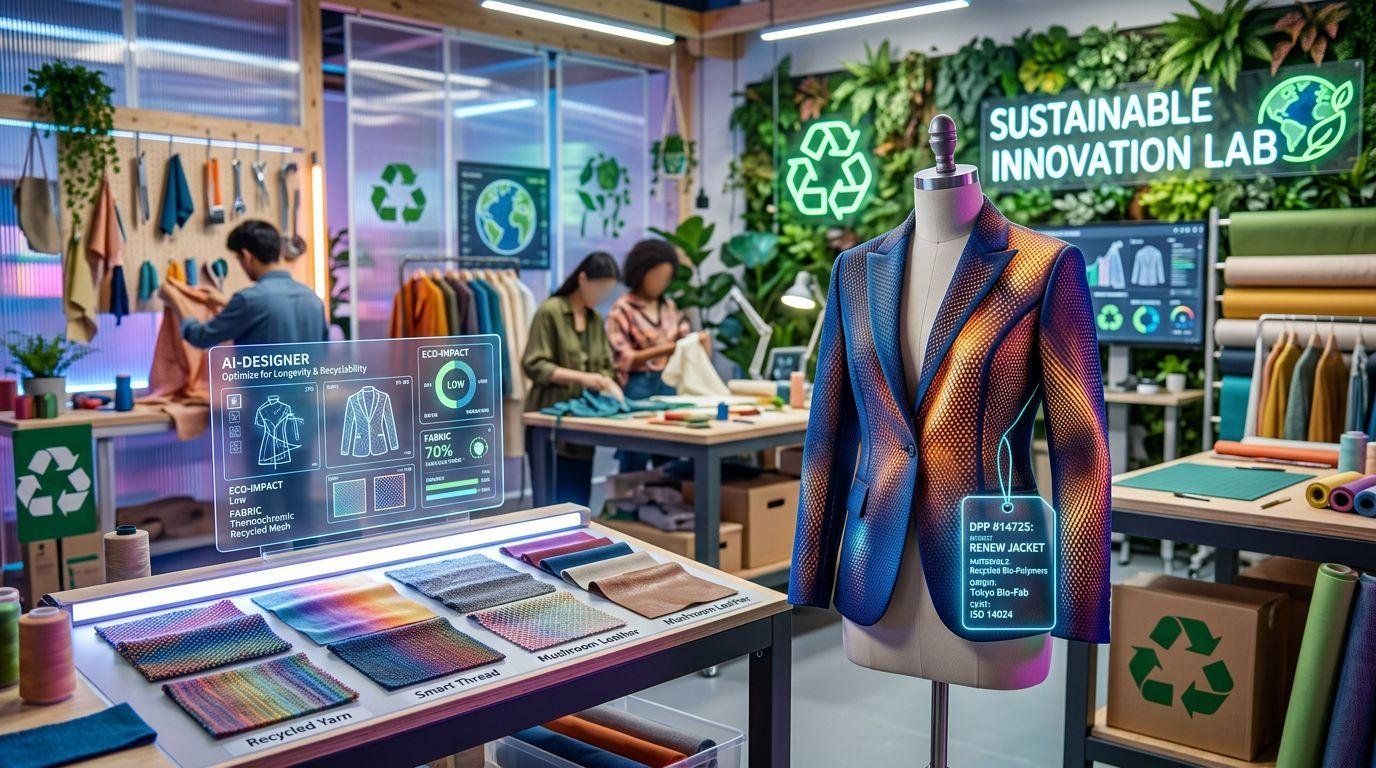
Fashion is moving far beyond the catwalk into a more technical, data-rich and commercially demanding phase, as designers, manufacturers and retailers try to reconcile creativity with climate pressure, supply-chain scrutiny and faster-changing consumer expectations.
The industry has long reinvented itself through new fabrics, shifting tastes and cultural change. What is different now is the speed and breadth of the transformation. Digital design tools, smart textiles, product-tr...
Continue Reading This Article
Enjoy this article as well as all of our content, including reports, news, tips and more.

By registering or signing into your SRM Today account, you agree to SRM Today's Terms of Use and consent to the processing of your personal information as described in our Privacy Policy.
Artificial intelligence is becoming one of the clearest signs of that shift. In practice, it is being used to generate concepts, test silhouettes, compare colourways, visualise prints and support early-stage decision-making before a physical sample is made. That matters because fashion development has traditionally been expensive, time-consuming and highly iterative. If digital tools can narrow the field more quickly, they can cut waste and speed up launches. Dowcloth, which offers a generative AI platform for fashion businesses, says such systems are designed to help brands, luxury houses, mills, retailers and sportswear companies bring collections to market faster through content generation, product visualisation and workflow automation.
But the promise of AI in fashion is not simply about acceleration. A critical review published by Nature this year argued that machine learning and deep learning are changing fabric design itself, influencing surface patterns, material properties and structural concepts. Another Nature Index analysis said generative systems, 3D simulation and virtual prototyping are shortening sampling cycles and improving collaboration across design, manufacturing and retail. A separate review on AI applications in apparel design and fit optimisation pointed to body scanning, computer vision and predictive modelling as tools that can improve drape, comfort and performance while reducing reliance on physical prototypes. The implication is that AI is not just a creative assistant; it is becoming part of the engineering of garments.
Still, the limits are obvious. A machine can suggest a form, but it cannot on its own understand whether that form works in real fabric, on a moving body or within a brand’s cultural language. Originality, authorship and intellectual property remain live concerns, especially as fashion houses test how much of the creative process can be delegated to automated systems. The most credible use of AI, therefore, is as an exploratory instrument, not a replacement for human judgement.
That same tension between innovation and practicality is shaping the rise of smart textiles. A recent review indexed by PubMed examined the convergence of smart fabrics, the Internet of Things and human-centred design, concluding that comfort, invisibility to the wearer and environmental responsibility must sit alongside technical performance. Across healthcare, sport, defence and fashion, textile-based sensors and conductive fibres are opening the door to garments that monitor, respond and adapt. Fulgar, a materials company, describes smart fabrics as textiles and yarns enhanced by sensors, microchips or nanomaterials that can react to temperature, humidity, pressure or movement.
For fashion, that means clothing can become more responsive to the body and the environment. Breathable layers, moisture management, modular construction and climate-adaptive silhouettes are no longer just performancewear concerns; they are filtering into mainstream collections as weather patterns become less predictable and consumers expect greater versatility from what they buy. Reuters reported this week that unusually warm weather was complicating the seasonal transition in Paris, underscoring how shifts in climate can affect both design decisions and retail planning. When autumn arrives late, coats and heavier garments can sit unsold for longer, increasing markdown risk and putting pressure on inventory management.
That commercial strain is one reason sustainability is moving from broad branding claims to harder questions of traceability. More brands now talk about tracking materials, documenting production and improving accountability across supply chains. One emerging tool is the Digital Product Passport, intended to carry information on composition, origin, repairability and end-of-life handling. The appeal is obvious: better data can support recycling, supplier oversight and more credible environmental claims. But the practical demands are significant. Manufacturers need systems capable of collecting and maintaining reliable information across multiple tiers of production, often in regions where digital infrastructure and standardisation vary widely.
Research published in 2026 on textile manufacturers in Bangladesh, India and China found that readiness for digital product passports and broader circularity systems remains uneven, even as the case for adoption grows stronger. The study, which surveyed 105 manufacturers, highlighted the gap between strategic ambition and day-to-day factory realities. That gap is especially important in Bangladesh, where the garment sector remains central to the economy and deeply embedded in international sourcing networks. Buyers increasingly expect not only cost efficiency and quality, but also transparency, compliance and evidence that production is becoming more resource-efficient.
For manufacturers, the pressure is therefore twofold. They must continue to deliver at scale while also investing in digital inventory systems, production planning, energy efficiency and better documentation. Automation can help with tasks such as cutting, inspection, warehousing and process monitoring, but it is not a universal remedy. Each factory faces its own combination of labour needs, capital constraints, product types and buyer expectations. The practical value of technology depends on whether it improves productivity without undermining working conditions or creating new forms of exclusion.
That human dimension is central to the industry’s next phase. Fashion innovation is often described in terms of machinery, software and smart materials, but the sector still relies on skilled people: pattern-makers, technicians, machinists, textile specialists, artisans and designers. The strongest examples of innovation do not erase that expertise; they build on it.
Recent fashion presentations have shown how tradition and technology can coexist. At Paris Fashion Week in October 2026, designer Gabriela Hearst unveiled a collection inspired by Afghanistan that included ikat patchwork and shisha mirror embroidery, with Afghan women artisans involved through the non-profit organisation Turquoise Mountain. Projects like that demonstrate that craft can remain commercially and culturally relevant in a high-tech era, while also raising questions about fair pay, recognition and who benefits when heritage techniques are translated into luxury markets.
The larger lesson is that novelty alone is not enough. A garment may use advanced software, smart fibres or detailed product data, but it still has to be wearable, durable, commercially viable and responsibly made. The industry’s most promising innovations are those that answer concrete questions: does this reduce waste, improve fit, extend usefulness or make production more transparent? Can it be scaled without placing unreasonable burdens on factories or workers? Does it add genuine value for the consumer?
Fashion’s future is likely to be defined by exactly that balance. Designers, engineers, manufacturers and artisans are all contributing to an industry that is no longer just about appearance. It is about systems, materials, climate resilience, traceability and the stories garments carry with them. The challenge is to ensure that, as clothes become smarter, the industry around them becomes more thoughtful as well.
Source: Noah Wire Services
Subscribe to Industry Updates
Get the latest news and updates directly to your inbox.