Artificial intelligence is already embedded in many supply chain systems, helping teams build forecasts, surface exceptions and interrogate data in ordinary language. Yet the harder question is not whether these tools are available, but whether they are changing the quality of decisions made on the factory floor, in warehouses and across distribution networks.
That question matters because supply chains are unforgiving places for technology that promises more than it can reliab...
Continue Reading This Article
Enjoy this article as well as all of our content, including reports, news, tips and more.
By registering or signing into your SRM Today account, you agree to SRM Today's Terms of Use and consent to the processing of your personal information as described in our Privacy Policy.
ly deliver. Gartner warned in June that more than 40% of agentic AI projects are likely to be cancelled by the end of 2027, blaming rising costs, vague business cases and weak risk controls. In supply chain operations, where margins are often tight and mistakes quickly become expensive, those problems can surface fast.
The core challenge is that supply chain decision-making is not a language problem alone. Generative AI is good at interaction: it can help planners query systems, tidy messy data and test scenarios without requiring them to become optimisation experts. But many operational choices depend on something more exacting than conversation. They require a model that can assess options against real constraints and determine what is actually possible.
A railcar illustrates the point. In one business, it is just a transport asset. In another, it doubles as temporary storage when tanks are full. That seemingly small detail can change the whole planning problem, affecting capacity, timing and inventory flow. A large language model may understand the description, but a decision engine has to convert it into workable constraints and trade-offs.
Consistency is another issue. Language models do not produce answers deterministically, which means the same question can yield different results at different times. That is acceptable when drafting an email. It is far more problematic when a planner is deciding which site should absorb lost production or how to protect customer service if a line goes down. Mathematical optimisation, by contrast, is repeatable: the same inputs generate the same output, and the logic can be traced.
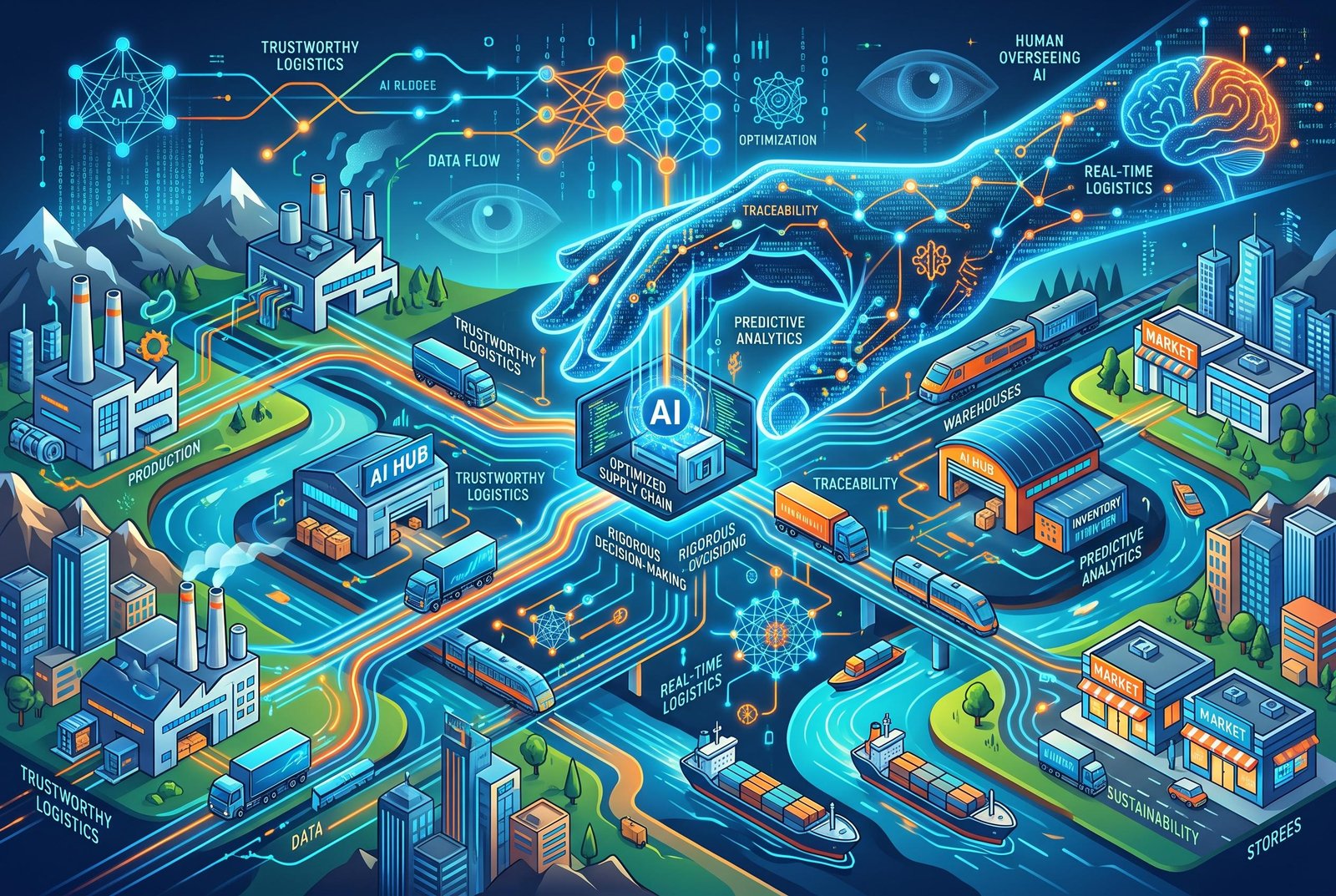
That is why the most promising approaches pair generative AI with optimisation rather than treating them as substitutes. The companies deriving genuine value from supply chain AI are not relying on a chatbot alone; they are building systems in which natural-language interfaces sit on top of a rigorous decision layer.
The need for that rigor becomes sharper when disruption hits. A production stoppage, a sudden tariff change or a carrier capacity crunch can make yesterday’s assumptions obsolete almost immediately. The task is to compress the time between recognising a change and deciding how to respond. Planners need answers that reflect available capacity, inventory, transport options and service commitments, not just a plausible explanation.
But speed only matters if the people using the system trust what it tells them. That is where governance comes in. As AI moves closer to consequential decisions, companies need transparency around assumptions, visibility into how recommendations were generated, and clarity about which data and constraints shaped the result. Models should be validated before deployment, material changes should be observable, and accountability for decisions affecting customers, workers and capital must remain clearly assigned.
That does not mean humans are being replaced. On the contrary, the most responsible model keeps decision ownership with people while using AI to widen the set of options they can examine. The technology should help planners think faster and more broadly, not take the final call away from them.
Regulators are moving in the same direction. The EU AI Act places emphasis on transparency and human oversight for higher-risk systems, even as implementation details continue to evolve. Supply chain leaders do not need to wait for enforcement to adopt those standards themselves. In a sector where confidence in a recommendation can influence service levels, labour allocation and cash tied up in inventory, waiting for problems to emerge in production is a costly way to learn.
There is a practical test for any supply chain AI project. Ask the planner who will use it whether they would put next week’s service targets on the line based on its recommendation alone. If the answer is that they would still need to verify it in a spreadsheet, the system may be impressive, but it is not ready to carry real operational weight.
Source: Noah Wire Services