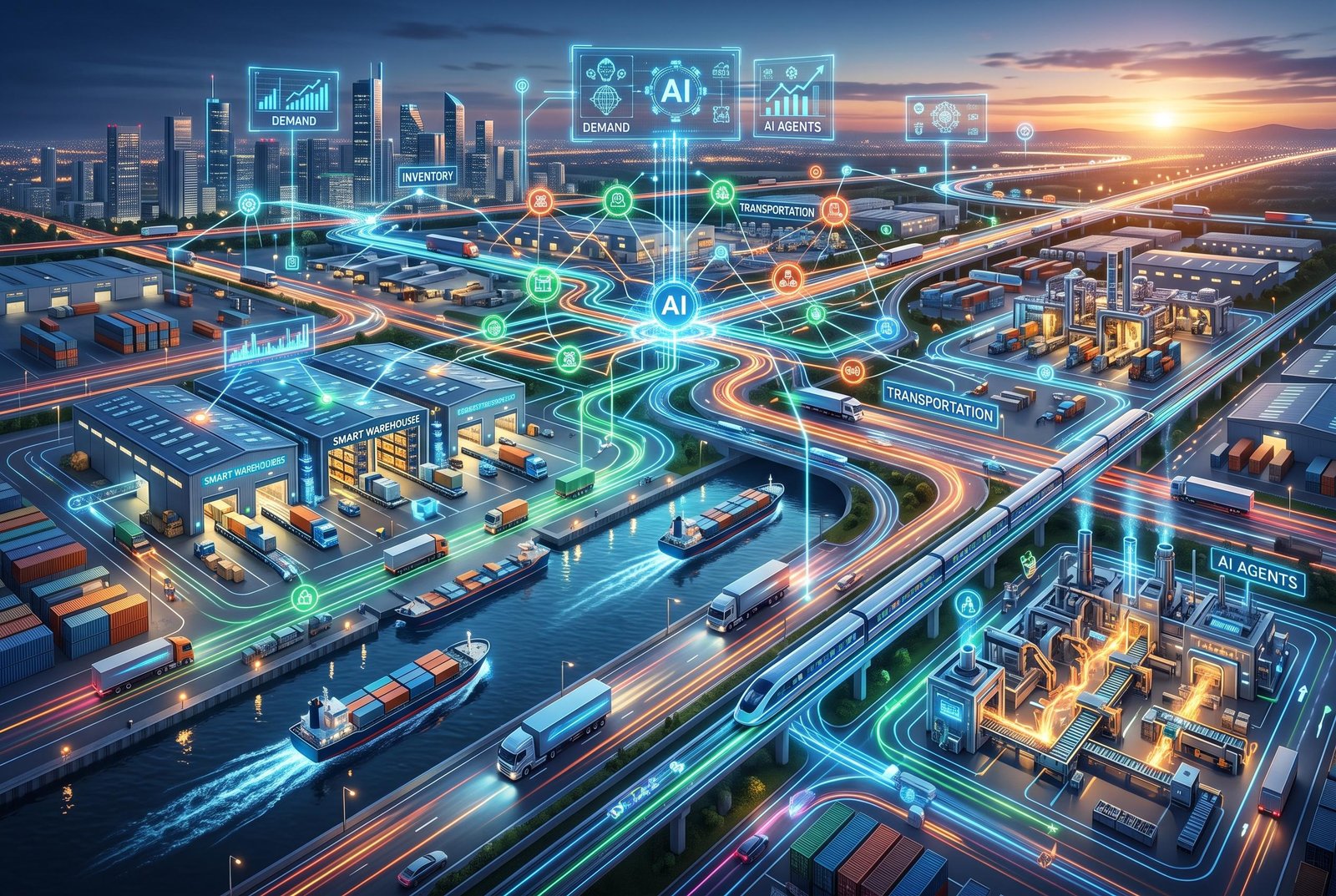
Vendors are positioning agentic AI as the bridge between supply chain planning and execution, enabling disruption responses to be assessed across demand, inventory, transport and production in near real time.
AI agents are increasingly being presented as the missing link between supply chain planning and execution, with vendors and consultants arguing that the biggest gains come not from isolated automation but from systems that can reason across functions in real time. In prac...
Continue Reading This Article
Enjoy this article as well as all of our content, including reports, news, tips and more.
By registering or signing into your SRM Today account, you agree to SRM Today's Terms of Use and consent to the processing of your personal information as described in our Privacy Policy.
tice, that means a disruption no longer sits in a queue waiting for a planner to interpret it in one system, then relay a response to another. Instead, the same event can be assessed against demand, inventory, transport and production constraints at once, shortening the time between detection and action.
The underlying appeal is straightforward. When a delay, surge in orders or material shortage appears, conventional workflows often force teams to reconcile fragmented information manually. IBM says AI agents can help by sharing data across supply chain functions, improving coordination, reducing errors and supporting faster decisions. Deloitte similarly describes agentic AI as systems that can perceive information, decide and act with limited human intervention, particularly in areas such as demand analysis, inventory control, fulfilment and logistics. Taken together, those arguments point to a supply chain model in which intelligence is distributed rather than confined to one planning tool or one team.
That shift matters because supply chains are not simply collections of transactions; they are networks of dependent choices. A late shipment may be absorbed if there is inventory in the right location, but it may also trigger a cascade of consequences if the order book is already tight or production capacity is booked. According to Infios, AI agents are beginning to close the gap between planning and execution by helping organisations react across orders, warehouses and transport in near real time. Manhattan makes a similar case for multi-agent orchestration, arguing that coordination across planning, warehouse, transport and order management can remove the delays created by manual hand-offs.
The value of these systems is not only speed but context. A connected agent can compare a late supplier delivery with open orders, available stock, promised customer commitments and manufacturing capacity before suggesting a response. As Logility illustrates in its own guide to AI agents in the supply chain, a bulk order may not be truly new demand at all but demand brought forward from an existing annual commitment. In that sort of scenario, the system can weigh whether to reschedule production, source substitute materials, expedite freight or reset customer expectations, while also showing the likely effect on margin, service levels and on-time-in-full performance.
That is one reason advocates argue that agentic AI is more than a productivity tool. Logistics Viewpoints says these architectures can compress decision cycles by continuously coordinating planning and execution, reducing the lag that often turns manageable interruptions into expensive disruptions. McKinsey has also argued that distributors in particular are using AI to improve decision-making across the business, from strategic planning to frontline operations, turning margin pressure into an advantage through faster and more informed choices.
The common thread is a move away from static plans. Traditional supply chain systems have often been good at producing forecasts and schedules, but less effective when conditions change unexpectedly. AI agents are being positioned as a way to make those plans adaptive, so that a planner is not merely informed of a problem but presented with practical options and their trade-offs. Human judgement still matters, especially when customer relationships, service commitments or commercial priorities are at stake. Yet the promise of agentic systems is that much of the diagnostic work can happen automatically, leaving people to approve the best course rather than assemble the facts from scratch.
For now, the case for AI agents in supply chains rests on a simple proposition: the faster an organisation can turn live signals into coordinated action, the more resilient and efficient it is likely to become. What vendors are describing is less a replacement for planners than a redefinition of their role, with software handling the continuous monitoring and orchestration while humans focus on exceptions, strategy and judgement.
Source: Noah Wire Services