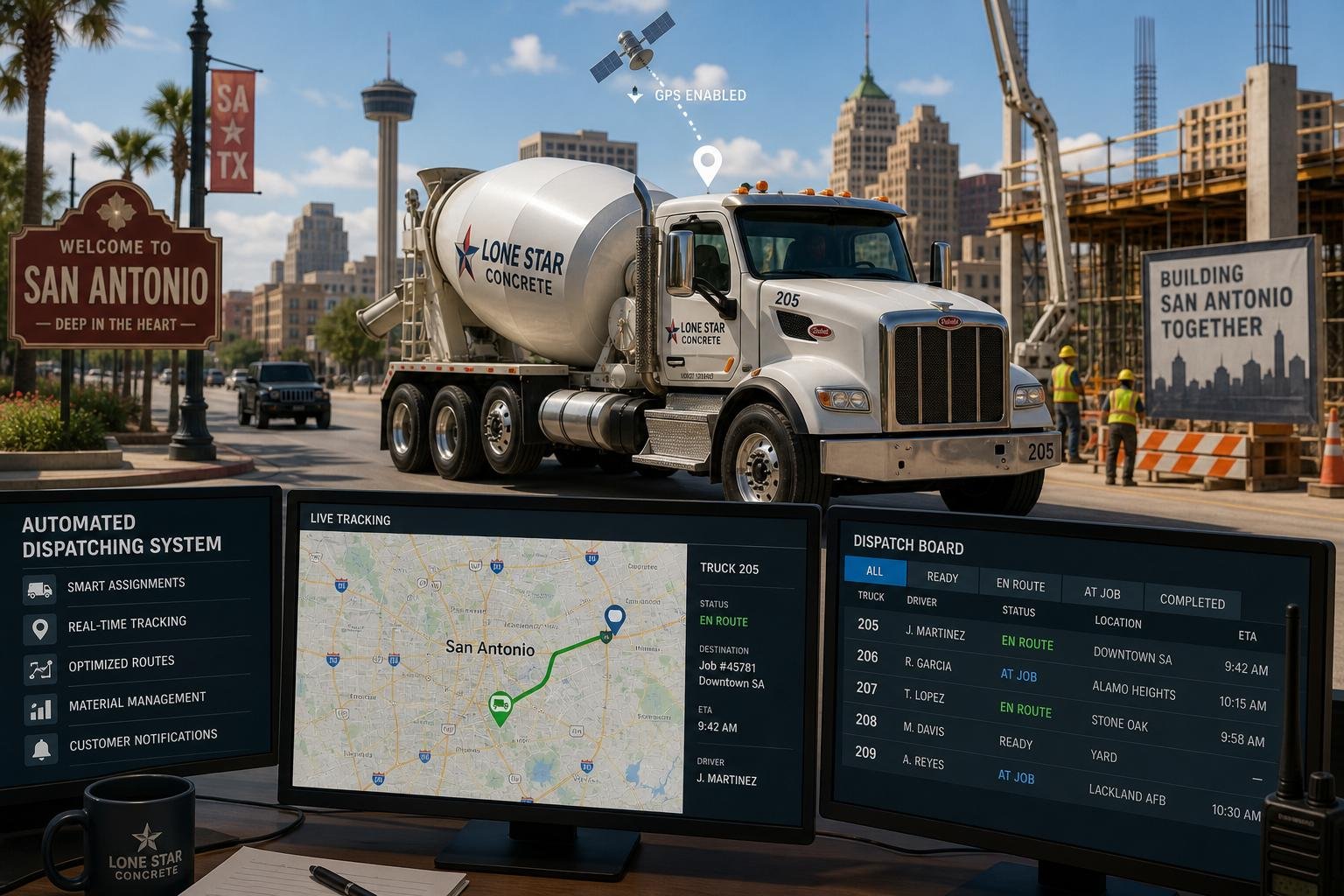
San Antonio’s construction boom has exposed a long-standing weakness in ready-mix concrete delivery: the material’s brief working life leaves little room for error. Once mixed, concrete begins the clock immediately, and hot Texas weather can shorten the usable window further. For years, that meant dispatchers leaned on phone calls, handwritten schedules and rough traffic estimates to keep pours moving. In a market where demand is rising quickly, that old system is increasingly bei...
Continue Reading This Article
Enjoy this article as well as all of our content, including reports, news, tips and more.
By registering or signing into your SRM Today account, you agree to SRM Today's Terms of Use and consent to the processing of your personal information as described in our Privacy Policy.
ng replaced by software-driven logistics.
The shift is most visible in dispatch. Systems that combine GPS tracking with live routing data now allow suppliers to follow each truck in real time, rather than relying on assumptions about where a load should be. That makes arrival times more reliable and gives crews on site a clearer picture of when to prepare for a pour. It also helps reduce costly standstill periods at both the plant and the job site, where every minute matters and delays can compromise a load.
Industry suppliers are also leaning on broader automation tools to manage production and delivery more efficiently. Companies such as ACE-CO, part of Libra Systems, have built batching controls, truck tracking and business integration software for concrete operations, reflecting how the sector is moving from manual coordination toward more connected systems. In practice, that means load ordering, sequencing and production timing can be optimised with less dependence on individual memory and more on live operational data.
That kind of coordination is especially important in San Antonio, where construction activity spans residential growth on the Far West Side, commercial work along major transport corridors and mixed-use development in expanding parts of the metro area. Suppliers serving those projects increasingly need to juggle multiple deliveries across different sites while keeping vehicles, batch plants and crews aligned. In that environment, software can do more than save time: it can reduce fuel use, limit wasted miles and help keep projects within budget.
Some local ready-mix companies are already marketing those capabilities directly to customers. Arcline Ready Mix says it offers GPS tracking so clients can monitor orders in real time, while other San Antonio suppliers, including SATX Ready Mix & Concrete Delivery and VenCrete Ready Mix, emphasise reliability, speed and experience in serving both residential and commercial jobs. That competition suggests the technology is becoming part of the service expectation rather than a premium extra.
The next stage of development may be even more advanced. Predictive tools that use weather, permit data and past ordering patterns could help suppliers plan around heat, storms and shifting demand. Telematics that track drum rotation, concrete temperature and mix consistency may also make it easier to monitor quality in transit. For now, though, the main change is already clear: in San Antonio, concrete delivery is becoming less of a manual balancing act and more of a logistics operation shaped by data.
Source: Noah Wire Services