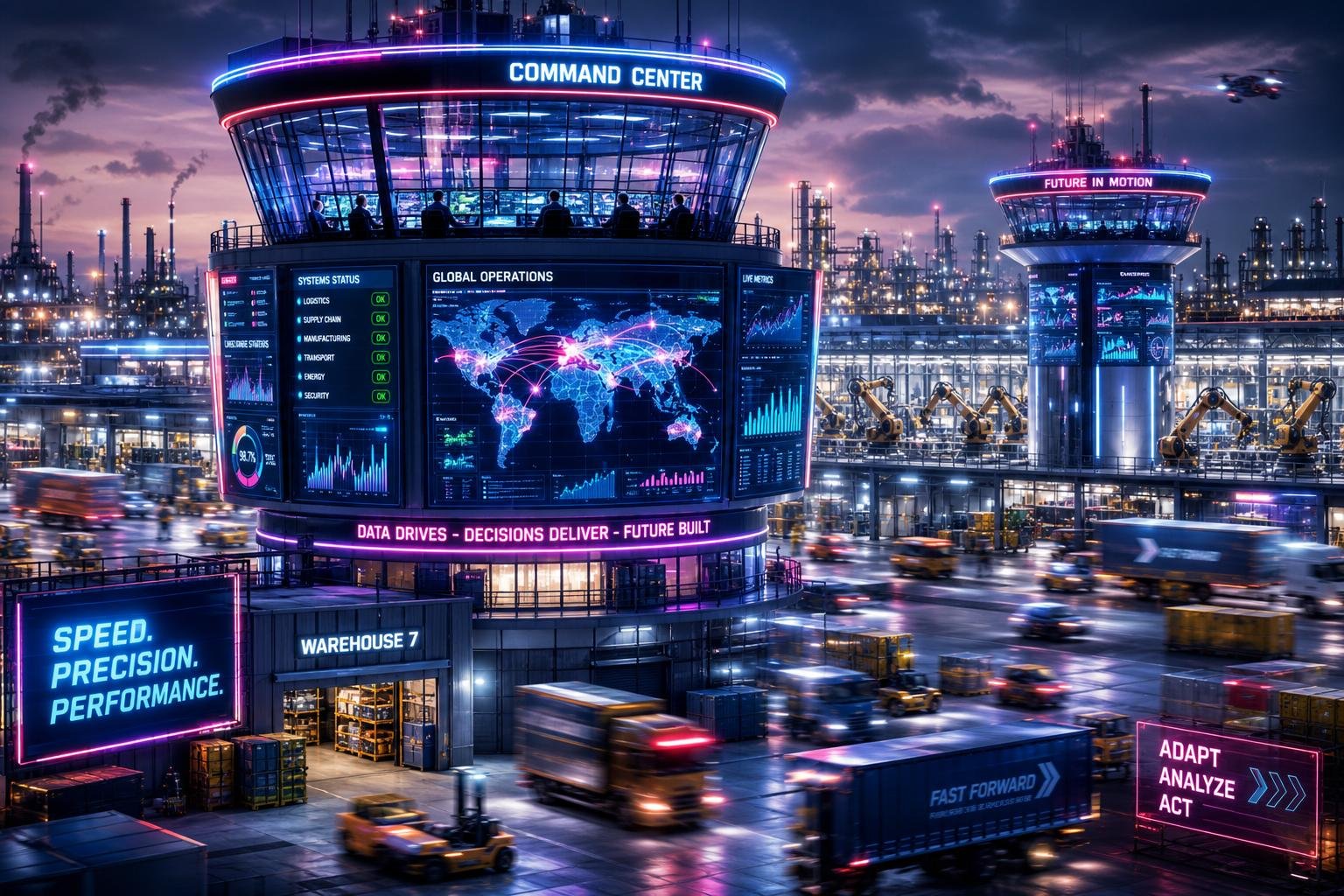
A supply chain warning rarely arrives neatly. More often, it surfaces as a delayed shipment, a missed pickup, or a production line that is about to run short of a critical component. By the time that signal reaches the right person, the business is already paying for it.
That is the central argument behind the growing case for AI-powered control towers. The problem is no longer simply whether companies can see what is happening across their networks. It is whether they can turn...
Continue Reading This Article
Enjoy this article as well as all of our content, including reports, news, tips and more.
By registering or signing into your SRM Today account, you agree to SRM Today's Terms of Use and consent to the processing of your personal information as described in our Privacy Policy.
that visibility into decisions quickly enough to matter.
Many organisations still rely on fragmented systems, with procurement, manufacturing, logistics and distribution each working from different data sets and different definitions of success. McKinsey’s 2025 supply chain risk research suggests the scale of the challenge is worsening: visibility beyond tier-one suppliers remains limited, while tariff pressure is affecting the majority of companies and pushing up costs across supply networks. In that environment, a dashboard may tell a team that something is wrong, but it will not decide what should happen next.
That distinction matters. A traditional control tower is often built to observe, alert and report. A more mature AI-driven version is designed to interpret signals, anticipate disruption and recommend or even trigger responses before the issue becomes a crisis. IBM has described modern control towers in similar terms, as connected systems that help organisations prioritise and resolve critical problems in real time, while also reducing manual work and breaking down data silos.
Some vendors are already pushing that model further. FourKites, for example, positions its Intelligent Control Tower as a platform that combines real-time visibility, digital twins and AI-driven automation to move from detection to action. C3 AI has also been promoting control tower software that supports near real-time monitoring, scenario analysis and root-cause identification. The common theme is clear: the market is shifting away from passive reporting and towards decision support.
SRM Tech’s partnership with Enmovil is framed around that same shift. According to the company, Enmovil’s CADDIE platform acts as an AI control tower that brings forecasting, planning, execution and freight verification into one environment. SRM Tech says its role is to create the integration layer beneath that intelligence, connecting ERP, TMS, WMS and plant-floor systems so the platform is not forced to work with partial information.
The appeal of that model lies in what it promises operationally. Instead of static plans, the business gets recalculated schedules when lead times change. Instead of rough estimated times of arrival, it gets predictive timing across road, rail, air and ocean. Instead of manual reconciliation, it gets automated verification and audit trails. More importantly, decisions can be routed to the right people with the context already assembled, rather than leaving planners to piece together the problem themselves.
That is increasingly important because the old approach to resilience has limits. McKinsey’s survey data suggests many companies have installed digital dashboards, but far fewer have built robust scenario-planning capabilities, and data quality remains uneven. In practice, that means plenty of firms can now see exceptions more quickly, but still struggle to coordinate responses across procurement, production and logistics.
This is why AI-powered control towers are moving from nice-to-have to necessity. The business case is not built on visibility alone. It rests on timing, coordination and the ability to act while choices still exist. In supply chains where disruption can ripple from a supplier delay to a factory stoppage and then on to a customer miss, that may be the difference between a manageable exception and an expensive failure.
The next generation of control towers is therefore less about watching the network and more about orchestrating it. For companies under pressure from tariffs, supplier risk and tighter service expectations, that is becoming a competitive requirement rather than a technology upgrade.
Source: Noah Wire Services