


Many ocean freight decisions still look sound when they are made. Procurement teams compare rates, weigh carrier commitments and award business on the assumption that service promises will hold. The trouble begins later, when operations inherits the consequences of a network that has shifted under pressure.
That gap between commercial planning and real-world execution is where supply chains often lose money. A low rate can sit atop a fragile service, and by the time the weakness becomes visible, the contract has already been signed. The result is familiar: larger inventory buffers, costly spot cover, missed production windows and hours spent tracing cargo that no longer appears to be where it was expected.

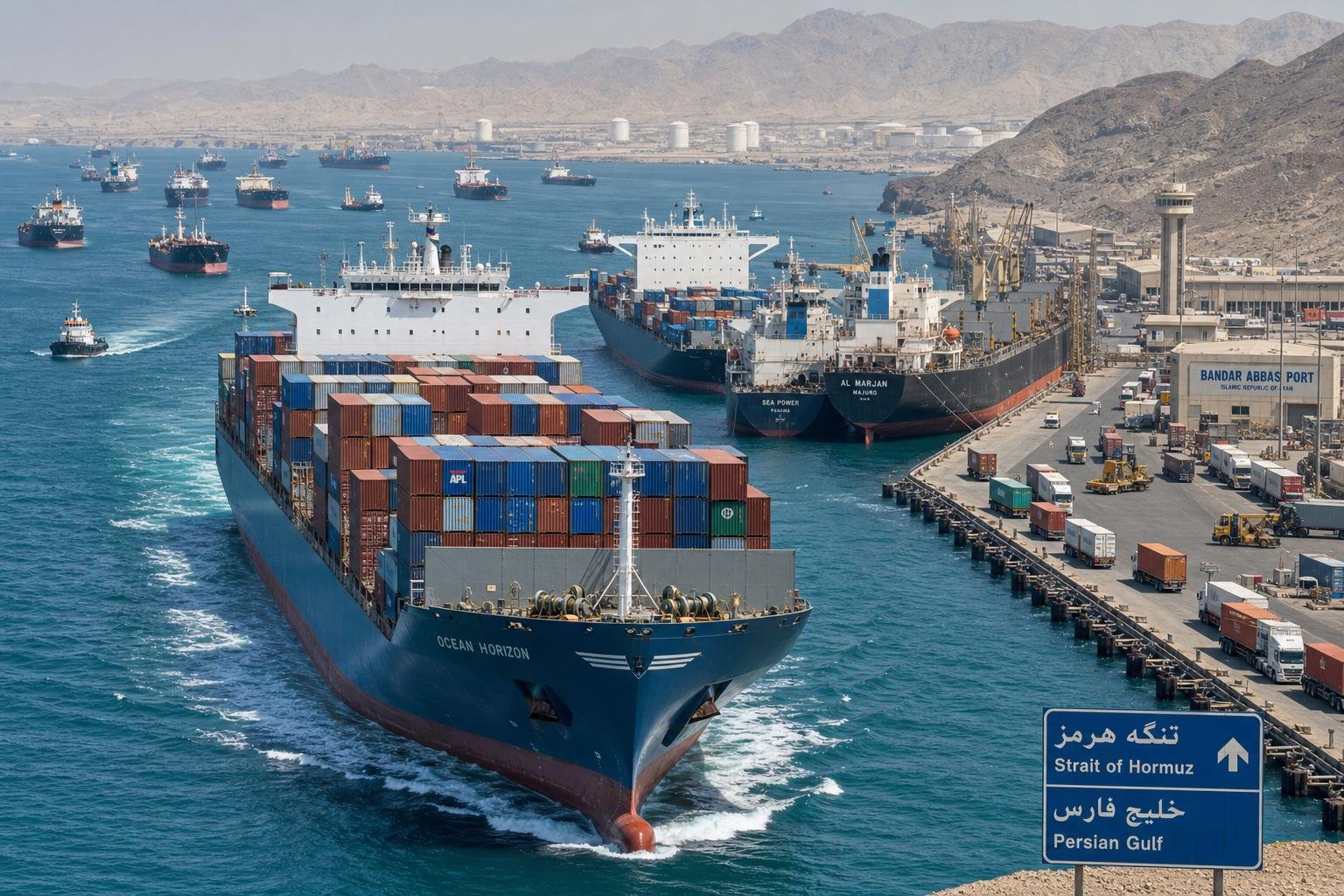
The Strait of Hormuz has become a stark example of how quickly that can happen. As tensions in the region escalated, cargo bound for Gulf markets was diverted and discharged at fallback ports including Khor Fakkan, Sohar, Karachi, Mundra and Nhava Sheva, while some shipments were rerouted through hubs such as Singapore and Colombo. Importers have been forced to improvise, shifting goods onward by road and dealing with customs paperwork that no longer matches the destination. In practice, a delay is no longer just a delay; it can mean freight landing in the wrong country, with the wrong documents and a plan that no longer works.
The wider strategic importance of the waterway explains why the disruption has such broad effects. The US Energy Information Administration says the Strait of Hormuz carried about 20 million barrels of oil a day in 2024, roughly one-fifth of global petroleum liquids consumption. That makes any disturbance in the region a threat not just to energy flows, but to the wider logistics network that depends on stability there.
What shippers need, therefore, is not simply a carrier’s schedule or a sales pitch about service quality. They need evidence of actual performance over time: reliability rates, blank sailings, port omissions and the difference between planned and actual vessel arrivals. Once a call is skipped or cargo is relayed through another hub, the next decision depends on understanding how far the voyage has drifted from the original plan.
Xeneta’s February 2026 Schedule Reliability Scorecard suggests that the problem is not easing. Global schedule reliability fell to 27%, its lowest level since January 2025, while average delays worsened from the previous month. The weakness was especially pronounced on some major trades, with Far East-Europe at 19% on-time and the Middle East trade at 18%. In some cases, services appeared less delayed only because carriers omitted calls to ports such as Abu Dhabi and Jebel Ali, effectively shortening the rotation rather than improving performance.
That distinction matters. A vessel can look more punctual on paper while still failing to provide the service originally sold. For importers, the practical effect is the same: disrupted plans, additional cost and reduced confidence in the carrier network. Freightos has argued that this volatility has pushed ocean freight procurement towards a more research-based approach, with shippers needing to judge carriers on actual execution rather than assumption. Industry observers are increasingly making the same point, saying reliability is no longer a secondary metric but a core part of purchasing decisions.
The pressure is not confined to the Gulf itself. ICIS reported in early April that the closure of the Strait of Hormuz had already lasted five weeks and was pushing spot rates higher on directly affected routes, while even lanes as far away as Asia to the US West Coast were seeing increases. That spillover underlines how disruption in one chokepoint can echo through unrelated corridors, especially when networks are already stretched.
This is where schedule intelligence becomes more than another dashboard. Used properly, it allows shippers to compare planned and actual vessel movements, see where congestion is forming and identify which ports or transshipment hubs are becoming bottlenecks. Xeneta’s argument is that this kind of visibility helps teams decide whether to wait, reroute or revise inland transport plans before the problem turns into a costly surprise.
It also changes how companies make decisions internally. Procurement can assess service quality before a contract is awarded, while operations can check whether a routing choice still makes sense once cargo is on the water. Instead of one team buying on price and another discovering the hidden cost later, both can work from the same view of execution.
In a market where cargo may be discharged at the wrong port, shifted onto a different loop or delayed at an overstretched hub, confidence comes from visibility, not hope. Cost still matters. But cost without execution data is only half the picture.
Source: Noah Wire Services

