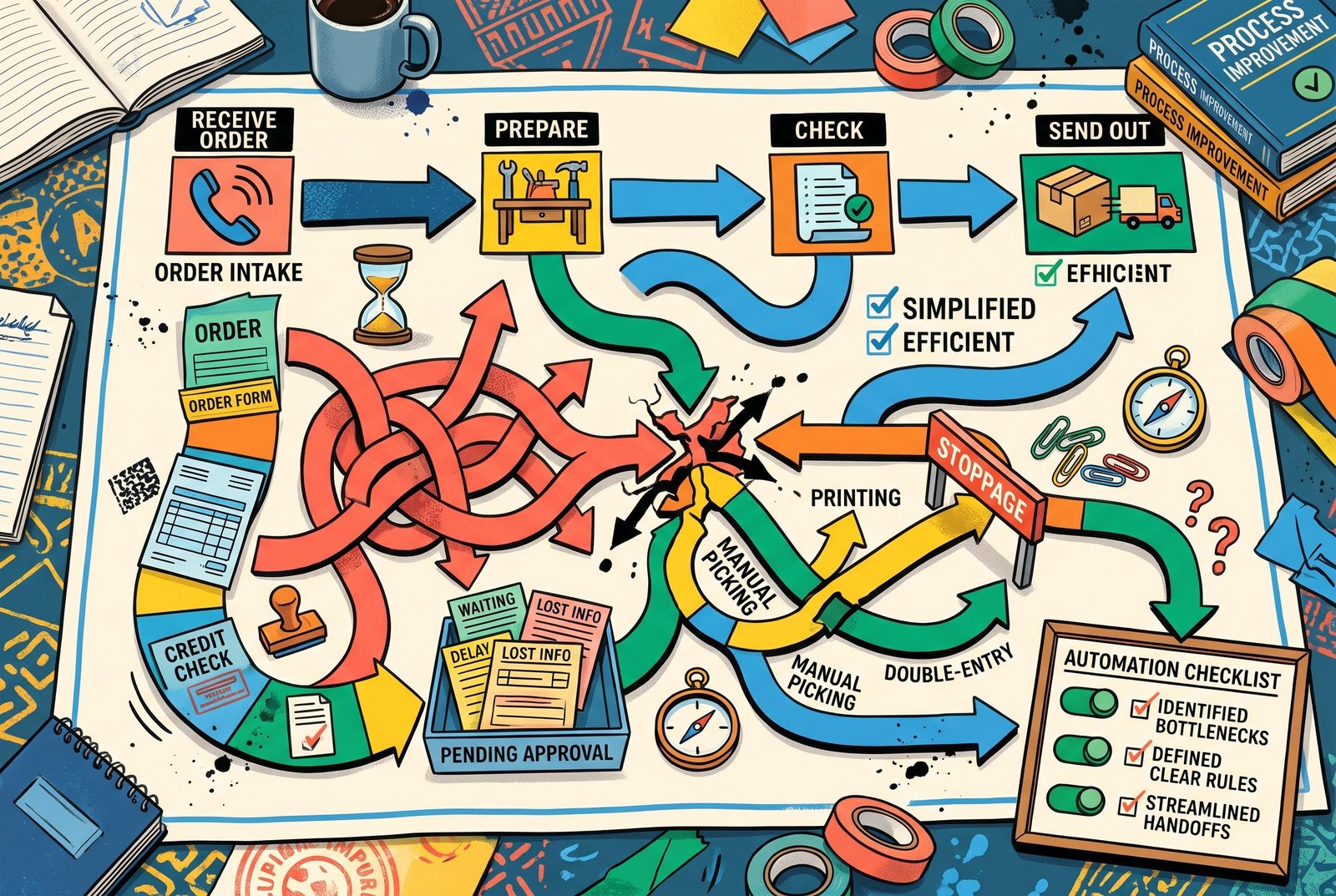
Business processes are connected activities that turn resources, information and effort into an outcome. They may produce something customers value, provide the support that makes that work possible, or guide the organisation’s decisions and oversight. For smaller businesses, understanding how these activities fit together can reveal delays, unclear responsibilities and unnecessary work , and help managers decide where improvement is most worthwhile.
A useful starting point i...
Continue Reading This Article
Enjoy this article as well as all of our content, including reports, news, tips and more.
By registering or signing into your SRM Today account, you agree to SRM Today's Terms of Use and consent to the processing of your personal information as described in our Privacy Policy.
s to distinguish between core, support and management processes. Core processes deliver value directly, through activities such as developing products, making sales, fulfilling orders and serving customers. Support processes , including human resources, information technology and finance , provide the people, systems and controls those activities rely on. Management processes cover planning, performance monitoring and risk management.
The categories are a guide, not a universal rule. APQC, a non-profit organisation specialising in process improvement, notes that a function’s place depends on a company’s business model and priorities. An activity that is central to value creation in one business may be an enabling function in another. Support work should not be dismissed as secondary: a failure in payroll, IT or finance can soon disrupt customer-facing operations.
Business processes are also more than isolated tasks. Microsoft Learn describes them as structured activities that work towards an organisational goal, often crossing teams and departments. Examples include hiring, sourcing and payment, production planning, order-to-cash and recording financial results. Mapping such work end to end can show where responsibility passes between people or systems, and where a delay in one step affects the rest.
The Small Business Trends article recommends documenting workflows, naming owners and tracking measures such as cycle time, error rates and throughput. Those measures can help identify where work is slow, inconsistent or producing avoidable mistakes. But its specific claims about potential gains in time-to-market, compliance and project success are not accompanied by detailed supporting evidence, so they should not be treated as guaranteed results.
A process map is most useful when it reflects what people actually do, rather than an idealised procedure. The Agency for Healthcare Research and Quality advises involving the people who carry out the work, as well as those affected by it. Its guidance suggests arranging observed steps in sequence and using a shared visual map to discuss how the process operates. Though written for healthcare, the method can help businesses expose hand-offs, gaps and workarounds that may otherwise remain hidden.
Not every workflow needs the same degree of structure. Standard processes are repeatable activities that benefit from clear instructions and consistent execution. Other, less regular tasks may arise in response to unusual customer requests or changing operational needs, and can involve substantial manual effort. Recognising the difference helps a business decide where standardisation is useful and where flexibility matters more.
Process management is not a one-off documentation exercise. IBM describes business process management as an iterative cycle: design and model a workflow, develop and test changes, put them into practice, monitor results and refine the process. Performance dashboards can help teams assess whether a change is working, while feedback from staff and customers can identify problems that measures alone might miss.
That sequence matters when considering automation. Technology may help coordinate people, applications and systems, but automating a poorly understood workflow can preserve its problems or make them harder to spot. IBM’s business automation materials promote low-code and no-code tools, process mapping and workflow automation; the company also presents customer examples of efficiency gains. Such cases are vendor-reported and should not be assumed to predict results for every organisation.
For a small business, the practical approach is to begin with the outcome a process is meant to achieve. Trace the work required to reach it, involve the people who perform it, clarify ownership and identify dependencies. Then use evidence from performance measures and user feedback to decide whether to simplify, standardise or automate. Regular review keeps processes aligned with changing priorities and helps ensure that efficiency improvements support , rather than distract from , the value the business aims to deliver.
Source: Noah Wire Services