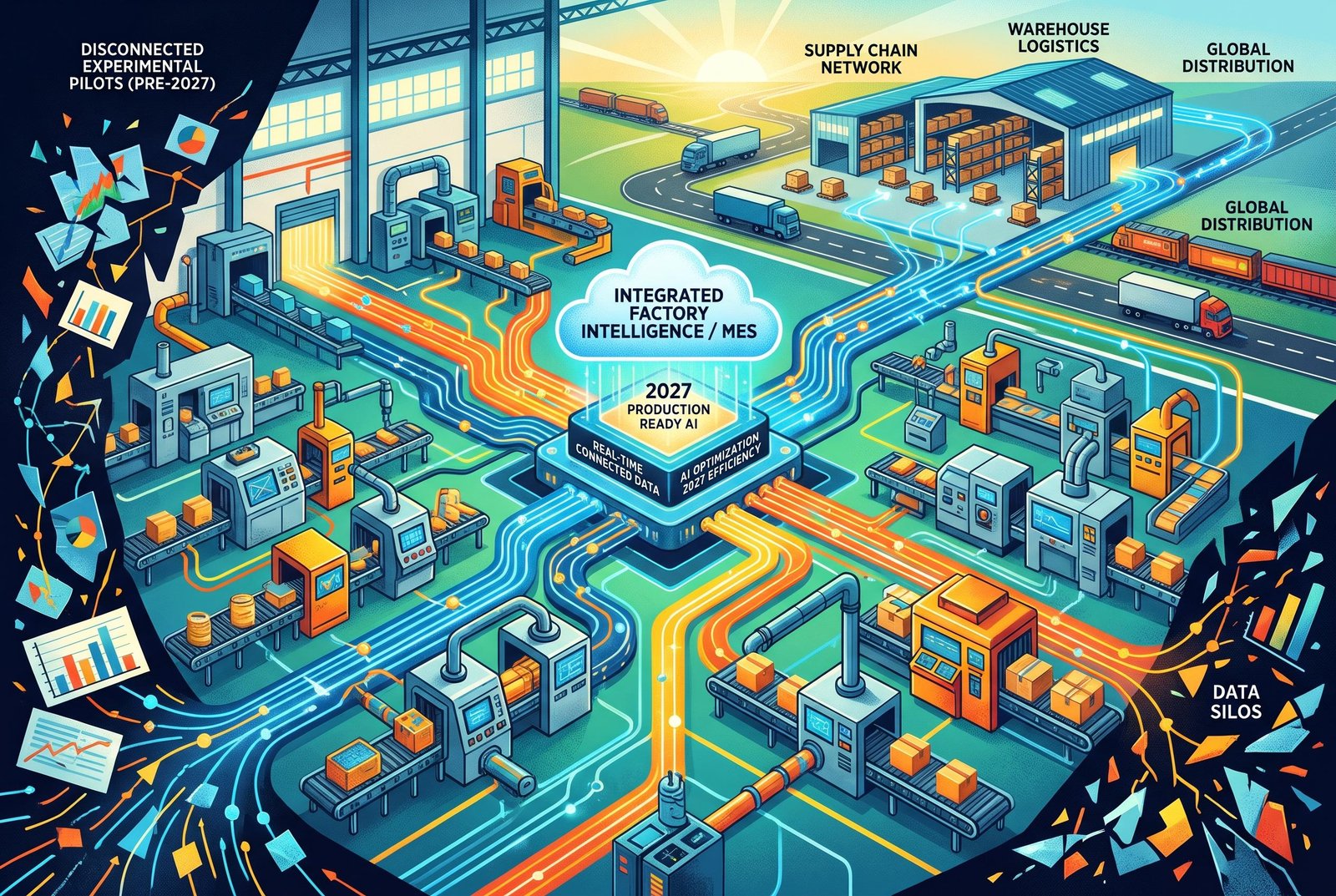
Manufacturers are likely to face three linked technology priorities in 2027: making artificial intelligence useful on the factory floor, deciding how to run manufacturing execution systems in the public cloud, and responding more quickly when supply chains are disrupted. That is the forecast from IT services and managed-cloud provider Syntax. The company’s David Förster, director of digital supply chain services, argues that success across all three will depend on reliable data and...
Continue Reading This Article
Enjoy this article as well as all of our content, including reports, news, tips and more.
By registering or signing into your SRM Today account, you agree to SRM Today's Terms of Use and consent to the processing of your personal information as described in our Privacy Policy.
effective data management.
Syntax says manufacturers are moving beyond artificial-intelligence trials towards applications that can demonstrate practical value in production. One proposed use is to give shop-floor workers access to AI agents that can retrieve machine manuals, maintenance records and previous support cases. Bringing those sources together could help staff diagnose faults sooner, avoid downtime and adjust equipment settings, although the benefits would depend on the quality and accessibility of the underlying information.
The challenge is not simply connecting systems. Production, quality and business data are often held in separate applications, making it difficult to interpret events in context. Siemens, in a product description of its agentic AI offering for shop-floor operations, says its approach combines information from manufacturing and product-lifecycle systems to help users investigate anomalies, assess quality and identify possible actions. The company also describes agents that can assist with rescheduling when components arrive late. These are vendor-stated capabilities, not evidence that all deployments will deliver the same results.
Costs are another uncertainty as manufacturers expand their use of large language models. Syntax expects providers to adjust pricing as the market moves from experimentation towards commercial use, and suggests that specialised agents could help control spending by directing requests to appropriate tools or models. Microsoft documents a model-router feature that assigns simpler prompts to faster, lower-cost models and reserves more capable options for tasks that require them. Research surveyed in a 2026 paper on language-model routing also describes different ways of matching requests to models, while noting that the methods involve distinct trade-offs. Neither source establishes what savings a particular factory would achieve; outcomes depend on the workload, system design and quality requirements.
For manufacturing execution systems, Syntax expects the debate to shift from whether public-cloud deployment is viable to how it should be implemented and which provider to choose. Cloud operation is already available in commercial products: SAP says its Digital Manufacturing service is delivered as software as a service in the public cloud. Its documentation also makes clear that product-specific compliance responsibilities remain with customers, including validating software for its intended use.
Cloud migration is not a universal prescription. AWS guidance on modernising MES outlines potential advantages such as flexibility and scalability, but emphasises that architecture choices depend on business priorities, budget, timing and an organisation’s capabilities. It contrasts older, monolithic systems with modular approaches that can make it easier to update individual services. Syntax, meanwhile, predicts that more manufacturers will favour standard software over extensive custom development and modification, with the aim of reducing maintenance work and simplifying updates. The scale of any savings will vary by company and implementation.
Supply-chain adaptability is the third priority. When components are delayed or unavailable, manufacturers may need to find alternative suppliers, redirect stock, defer orders or shift production between sites. Syntax argues that coordinating these decisions manually can be too slow, and sees AI-supported planning as a way to test options quickly, potentially down to individual components.
Research from the US National Institute of Standards and Technology identifies potential uses for AI in supply-chain planning, including dynamic routing and digital twins that can model changing conditions. It also highlights persistent obstacles: inconsistent data, limited training material and difficulties connecting AI tools with enterprise resource planning and MES platforms. Those constraints reinforce Syntax’s central point that faster decisions depend on data that is accurate, available and compatible across systems. The forecast is not a guarantee of real-time replanning, but a sign of where manufacturers may seek an advantage as disruption and delivery pressures continue.
Source: Noah Wire Services