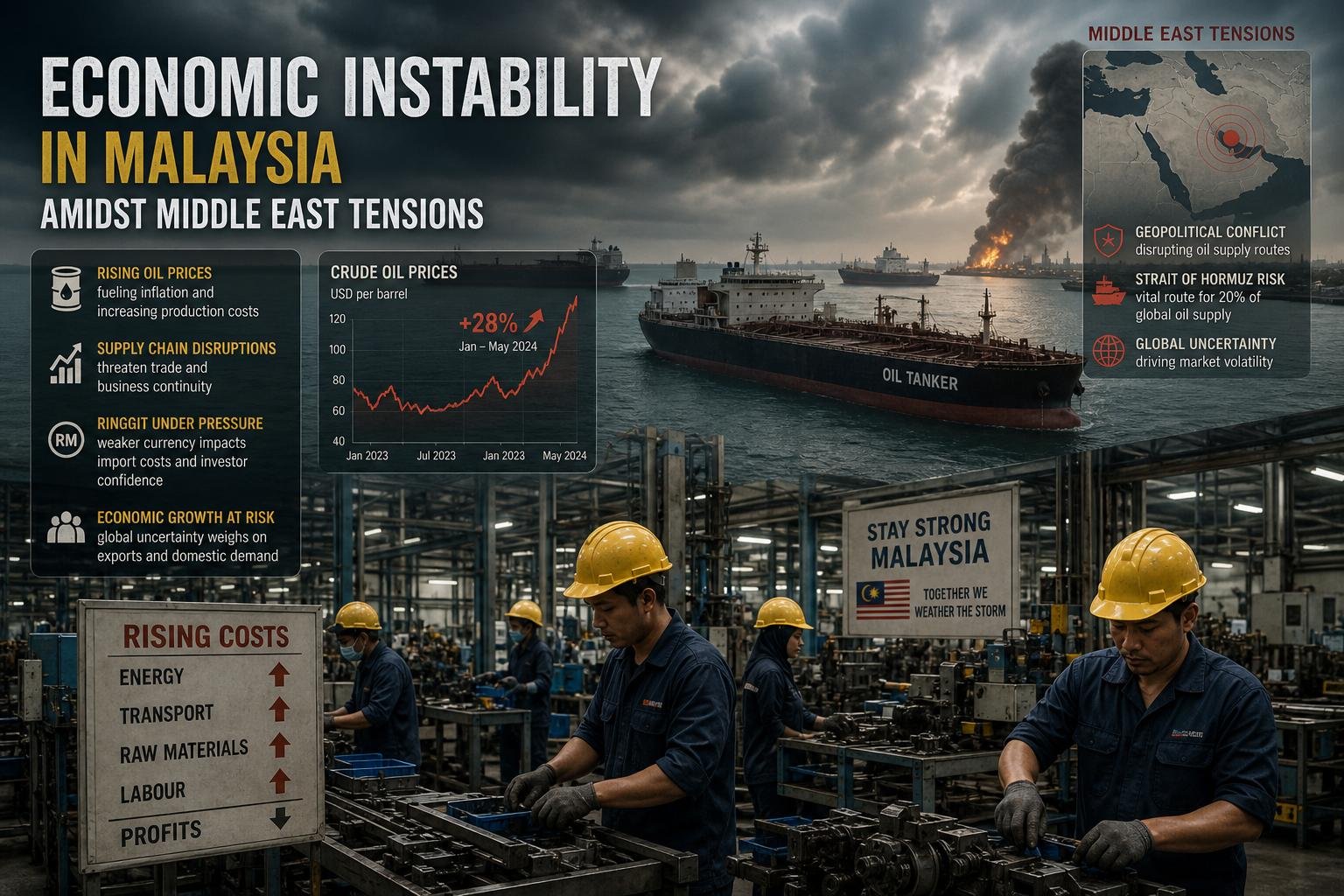
Malaysia is being pulled into the economic shockwaves from the Middle East as tensions around the Strait of Hormuz unsettle energy markets, raise shipping costs and deepen pressure on exporters and smaller firms.
The most immediate strain is falling on small and medium-sized enterprises. According to the survey cited in the original report, 63.9 per cent of Malaysian companies expect to be affected, largely through delayed shipments, cancelled orders and higher freight and insu...
Continue Reading This Article
Enjoy this article as well as all of our content, including reports, news, tips and more.
By registering or signing into your SRM Today account, you agree to SRM Today's Terms of Use and consent to the processing of your personal information as described in our Privacy Policy.
rance charges. That exposure is especially acute for firms trading with the United Arab Emirates and Saudi Arabia, where the Red Sea and Gulf routes have become far more precarious.
The geopolitical risk is also feeding directly into Malaysia’s energy bill. Brent crude has risen as fears grow that flows through Hormuz could be disrupted, and market analysts have warned that the strait remains one of the world’s most important chokepoints, handling a large share of global oil and LNG trade. For Malaysia, which produces oil, higher prices can bring revenue gains, but they also lift the cost of imports, power generation and industrial inputs. New Straits Times has reported that manufacturers are already bracing for longer delivery times and more expensive logistics as vessels divert around the Cape of Good Hope.
That matters because the higher cost of fuel and freight does not stay confined to the energy sector. It feeds through to plastics, chemicals, electricity and transport, adding pressure on production costs in industries that depend on imported materials and on just-in-time supply chains. S&P Global has noted that war-risk premiums and rerouting expenses have climbed sharply for ships using the region, reinforcing the view that the disruption is not merely temporary but potentially structural if the conflict persists.
Against that backdrop, the government has moved to steady public expectations. Agriculture and Food Security Minister statements that rice and other staples remain secure have helped calm fears of an immediate food shock. Officials have pointed to diversified sourcing from India, Asean, Australia and Brazil, together with buffer stocks that are said to cover several months of demand.
Bank Negara Malaysia has also sought to project calm. The central bank has said the economy remained resilient, with growth holding up and the financial system intact. It has kept policy unchanged, while acknowledging that a firmer ringgit can cushion some imported inflation. That stance suggests authorities do not yet see a need for emergency action, even if external volatility remains high.
Still, the country is not insulated. Malaysia’s targeted fuel subsidies may help suppress headline inflation, but they also leave the budget exposed if oil stays elevated for long. Any extra energy revenue is likely to be offset in part by the cost of sustaining controlled retail fuel prices. That makes the fiscal arithmetic delicate, even if the government still believes its deficit target can be met.
The wider lesson is strategic as much as economic. The Hormuz crisis has revived calls for greater energy diversification and a faster shift towards renewables, not simply as an environmental ambition but as a buffer against imported shocks. It has also strengthened the case for market diversification, with more Malaysian firms looking beyond a narrow set of destinations and trying to move up the value chain.
For exporters, that means selling more than raw commodities. The push to present Malaysian companies as full-service suppliers, particularly in food and downstream processing, reflects a broader effort to reduce dependence on volatile trade corridors and low-margin business. The same logic applies to the oil and gas services sector, which has generated strong revenues but still relies heavily on a limited regional base.
The conflict in the Middle East is therefore more than a distant crisis. It is a test of how far Malaysia’s economy can absorb external shocks, and whether the country can use disruption to accelerate reforms that make it more diversified, more resilient and less exposed to the next geopolitical flare-up.
Source: Noah Wire Services