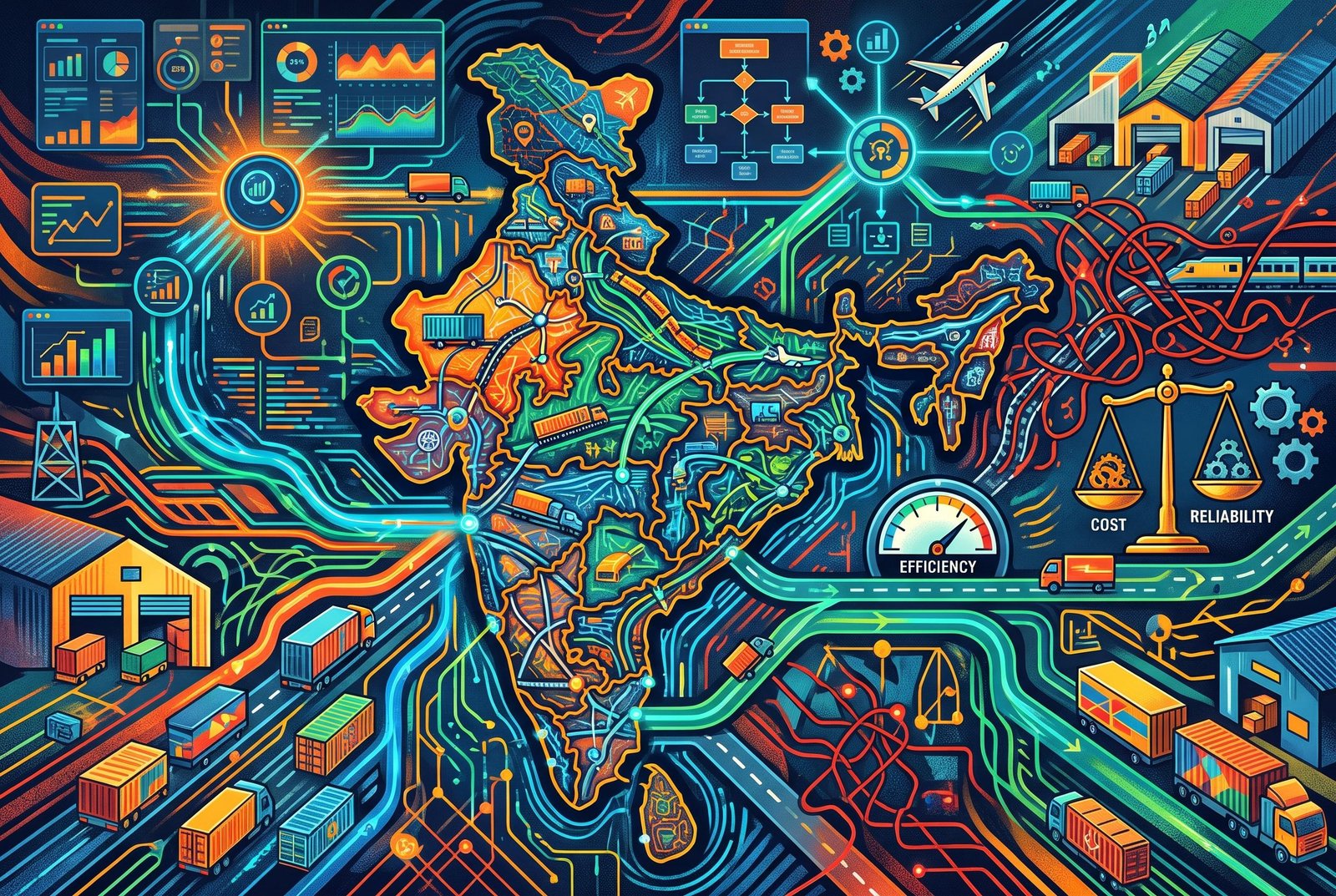
India’s logistics startups are moving beyond standalone software and services towards a more connected model of supply-chain management. Their ambition is to make freight, fulfilment and delivery more visible and responsive, as businesses contend with fragmented transport networks, uneven last-mile capacity and rising expectations for speed.
The opportunity is substantial, but so are the obstacles. India’s logistics market is expanding alongside e-commerce, manufacturing an...
Continue Reading This Article
Enjoy this article as well as all of our content, including reports, news, tips and more.

By registering or signing into your SRM Today account, you agree to SRM Today's Terms of Use and consent to the processing of your personal information as described in our Privacy Policy.
Government policy has helped establish a wider environment for entrepreneurship. The Startup India initiative began on 16 January 2016, according to the government’s programme page, with measures intended to encourage innovation and make it easier to establish and operate new businesses. Its action plan includes support for incubation, intellectual property, financing and simpler compliance. The programme page sets out the government’s aims; it does not, by itself, demonstrate the results of those measures.
The scale of the logistics opportunity is reflected in a range of industry estimates. Logistics Insider’s cover story says India had about 1,060 logistics startups, founded by more than 1,200 people, which had raised a combined $8.26 billion, with 47 acquisitions recorded. It projects the market will grow from $107.2 billion in FY23 to $159.5 billion in FY28, and reach $357.3 billion by 2030. Separately, an annual report for FY2024-25 estimates the market at $228.4 billion in FY24 and forecasts growth to $357.3 billion by 2030. The estimates use different baselines and should not be treated as directly comparable.
Policy is also focused on connecting infrastructure and digital systems. The Department for Promotion of Industry and Internal Trade describes PM GatiShakti as a master plan for coordinating infrastructure development and improving multimodal and first- and last-mile links. The National Logistics Policy, launched in September 2022, focuses on the services and processes around those networks, including digitisation, skills and regulatory reform.
In a 2025 update, the Press Information Bureau said the Unified Logistics Interface Platform had facilitated more than 160 crore transactions by August that year. The government also cited the Logistics Data Bank, which tracks import and export containers across inland container depots. These are reported programme metrics, not evidence that every operator has gained the same benefits. They nevertheless illustrate the public sector’s push to link systems and improve the flow of logistics data.
A central difficulty remains the structure of road freight. Redseer estimates that India has 12.5 million trucks and 3.5 million drivers, and says roughly three-quarters of truck operators own fewer than five vehicles. This dispersed ownership makes it harder to match loads with vehicles, manage payments and working capital, and keep trucks in use. The figures describe trucks, drivers and operators as distinct categories; the terms should not be conflated.
For Zaiba Sarang, co-founder and chief commercial officer of iThink Logistics, fragmented operations and India’s geographical diversity complicate efforts to apply a single delivery model across the country. Smaller transport and courier businesses often rely on manual processes, while delivery conditions vary widely between cities, rural areas and remote locations.
“Every one of these gaps is an opportunity: fragmentation, geography, addresses, manpower and speed. That’s exactly where startups and new business models are stepping in and making a real difference,” Sarang says.
Address quality and last-mile capacity are among the problems that can make a delivery fail or trigger a return. GPS-based mapping and artificial-intelligence tools may help, as can regional partners with detailed knowledge of local routes and delivery conditions. But faster services also bring pressure: same-day and next-day expectations require more precise coordination across networks that are not uniformly equipped.
Farhan Vhora, co-founder and chief executive of Haulog, sees the core weakness not as a lack of vehicles but as poor deployment decisions. He says many manufacturers still organise dispatch through phone calls and spreadsheets, which can lead to unsuitable vehicles being assigned, empty freight being paid for and visibility ending at the factory gate.
Vhora also points to pressure on exporters to report emissions. By 2030, he argues, manufacturers unable to provide shipment-level cost and emissions data may risk losing international business. His view is that the opportunity lies in building a shared operating system for manufacturing logistics, rather than simply adding more transport capacity.
In e-commerce, the problem has shifted from access to courier networks to the quality of decisions made around each parcel. Ankit Sood, chief executive of NimbusPost, says unreliable addresses, cash-on-delivery orders and inconsistent last-mile performance can erode profitability, particularly for direct-to-consumer brands operating in smaller cities.
“The value is no longer in connecting brands to more couriers, but in acting as an intelligence layer above the courier network that helps brands make better decisions before, during and after dispatch. As more brands grow beyond the metros, the ones that build profitably will be those that treat every shipment as a considered decision rather than a routine dispatch,” Sood says.
The same emphasis on decision-making runs through forecasts of how logistics technology may develop. Uddhav Kumar, co-founder and chief executive of Lynkit, expects systems to progress from reporting problems to resolving some of them automatically, for example by rerouting a delayed truck or assigning another vehicle. Human intervention, in this model, would be reserved for cases requiring judgement.
Kapil Makhija, managing director and chief executive of Unicommerce, says companies are adopting artificial intelligence and automation for courier selection, reducing returns to origin and bringing logistics information into unified dashboards. He identifies fast-growing direct-to-consumer businesses and large omnichannel retailers as particularly active users, seeking to reduce warehouse errors and improve customer experience.
For Naman Vijay, co-founder and chief executive of ClickPost, competitive advantage will increasingly depend on the quality of decisions made across existing networks, rather than ownership of the networks themselves. He expects carriers, brands and technology providers to share data to improve delivery outcomes, instead of treating each transfer between parties as a separate hand-off.
That transition is not guaranteed by technical capability alone. Rao Korupolu, chief executive and co-founder of ZedBlox, says startups must overcome customer reluctance when existing systems are already established. A successful pilot can show that a product works, but wider adoption depends on reliable performance, straightforward integration and a convincing return on investment.
The commercial test continues after adoption. Ajay Rao, founder and chief executive of Emiza, argues that long-term viability rests on customer retention, repeat business, consistent operations and sound unit economics. Startups need to understand their costs and price their services to support healthy margins; expansion that does not strengthen the business can leave a company less resilient, not more.
By 2030, the sector’s progress will therefore depend on more than predictive software or automated freight decisions. Infrastructure, skills, data-sharing and coordination between public bodies and private operators will also shape whether digital tools improve daily operations. The likely prize is a supply chain that responds earlier to disruption and makes better use of available capacity. Reaching it will require startups to convert promising technology into dependable services that customers can adopt and afford.
Source: Noah Wire Services
Subscribe to Industry Updates
Get the latest news and updates directly to your inbox.