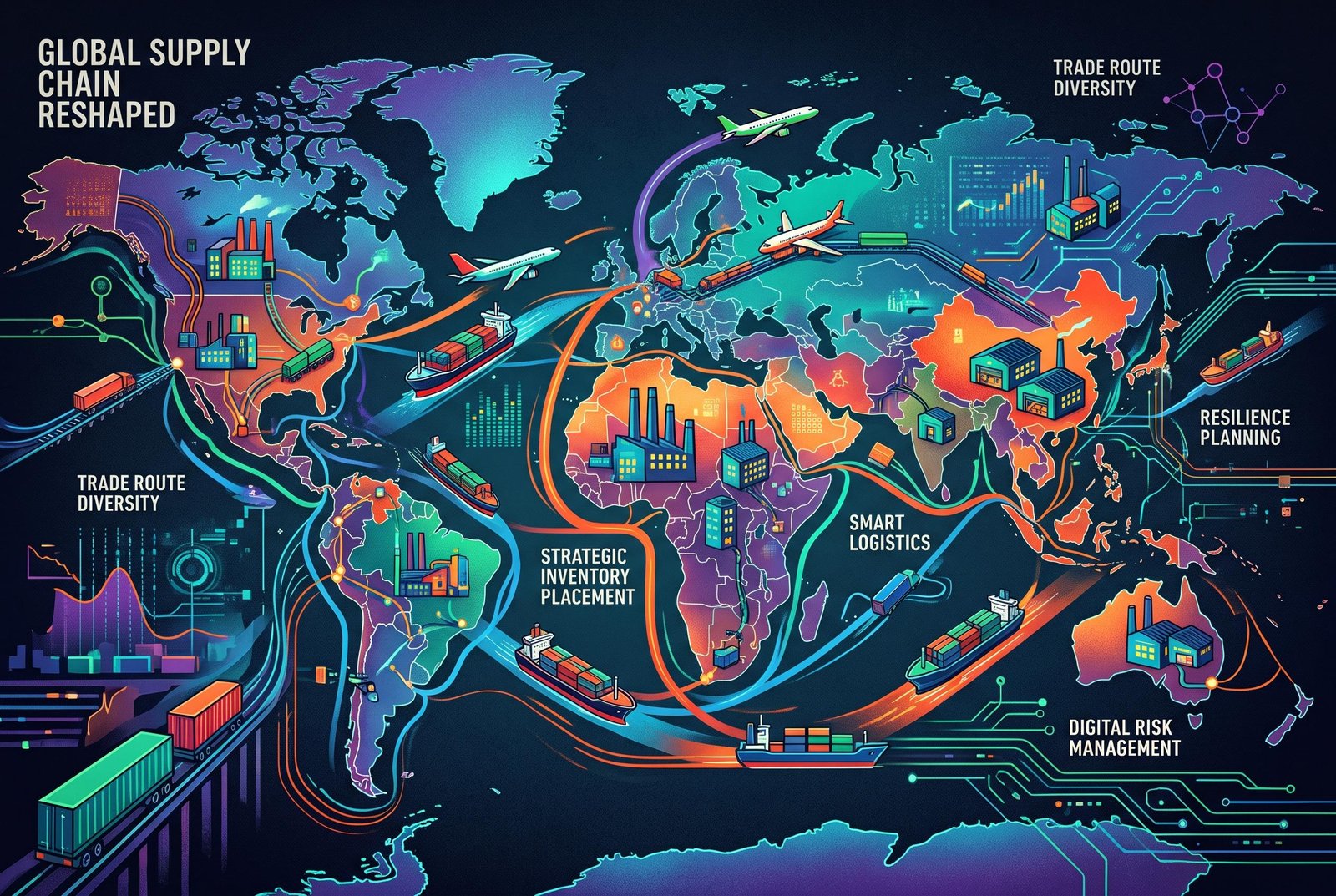
Political debate increasingly centres on tariffs, economic security and bringing production closer to home. Yet businesses are not turning away from international markets. Santander’s 2026 Trade Barometer, based on a survey of more than 6,000 companies across Europe and the Americas, found that 55% considered international trade more important to their growth plans, while just 4% said it had become less important.
The findings, presented by Santander executive chair Ana Botí...
Continue Reading This Article
Enjoy this article as well as all of our content, including reports, news, tips and more.
By registering or signing into your SRM Today account, you agree to SRM Today's Terms of Use and consent to the processing of your personal information as described in our Privacy Policy.
n, suggest that companies are adapting their overseas operations rather than abandoning them. Trade restrictions, geopolitical tensions and weak global growth remain concerns, prompting businesses to diversify suppliers, move some production nearer to customers and reduce reliance on individual countries.
That shift is not simply a retreat from globalisation. The World Trade Organization’s Global Value Chain Development Report 2025 describes international production as being reconfigured, with companies placing greater emphasis on regional links, digital tools and a broader spread of suppliers. Global value chains still account for nearly half of world trade in value-added terms, the report says, even as production networks change shape.
The trade-offs are not as straightforward as choosing security over cost. Among businesses changing or diversifying their supply chains, 59% said they were seeking greater efficiency or lower costs. Reducing geopolitical exposure and vulnerabilities associated with long-distance transport also featured in their decisions. Companies are therefore looking for ways to make international operations more adaptable without giving up the advantages of efficiency.
Their growth expectations help explain why overseas markets remain attractive. Nearly four in five businesses surveyed expect to grow over the next three years, and Santander found that internationally active companies were more optimistic about revenue growth than those operating only at home. Among companies not currently trading internationally, 59% said they were considering expansion abroad within three years.
Artificial intelligence is emerging as one tool for pursuing that growth. Santander’s survey found that AI was a leading investment priority; among companies already operating internationally or seeking to do so, 64% believed it could help them reach more markets, while 60% expected it to accelerate expansion. More than half of internationally active firms said they were already using AI in some aspect of their trade activity, according to the bank’s executive summary.
Technology cannot remove the practical hurdles facing companies that want to enter new markets. Santander identifies bureaucracy as the most commonly cited obstacle, alongside the difficulty of finding reliable business partners and managing cross-border operations. Shipping costs are another concern. For smaller firms in particular, tools that improve access to information may help, but they do not replace the need to understand regulations, customs procedures and local commercial relationships.
The WTO’s analysis also points to an uneven distribution of opportunity. Its 2025 report describes stronger regional production links, including in Asia and North America, and a more diverse set of manufacturing hubs. Viet Nam, Mexico, Poland and Türkiye have expanded their roles in selected industries, while China remains a major manufacturing centre. Latin America and Africa, however, continue to face constraints linked to logistics, digital infrastructure and skills.
The policy environment will influence how far businesses can adapt. In a separate discussion of the 2026 World Trade Report, the WTO warns that tariffs and export restrictions can ripple through supply networks, affecting firms beyond the countries directly involved. It also cautions that measures intended to reduce dependence may prompt restrictions elsewhere, deepening fragmentation. Predictable rules and cooperation, the organisation argues, matter in an economy where production is increasingly interconnected.
For businesses, predictability is not an abstract concern. Trade agreements can shape which markets companies are prepared to enter, while uncertainty over rules, costs and access can complicate long-term investment decisions. Governments may have legitimate reasons to strengthen economic security, but a wider spread of suppliers and customers can itself help reduce exposure to disruption.
The emerging picture is not of international commerce disappearing, but of companies reshaping how they participate in it. Production is becoming more regional in some areas, supply chains are being diversified, and digital services are taking a larger role in coordinating trade. The search for growth, however, continues to lead many businesses across borders.
Source: Noah Wire Services